
Planning a multi-country trip and comparing Europe eSIM options? This guide explains how to choose the best eSIM for Europe travel in 2026, whether you are city-hopping through Paris, Rome and Barcelona, adding London or Zurich to the route, or spending a month working remotely across the EU. The goal is simple: one data plan that crosses borders with you, no SIM queues, no roaming bill surprises.
Europe is the easiest region in the world for eSIM travel: dense 4G/5G networks, mature roaming agreements and dozens of plan choices. But it is also where travelers make the most avoidable mistakes — buying a plan that skips the United Kingdom or Switzerland, underestimating data for a three-week trip, or installing the eSIM too late. Use this guide as a checklist before you choose a Europe eSIM data plan.
Quick answer: what is the best Europe eSIM for travel?
The best Europe eSIM is a prepaid regional data plan whose country list covers every stop on your itinerary, whose validity covers your full trip, and whose data size matches how you actually use your phone. For most tourists, a data-only regional Europe eSIM handles maps, translation, train and transit apps, hotel check-in, messaging, social media and browsing.
A good starting point:
- One-week, one or two countries: 5GB to 10GB is comfortable for maps, messaging and browsing.
- Two-week multi-country trip: 10GB to 20GB gives room for photos, transit apps and occasional hotspot.
- Three weeks or longer: 20GB to 50GB, or an unlimited-data option if you stream or tether often.
- Remote work on the road: choose the largest plan available and confirm hotspot support before paying.
If you are comparing search results for best eSIM for Europe, Europe data eSIM or eSIM Europe unlimited data, focus less on the headline price per GB and more on the country list, validity, activation rules and hotspot policy.
Why use a Europe eSIM instead of buying SIM cards along the way?
Inside the EU, a local SIM from one member state can roam across the others under the “roam like at home” rules. So why not just buy a local SIM on arrival? Three practical reasons:
- Registration friction: many European countries require passport ID registration for physical SIM cards, which means shop queues and paperwork in a language you may not read.
- Fair-use limits: local SIMs used mostly outside their home country can hit fair-use roaming caps, and the UK and Switzerland are no longer covered by EU roaming rules on many tariffs.
- Timing: a travel eSIM is installed before departure on hotel or home WiFi, so data works minutes after landing — no airport kiosk detour after a long-haul flight.
With an eSIM you also keep your home SIM active in the same phone for calls, banking verification codes and emergency SMS, while the Europe eSIM carries all your data traffic.
Coverage: check the country list before anything else
“Europe” means different things on different plans, and this is the single most common Europe eSIM mistake. Before you pay, open the plan’s country list and check:
- United Kingdom: post-Brexit, the UK is excluded from some EU-focused plans. If London is on your route, confirm it explicitly.
- Switzerland: not an EU member and frequently excluded from cheaper regional plans, despite sitting in the middle of the continent.
- Balkans and Eastern Europe: Albania, Serbia, Bosnia, Montenegro and North Macedonia are often not included in standard “Europe 28” style plans.
- Turkey: usually sold separately or included only in wider “Europe+” regional plans.
Regional plans in our store typically cover 28 or more European countries — including the big Western Europe circuit of France, Italy, Spain, Germany, the Netherlands, Austria and Portugal — while smaller two-, three- and four-country combo plans exist for focused itineraries. Start from the destination page here: Europe eSIM data plans.
Regional plan, multi-country combo or single-country eSIM?
Europe gives you three plan shapes, and the right one depends on your route:
| Plan type | Best for | Watch out for |
|---|---|---|
| Regional Europe eSIM (28+ countries) | Multi-country trips, flexible routes, rail passes, cruises | Confirm UK and Switzerland; price per GB can be higher |
| 2–4 country combo plan | Fixed itineraries like France + Italy or Spain + Portugal | No flexibility if you add a side trip across a border |
| Single-country eSIM | One-country holidays, longer stays, heavy data use | Stops working (or roams expensively) when you cross a border |
The trade-off logic is the same one we walk through for Asia itineraries in the regional vs country eSIM comparison: fixed route and heavy data favor country plans; flexible route and moderate data favor regional plans.
How much data do you need in Europe?
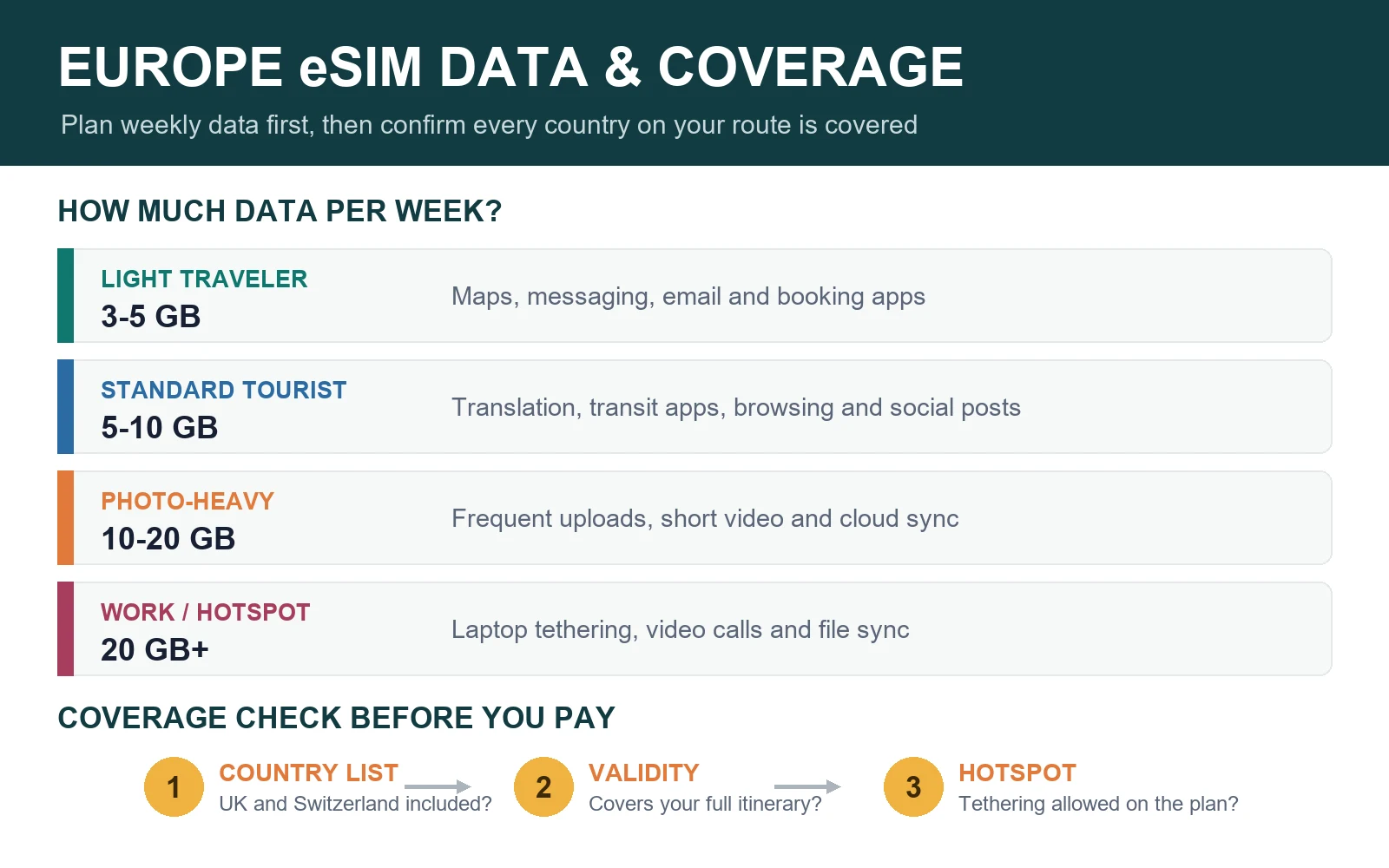
Your Europe eSIM data budget depends on trip length and habits. Navigation, messaging and transit apps are light. Video streaming, cloud photo backup and laptop tethering are heavy. Hotels and cafes provide WiFi, but you should not depend on public WiFi for train bookings, taxi apps or payment confirmations mid-journey.
| Traveler type | Typical use | Suggested data range |
|---|---|---|
| Light traveler | Maps, WhatsApp, email, booking apps | 3GB to 5GB per week |
| Standard tourist | Maps, translation, transit apps, social posts, browsing | 5GB to 10GB per week |
| Photo-heavy traveler | Frequent uploads, reels, short video, cloud sync | 10GB to 20GB per week |
| Work or hotspot user | Laptop tethering, video calls, file sync | 20GB or larger, or unlimited if available |
Tip: multi-country trips quietly use more data than single-city trips — every border crossing means new transit apps, new maps downloads and more time relying on mobile data instead of a familiar hotel WiFi. Budget one tier higher than you would for a single-city holiday.
When should you install your Europe travel eSIM?
Install the eSIM on reliable WiFi before your flight, then switch its data line on after landing. Some plans start validity at installation, others at first network connection — check the product page so a 15-day plan doesn’t start ticking three days before you fly.
Use this setup flow:
- Check that your phone supports eSIM and is carrier unlocked.
- Buy the Europe eSIM before departure.
- Install on WiFi using the QR code or manual activation details.
- Keep your home SIM as the default line for calls and SMS.
- After arrival, select the travel eSIM for mobile data.
- Enable data roaming for the eSIM line if the provider instructions require it — on a regional plan this is what lets the same profile work across borders.
For step-by-step screenshots, use the eSIM installation guide.
Phone compatibility checklist
Do not buy any eSIM until your phone passes these checks:
- The phone model supports eSIM.
- The phone is carrier unlocked.
- You can see an EID or an “Add eSIM” option in settings.
- The operating system is current enough to install an eSIM profile.
Not sure? Run through the EID and *#06# compatibility check guide or the quick eSIM compatibility checklist before purchase.
Europe eSIM vs pocket WiFi vs local SIM vs roaming
| Option | Best for | Trade-off |
|---|---|---|
| Europe eSIM | Solo travelers, couples, multi-country routes, instant setup | Usually data-only; no local phone number unless stated |
| Local physical SIM | Long single-country stays; travelers needing a local number | ID registration, shop queues, fair-use limits when roaming |
| Pocket WiFi rental | Groups sharing one connection all day | Extra device to charge, carry, insure and return |
| Home carrier roaming | Short trips with a generous roaming pass | Daily fees add up fast on two- or three-week trips |
Deciding between the first and third option for a family trip? Read the full comparison: eSIM vs pocket WiFi for international travel.
Route examples: matching the plan to the itinerary
Classic Western Europe circuit
Paris → Amsterdam → Berlin → Prague → Vienna → Rome by rail is the textbook case for a regional Europe eSIM: five or six countries in two or three weeks, with data needed for train bookings, platform changes, maps and translation at every stop. A 20GB regional plan is a comfortable fit.
Mediterranean holiday
Spain, southern France, Italy, Greece and the islands. Coverage is strong in cities and resort areas, thinner on ferries and remote beaches. Download offline maps for island days and keep booking confirmations saved locally. A 10GB to 20GB regional plan suits most two-week trips.
London plus the continent
The most common coverage trap. If your route is London → Paris → Brussels on the Eurostar, make sure the plan explicitly lists the United Kingdom — or pair a UK single-country eSIM with an EU regional plan.
Alps and Switzerland
Zurich, Lucerne, Interlaken and the mountain routes. Switzerland is excluded from many budget “EU only” plans, so verify it in the country list. In mountain valleys and on high passes, expect signal gaps regardless of plan — offline maps are essential for hiking days.
Common mistakes to avoid
- Assuming Europe includes the UK and Switzerland: the two most frequent gaps in regional country lists.
- Buying by price per GB only: a cheap plan that excludes one country on your route costs more than the saving.
- Installing at the airport: unstable arrival-hall WiFi is the worst place to scan a QR code. Install before you fly.
- Ignoring hotspot policy: if you need laptop data on trains, confirm tethering is allowed before purchase.
- Deleting the eSIM after a hiccup: many QR codes are single-use; troubleshoot first, delete last.
Europe eSIM FAQ
Does one Europe eSIM work in every European country?
No plan covers literally every European country. Regional plans typically cover 28 or more, centered on the EU plus popular destinations. Always match the plan’s country list against your full itinerary, especially for the UK, Switzerland, the Balkans and Turkey.
Do I need a new eSIM for each country in Europe?
Not with a regional plan — one profile switches to a partner network automatically as you cross borders. You only need separate country eSIMs if you chose single-country plans or your route leaves the covered list.
Is an unlimited data Europe eSIM worth it?
For streamers, heavy hotspot users and remote workers, yes. Check the fair-use policy: some unlimited plans reduce speed after a daily high-speed allowance.
Does a Europe eSIM include a phone number?
Most travel eSIMs are data-only. Keep your home SIM active for calls and verification SMS, and use WhatsApp or similar apps for voice over data.
What if my eSIM stops working after crossing a border?
Toggle airplane mode, then let the phone reselect a network; if needed, pick a partner network manually in settings. Confirm data roaming is enabled for the eSIM line — on regional plans it must stay on. If it still fails, contact support with your device model and location.
Bottom line
For most travelers, the best Europe eSIM in 2026 is a prepaid regional data plan that lists every country on your route (verify the UK and Switzerland), covers your full trip length, and carries at least 10GB for a two-week multi-country itinerary. Fixed two-country routes can save with combo plans; single-country holidays and heavy data users should look at country plans or unlimited options.
Ready to compare? Start with Europe eSIM for travel. Flying onward across the Atlantic or to Asia? See the USA eSIM guide and the Asia regional eSIM comparison.
Sources reviewed July 14, 2026: European Union: Roaming — using a mobile phone in the EU and Apple Support: Use eSIM while traveling internationally. Network availability, country lists, device support and plan terms change by provider and date — always confirm on the product page.