
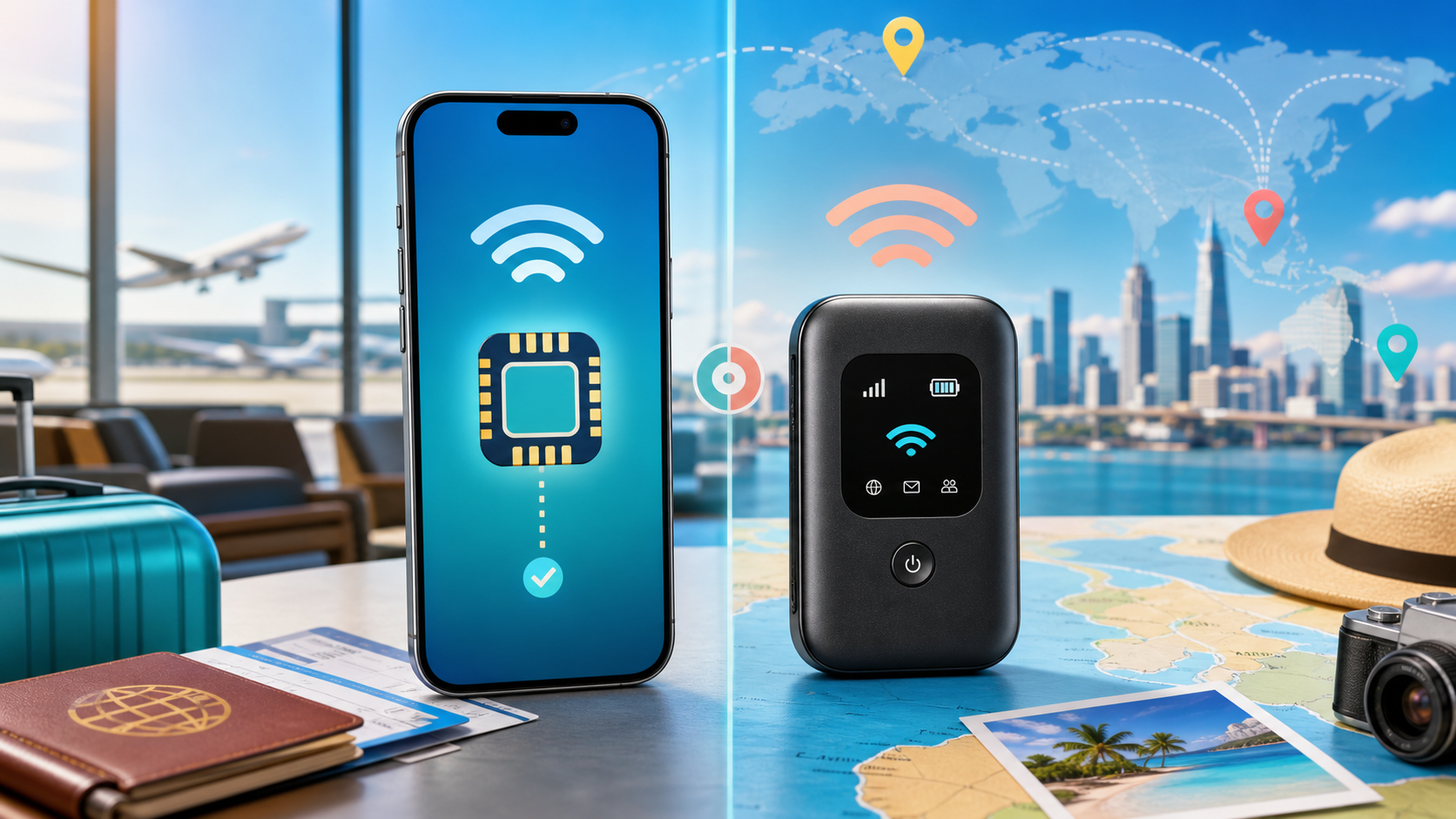
International travel internet used to mean one of three things: pay expensive roaming charges, buy a physical SIM card after landing, or rent a pocket WiFi device at the airport. In 2026, travel eSIM plans have become a much easier option for many trips, but pocket WiFi still makes sense in some situations.
This guide compares eSIM vs pocket WiFi for international travel, including setup, convenience, battery life, group trips, hotspot use, cost control, and device compatibility.
Quick Answer
For most solo travelers, couples, business travelers, and people visiting multiple cities, a travel eSIM is usually the simpler choice. You can buy online, install before departure, land with mobile data ready, and avoid carrying or returning a rental device.
Pocket WiFi can still be useful for groups who stay together all day, travelers with phones that do not support eSIM, or people who want several devices connected to one shared hotspot.
eSIM vs Pocket WiFi At A Glance
| Factor | Travel eSIM | Pocket WiFi |
|---|---|---|
| Setup | Install on your phone before or during travel | Pick up, receive by mail, or rent at airport |
| Carrying extra device | No | Yes |
| Battery | Uses phone battery only | Pocket WiFi must also be charged |
| Group use | Best when each person has their own plan | Good when the group stays together |
| Splitting up | Easy | The person carrying the device keeps the internet |
| Return process | No return needed | Usually needs return or drop-off |
| Phone support | Requires eSIM-compatible, unlocked phone | Works with WiFi-capable devices |
| Hotspot | Depends on the selected eSIM plan | Usually supported, subject to device limits |
When eSIM Is The Better Choice
An eSIM is usually better when you want travel internet that feels close to normal phone use. There is no plastic SIM card, no rental counter, and no separate battery pack to manage.
For example, if you are visiting China, Japan, Korea, Thailand, Europe, or the United States, you can often choose a destination-specific travel eSIM before your flight. Code eSIM already has country pages for trips such as China eSIM and Japan eSIM, plus setup help in the English install guide.
eSIM is especially practical if:
- You travel alone or as a couple.
- You may split from your group during the day.
- You want data immediately after landing.
- You do not want to queue for SIM cards or device rental.
- Your phone supports eSIM and is not carrier locked.
- You need your physical SIM to stay active for bank messages or verification codes.
Most travel eSIM plans are data-only unless the product page clearly says calls or SMS are included. If you need a local phone number, check the plan details carefully before buying.
When Pocket WiFi Still Makes Sense
Pocket WiFi is not obsolete. It can still be a reasonable option when several people will stay together all day and connect phones, tablets, and laptops to one shared device.
It may also work better if your phone does not support eSIM, if your phone is carrier locked, or if you are carrying several WiFi-only devices.
The trade-off is friction. You need to pick up or receive the device, keep it charged, carry it, avoid losing it, and return it after the trip. If the group separates, only the person near the pocket WiFi has internet.
Cost: Which One Is Cheaper?
There is no single winner because pricing depends on country, duration, data size, rental rules, deposits, and whether the group shares one device.
For one traveler, eSIM is often competitive because you buy only the data plan and avoid rental deposits or device return steps. For a family or group that stays together, pocket WiFi may be cost-effective if one plan covers everyone.
The better comparison is not only price. Look at total travel friction:
- Do you need airport pickup?
- Is there a deposit?
- Is return shipping required?
- What happens if the device battery dies?
- Does everyone need internet while separated?
- Does the eSIM plan allow hotspot if you need it?
Battery Life And Convenience
Pocket WiFi adds another battery to manage. On a long sightseeing day, that means charging your phone and the pocket WiFi device. If the router runs out of power, every connected device loses internet.
With eSIM, your phone remains the main device. Battery usage depends on signal, navigation, hotspot use, and screen time, but you are not responsible for a second rental device.
If you plan to share your phone hotspot heavily, check whether hotspot is allowed on the selected eSIM plan and bring a power bank.
Device Compatibility Before You Buy
The most important eSIM step is compatibility. Before buying, check:
- Your phone supports eSIM.
- Your phone is not carrier locked.
- You can see an option such as Add eSIM or Add Cellular Plan.
- You have stable WiFi for installation.
- The selected plan supports your destination and travel dates.
Use the Code eSIM compatibility guide before purchasing. If you are choosing a destination plan, also read the country guide, such as the China travel eSIM guide or Japan eSIM travel guide.
Which Should You Choose?
Choose eSIM if you want the simplest setup, no rental hardware, flexible movement, and internet on your own phone. This is the better fit for most modern travelers with compatible unlocked phones.
Choose pocket WiFi if your group will stay together, your phone does not support eSIM, or you need one shared hotspot for several WiFi-only devices.
Before buying any travel internet plan, check compatibility, activation rules, refund terms, hotspot support, and destination coverage. Code eSIM keeps these practical pages available for English users: install guide, compatibility, and refund policy.
FAQ
Is eSIM better than pocket WiFi for international travel?
For many solo travelers and couples, yes. eSIM is usually more convenient because there is no rental device to pick up, charge, carry, or return. Pocket WiFi can still be useful for groups who stay together all day.
Can I use hotspot with a travel eSIM?
Sometimes. Hotspot support depends on the specific eSIM plan and local network rules. Check the product page before buying if hotspot sharing is important.
Does eSIM work on every phone?
No. eSIM requires a compatible phone that is not carrier locked. Always check device compatibility before buying a travel eSIM.
Is pocket WiFi better for families?
It can be, especially if everyone stays together and wants to share one connection. If family members split up during the day, individual eSIM plans are often more flexible.