
Planning a route through China, Japan, Korea and Thailand creates a practical eSIM question: should you buy one Asia regional eSIM, or separate country eSIMs for each stop?

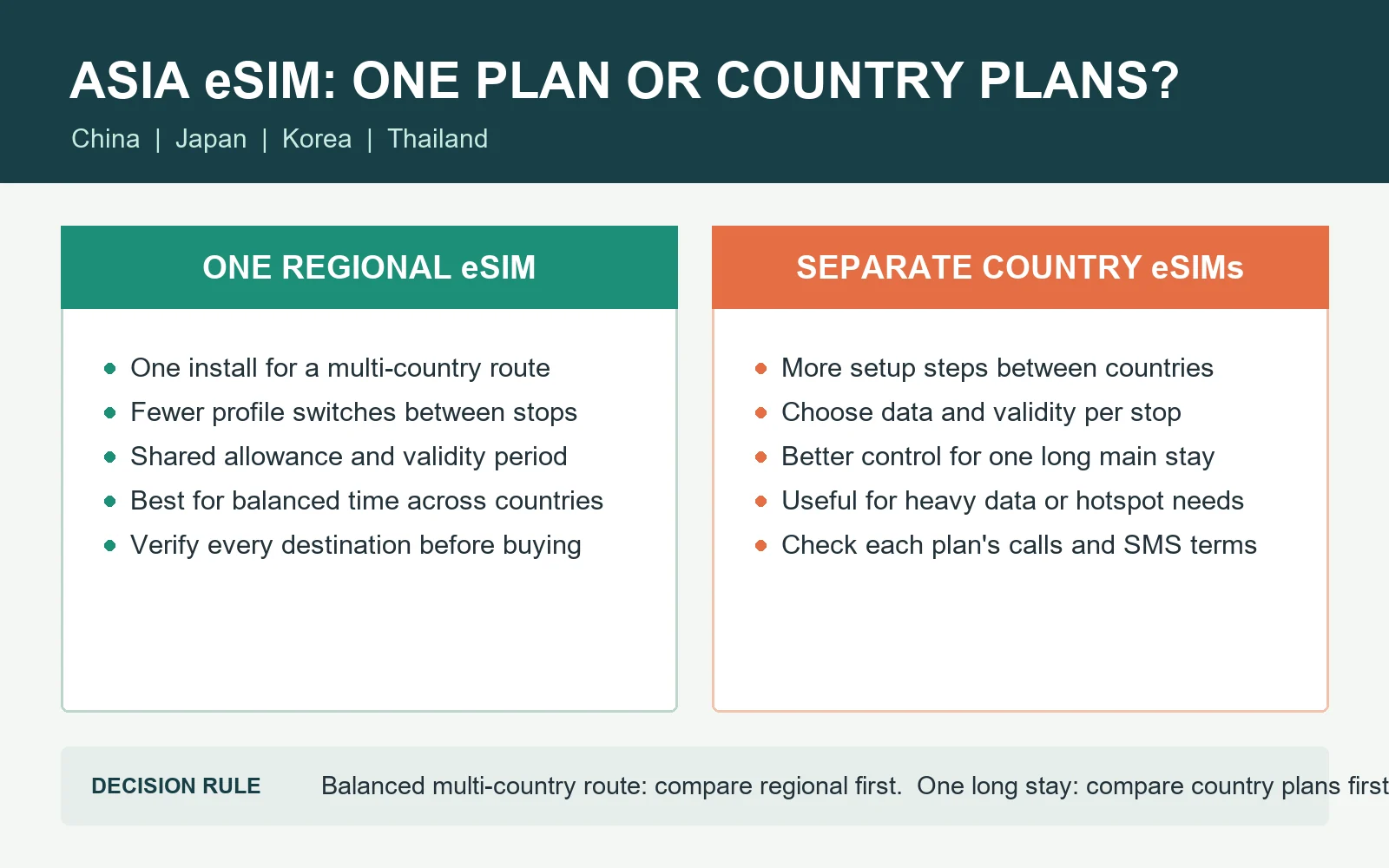
The short answer: choose one Asia regional eSIM if your itinerary covers several countries in a short trip, your data needs are moderate, and you mainly want maps, messaging, translation, bookings and browsing. Choose separate country eSIMs if one country is the main part of the trip, you need more data, you want clearer country-specific coverage, or China app-access notes are especially important.
This guide explains how to decide before you fly, with special notes for China, Japan, South Korea and Thailand. If you already know your route, you can also start from the China eSIM, Japan eSIM, Korea eSIM and Thailand eSIM pages.
Quick Answer: Regional Asia eSIM vs Separate Country eSIMs
| Choose this | Best for | What to check |
|---|---|---|
| One Asia regional eSIM | China + Japan + Korea + Thailand routes, short stopovers, moderate data use, travelers who want fewer setup steps | Country list, data allowance, validity, hotspot rules, activation timing |
| Separate country eSIMs | Longer stays in one country, heavy data use, remote work, hotspot use, country-specific plan requirements | Per-country coverage, price per GB, fair usage policy, install limits, refund rules |
| Hybrid setup | Multi-country trips where China or Japan has special requirements, plus shorter stops elsewhere | Use a China-specific or Japan-specific plan for the demanding stop, then a regional eSIM for the rest |
For many travelers, the best answer is not purely regional or purely separate. A hybrid setup often works well: for example, a China-focused eSIM for the China part of the trip, then a regional Asia eSIM for Japan, Korea and Thailand if the same plan covers them.
Why Asia eSIM Planning Is Different From Europe eSIM Planning
In Europe, a regional eSIM decision is often straightforward because many trips cross borders frequently and regional roaming is common. Asia is different. The distance between destinations is larger, data habits vary by country, and China has extra compatibility and app-access considerations that should be checked before buying.
A route such as Shanghai – Tokyo – Seoul – Bangkok has four very different mobile-data situations. In China, you may care about whether the plan is designed for travelers and whether it reduces extra setup steps for everyday apps. In Japan, you may care about train navigation, translation, hotspot support and larger data allowances. In Korea, you may care about map apps, messaging and whether a data-only plan is enough. In Thailand, you may compare Bangkok, Phuket, Chiang Mai and island coverage, plus whether a tourist plan includes calls or a local number.
When One Asia Regional eSIM Makes Sense
A regional Asia eSIM is usually the cleanest choice when your trip includes several countries and you do not want to manage a new QR code or setup flow for every stop.
It is especially useful if:
- You will visit at least two or three countries on the same trip.
- Your route includes short stays, such as 2 to 5 days per country.
- You mainly use data for maps, search, messaging, translation, ride-hailing, restaurant lookups and hotel bookings.
- You want one validity period that covers the whole route.
- You do not need a local phone number in every country.
- You prefer fewer installation steps before departure.
The trade-off is that a regional plan may not be the cheapest or strongest option for every single country. It may also have a smaller total data allowance than a country-specific plan, or different network partners depending on the destination. Always read the country list carefully. Do not assume that an “Asia” plan automatically includes China, Japan, South Korea and Thailand.
When Separate Country eSIMs Are Better
Separate country eSIMs make more sense when one country is the main part of the trip, or when you need more control over data, validity and plan details.
Choose separate country eSIMs if:
- You will spend a week or more in one country.
- You need a large data allowance for video, hotspot sharing, cloud backup or remote work.
- You want a plan built specifically for China, Japan, Korea or Thailand.
- You need clearer country-specific network notes.
- You want to compare unlimited, daily high-speed, fixed-data or local tourist plans.
- You need a local phone number, calls or SMS, and the product page clearly says those are included.
For example, if your trip is 12 days in Japan and only a 2-day stopover in Seoul, a Japan-specific eSIM plus a smaller Korea plan may be better than a regional package. If your trip is 4 days in China, 4 days in Japan, 3 days in Korea and 5 days in Thailand, one regional Asia eSIM may be more convenient if it covers every stop and has enough data.
China eSIM Notes: Compatibility And App Access Matter
China is the country where you should read the details most carefully. There are two separate questions that travelers often mix together:
- Can my phone use eSIM at all?
- Does the travel eSIM plan support China and match the kind of access I need?
Apple says that in China mainland, only iPhone 17e model A3635 and iPhone Air model A3518 support eSIM with China mainland carriers. Apple also notes that other iPhone models, including those purchased outside China mainland, cannot install an eSIM profile from China mainland carriers. This is about China mainland carrier eSIM activation, not every international travel eSIM sold by global providers.
For travel, Apple separately notes that if you visit China mainland and want a prepaid data eSIM, global service providers offer many plans. That means a visitor may still compare travel eSIM options for China, but should not assume that local China carrier eSIM activation works the same way as a travel data eSIM.
If China is part of your route, read the China eSIM with no extra VPN app setup guide and the Mainland China iPhone eSIM support guide. Also install your eSIM before travel when possible, while you still have reliable WiFi and time to troubleshoot.
Japan eSIM Notes: Data Size And Hotspot Rules
Japan is a data-heavy destination for many visitors. You may use maps, train-transfer apps, translation tools, digital tickets, restaurant searches, hotel check-in messages and social uploads every day.
A regional Asia eSIM can work well for a short Japan stop, especially if Tokyo, Osaka or Kyoto is only one part of a longer Asia trip. But if Japan is your main destination, a separate Japan eSIM may be easier to match to your stay length and data habits.
Be careful with “unlimited” wording. Some unlimited plans have daily high-speed limits, fair usage policies or hotspot restrictions. If you need a laptop hotspot or plan to upload large videos, check the details before buying. For a deeper Japan-focused comparison, read the Best Japan eSIM for travel guide.
Korea eSIM Notes: Data-Only Is Usually Enough, Until It Is Not
For many travelers, a data-only Korea eSIM is enough for Seoul, Busan and Jeju. You can use mobile data for maps, translation, messaging, search, reservations and transit planning.
The main exception is when you need a local Korean phone number for specific local services. Many travel eSIMs are data-only unless the product page clearly says calls or SMS are included. If your itinerary depends on delivery apps, local reservations or services that require a Korean number, check that before buying.
If Korea is only a short stop between Japan and Thailand, a regional Asia eSIM may be enough. If you are staying longer or want a plan focused on Seoul, Busan and Jeju, compare a separate Korea eSIM.
Thailand eSIM Notes: Bangkok, Phuket, Chiang Mai And Islands
Thailand is often the easiest country in this four-country route for tourist mobile data. Many travelers need data for Bangkok transport, hotel addresses, Grab rides, restaurant searches, translation, island transfers, social uploads and messaging.
A regional Asia eSIM is convenient if Thailand is one stop on a longer route. A separate Thailand eSIM may be better if Thailand is the longest part of the trip, if you want more data, or if you are comparing tourist plans that may include local calling features.
For Bangkok, Phuket and Chiang Mai planning, see the Best Thailand eSIM for travel guide.
Example Itineraries
China + Japan, 8 to 10 days
Consider separate country eSIMs or a hybrid setup. China has enough special compatibility and access considerations that a China-focused plan is worth checking carefully. Japan can then use a separate Japan eSIM if you need more data, or the same regional plan if it covers both countries and your data needs are moderate.
Japan + Korea + Thailand, 10 to 14 days
A regional Asia eSIM is often a strong starting point because the route crosses several countries and setup simplicity matters. Check that Japan, South Korea and Thailand are all included, and that the total data allowance fits your trip. If Japan is data-heavy, consider a Japan-specific eSIM plus regional coverage for Korea and Thailand.
China + Japan + Korea + Thailand, 2 to 3 weeks
Compare both approaches. One regional eSIM may be simpler, but separate plans can provide better control if you spend many days in each country. A practical setup is: China-specific eSIM for the China portion, then either a regional Asia eSIM or separate country eSIMs for Japan, Korea and Thailand.
One country plus short stopovers
If most of the trip is in one country, buy for that country first. For example, a 12-day Japan trip plus 24 hours in Seoul should be planned around Japan data needs. A small add-on or regional plan may cover the stopover if needed.
Data Planning: How Much Is Enough?
Use this rough guide before choosing a regional or separate country eSIM:
- Light use: maps, messaging, translation and browsing. A smaller plan may be enough for short trips.
- Normal travel use: maps, social uploads, restaurant searches, ride-hailing and daily planning. Choose more data for multi-country routes.
- Heavy use: video, cloud backup, hotspot sharing, remote work and frequent calls. Consider larger country-specific plans.
- Group travel: one eSIM per person is more flexible, but pocket WiFi can still work if the group stays together.
For broader planning, compare eSIM vs pocket WiFi for international travel.
Buying Checklist Before You Choose
Before buying one Asia regional eSIM or several country eSIMs, check:
- Your phone supports eSIM and is not carrier locked.
- The plan includes every country on your route.
- The validity period covers arrival and departure days.
- You understand when the plan activates: at installation, at first network connection, or at another trigger.
- Hotspot is supported if you need to share data.
- The plan is data-only unless calls or SMS are clearly listed.
- You know whether the eSIM can be reinstalled if deleted.
- You have read refund rules before installation or activation.
If you are unsure about your device, use the eSIM compatibility guide. If you already bought a plan and need setup help, use the eSIM installation guide.
Recommendation
For a fast multi-country Asia trip, start by comparing one regional Asia eSIM. It reduces setup friction and can cover several border crossings with one plan.
For China-heavy, Japan-heavy or remote-work-heavy trips, compare separate country eSIMs before buying. You may get a better match for data size, validity, hotspot support and country-specific instructions.
The safest buying rule is simple: match the eSIM to the hardest part of your route, not the easiest. If China compatibility, Japan data volume, Korea local-number needs or Thailand tourist-plan features are important, let that country drive your choice.
FAQ
Can one Asia eSIM cover China, Japan, Korea and Thailand?
Yes, some Asia regional eSIMs cover all four, but not every plan does. Always check the country list before buying. Do not assume that “Asia” automatically includes China mainland, Japan, South Korea and Thailand.
Is a regional Asia eSIM cheaper than separate country eSIMs?
Sometimes, especially for short multi-country trips. But separate country eSIMs can be better value for longer stays or heavy data use. Compare total data, validity and hotspot rules, not only the headline price.
Should I install my Asia eSIM before departure?
In most cases, yes. Install while you have reliable WiFi and time to troubleshoot. Read the activation instructions carefully because some plans start when installed, while others start when they first connect to a supported network.
Do I need a VPN for China with an Asia eSIM?
Some travel eSIMs for China use international routing or describe no-extra-VPN-app setup, but app and website availability can change. Code eSIM treats China app access as travel connectivity guidance, not a guarantee that any third-party app will always work.
Does an Asia eSIM include calls or SMS?
Most travel eSIMs are data-only unless the product page clearly says calls or SMS are included. If you need a phone number in Korea, Thailand or another country, check that before buying.
Can I use hotspot with a regional Asia eSIM?
It depends on the plan. Some plans support hotspot sharing, while others limit it. Check the product details if you need to connect a laptop or share data with another traveler.
What if my phone is carrier locked?
A carrier-locked phone may not accept another provider’s eSIM. Check your phone lock status before buying. On iPhone, Apple recommends checking carrier lock status in Settings under General and About.
Sources Reviewed
- Apple Support: Using eSIM with your iPhone in China mainland
- Apple Support: Use eSIM while traveling internationally with your iPhone
- eSIMDB travel eSIM comparison database
Sources reviewed July 9, 2026. Plan availability, networks, app access, activation rules and prices can change, so always check the live product details before buying.