
You do not need a VPN app to get online in mainland China with a travel eSIM, because its data leaves the network outside the mainland: in Hong Kong, Macau, Singapore or the UK on the plans we sell. Where it exits still matters. ChatGPT and Claude do not serve Hong Kong or Macau, so for them you need a plan that exits in the UK or Singapore. Of the 76 plans covering mainland China in our catalogue, 7 exit in the UK or Singapore, 52 in Hong Kong or Macau, and 17 do not publish an exit location.
Here is the situation this page is for. You land in Shanghai, switch on the eSIM, and maps and messaging work. Then you open ChatGPT to draft an email and get a message that the service is not available in your region. Nothing is broken. Your data is coming out in Hong Kong, and Hong Kong is not on OpenAI’s list. The plan decided that before you left home, and the plan page tells you if you know where to look. These are the figures on 1 October 2026.
- 76 plans in our catalogue cover mainland China; 29 are China-only and 47 are regional or global.
- Exit in Hong Kong or Macau: 52 plans, including 24 of the 29 China-only plans, from $1.99 for a 1 GB day pass.
- Exit in the UK or Singapore: 7 plans. Global Special exits in the UK from $6.50; China Special 50 GB exits in Singapore at $44.80.
- Exit not published: 17 plans, including Airalo’s China Unlimited, Asialink and Discover Global ranges.
Why a travel eSIM works without a VPN
A SIM card from a Chinese operator sends your data onto the internet inside mainland China, so it is subject to the mainland’s internet filtering. A travel eSIM is a roaming connection. It uses a Chinese network for the radio signal, but your data is carried back to the eSIM provider’s network and only reaches the public internet at that provider’s exit point, called the breakout.
This routing is how international roaming is normally built. The mobile standards body 3GPP calls it “home-routed” traffic, as opposed to “local breakout” in the visited country, in its TS 23.401 architecture specification. Travel eSIM providers choose where the breakout is, and that location is the IP address websites see.
Two things follow. First, no app is involved: you do not install or switch on anything beyond the eSIM itself. Second, this is not a VPN. Your traffic is not encrypted end to end by the eSIM, and it does not hide your location from the provider. It simply comes out somewhere other than mainland China.
Where each China plan’s data exits
All 76 plans covering mainland China, grouped by the IP location on the plan page.
| Data exits in | Plans | Examples | ChatGPT and Claude |
|---|---|---|---|
| Hong Kong | 41 | China 10 GB, 30 days, $8.00; China Korea Japan 7 GB, $9.00 | Not on either supported list |
| Macau | 11 | Greater China and Taiwan 10 GB, $9.00 | Not on either supported list |
| United Kingdom | 6 | Global Special 1 GB, 7 days, $6.50 to 20 GB, 365 days, $64.18 | On both supported lists |
| Singapore | 1 | China Special 50 GB, 60 days, $44.80 | On both supported lists |
| Not published | 17 | China Unlimited 7 days, $18.00; Asialink; Discover Global | Unverified |
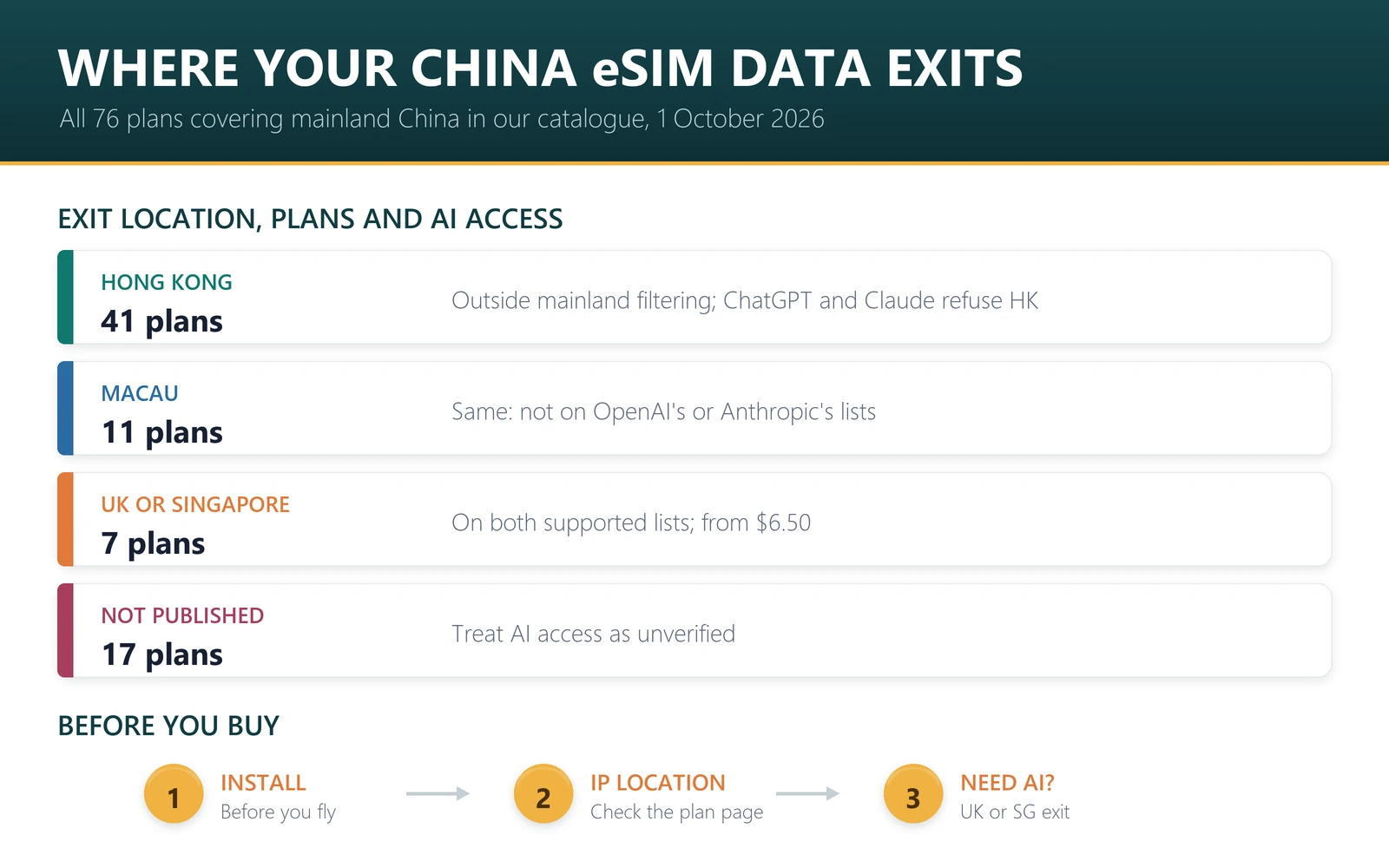
Every exit on that list is outside mainland China, so none of these plans routes your data through mainland filtering. The difference between them shows up only with services that decide by region, which is the next section.
See every plan with its exit location: the China eSIM page shows the routing location on each plan card where it is recorded, with a badge for whether AI tools are reachable.
ChatGPT, Claude and other services that check your region
Some services allow or refuse access based on the country of your IP address. Two of the most asked about publish their lists:
- OpenAI’s supported countries and territories list includes the United Kingdom and Singapore, and does not include mainland China, Hong Kong or Macau. OpenAI warns that access from outside the list may lead to an account being blocked or suspended.
- Anthropic’s supported regions for Claude include the United Kingdom and Singapore, and do not include mainland China, Hong Kong or Macau.
So on a plan that exits in Hong Kong or Macau, ChatGPT and Claude see an unsupported region even though the rest of the internet is reachable. On a plan that exits in the UK or Singapore, they see a supported one. Other streaming, banking and shopping services set their own regional rules, and we do not test or guarantee any particular app. The exit location is the fact you can check before you buy.
Pick a plan by what you need
| Your trip | Good fit | Exits in | Price |
|---|---|---|---|
| A week of maps, messaging and browsing | China day pass, 1 GB a day for 7 days | Hong Kong | $6.49 |
| Up to a month, moderate use | China 10 GB, 30 days | Hong Kong | $8.00 |
| You need ChatGPT or Claude, light data | Global Special 3 GB, 30 days | United Kingdom | $14.10 |
| You need ChatGPT or Claude, heavy data | China Special 50 GB, 60 days | Singapore | $44.80 |
| China plus Hong Kong and Macau | China HK Macau 15 GB, 180 days | Hong Kong | $14.60 |
| China, Korea and Japan | China Korea Japan 7 GB, 30 days | Hong Kong | $9.00 |
If AI tools matter but you also want a cheap, large allowance, you can install two eSIMs: a low-cost China plan for everyday data, and a small UK-exit plan that you switch to when you need ChatGPT or Claude. Most recent phones hold several eSIMs and let you choose which line carries data.
What a travel eSIM does not do
- It does not encrypt your traffic or hide it from the provider. If you need a VPN for privacy or for work, you still need a VPN.
- It does not guarantee any app. Services can block by account, payment country or policy, not only by IP address.
- It does not include a Chinese phone number. Our China plans are data-only. Keep your home SIM active for bank and airline text messages.
- It does not always state hotspot support. The China-only day passes and most fixed China-only plans do not list it, while the regional plans do. Check the plan page if you need to tether a laptop.
Before you fly
- Check that your phone supports eSIM and is carrier-unlocked, using our compatibility guide.
- Buy and install the eSIM on Wi-Fi before you leave, while your email and our site are easy to reach. The install guide covers iPhone and Android.
- Check the IP location line on the plan page if ChatGPT or Claude matter to you.
- After landing, choose the eSIM for mobile data and turn on data roaming for it. Our guide to avoiding accidental roaming charges covers the settings for your home line.
For data sizing, network choice and city-by-city tips, see our China eSIM travel guide and how a travel eSIM changes your IP address.
Frequently asked questions
Do I need a VPN with a China eSIM?
Not to get online. A travel eSIM’s data leaves the network outside mainland China, in Hong Kong, Macau, Singapore or the UK on our plans, so it does not pass through mainland filtering and no VPN app is needed. You may still want a VPN for privacy or work, because an eSIM does not encrypt your traffic.
Can I use ChatGPT in China with an eSIM?
Only on a plan whose data exits in a supported region. OpenAI’s and Anthropic’s supported lists include the UK and Singapore but not mainland China, Hong Kong or Macau. Of our 76 plans covering China, 7 exit in the UK or Singapore; the cheapest is Global Special 1 GB at $6.50.
Which China eSIM exits in Singapore or the UK?
On 1 October 2026, the six Global Special plans exited in the UK, from 1 GB for 7 days at $6.50 to 20 GB for 365 days at $64.18, and China Special 50 GB for 60 days exited in Singapore at $44.80. Each plan page shows its IP location.
Is a China eSIM the same as a VPN?
No. A VPN app encrypts your traffic and sends it through a server you choose. A travel eSIM is ordinary international roaming: the provider decides where your data reaches the internet, and nothing extra is installed or encrypted. The effect on reachable websites can look similar, but the technology and privacy are different.
Why does the China eSIM I bought exit in Hong Kong?
Because its provider breaks out traffic there. 52 of the 76 plans covering mainland China in our catalogue exit in Hong Kong or Macau. That clears mainland filtering, but services that refuse Hong Kong or Macau, including ChatGPT and Claude, will still refuse you.
Does a China eSIM include a Chinese phone number?
Not ours. Every plan covering mainland China in our catalogue is data-only. You can call and message over apps, and your home number keeps receiving texts on your phone’s other line, which is useful for bank and airline verification codes.
“Do I need a VPN?” turns out to be the wrong first question for a China eSIM. The useful one is where the data comes out, and every plan page already answers it.
Last reviewed 1 October 2026. Exit locations, networks and prices come from our own catalogue and product pages on that date and change often; product pages are authoritative. Supported-region lists are from OpenAI’s and Anthropic’s own pages on that date. We do not test or guarantee access to any third-party app or website. ChatGPT, OpenAI, Claude and Anthropic are trademarks of their owners; this page is independent of them.