
Which eSIM should you buy for Bali? Almost any Indonesia plan will connect you — every one we sell includes Telkomsel, the network with the widest reach outside the tourist strips. The two things that actually vary, and that most buyers never check, are when the validity clock starts and whether the plan can be topped up. Both are printed on the product page, and both can cost you a day or a second purchase if you get them wrong.
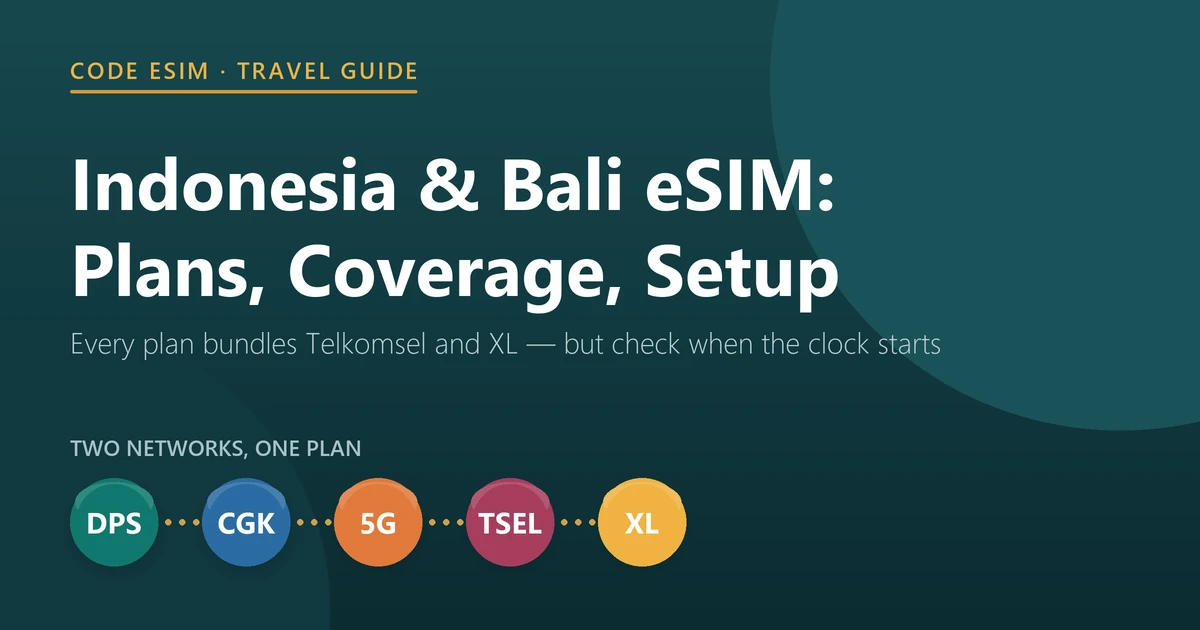
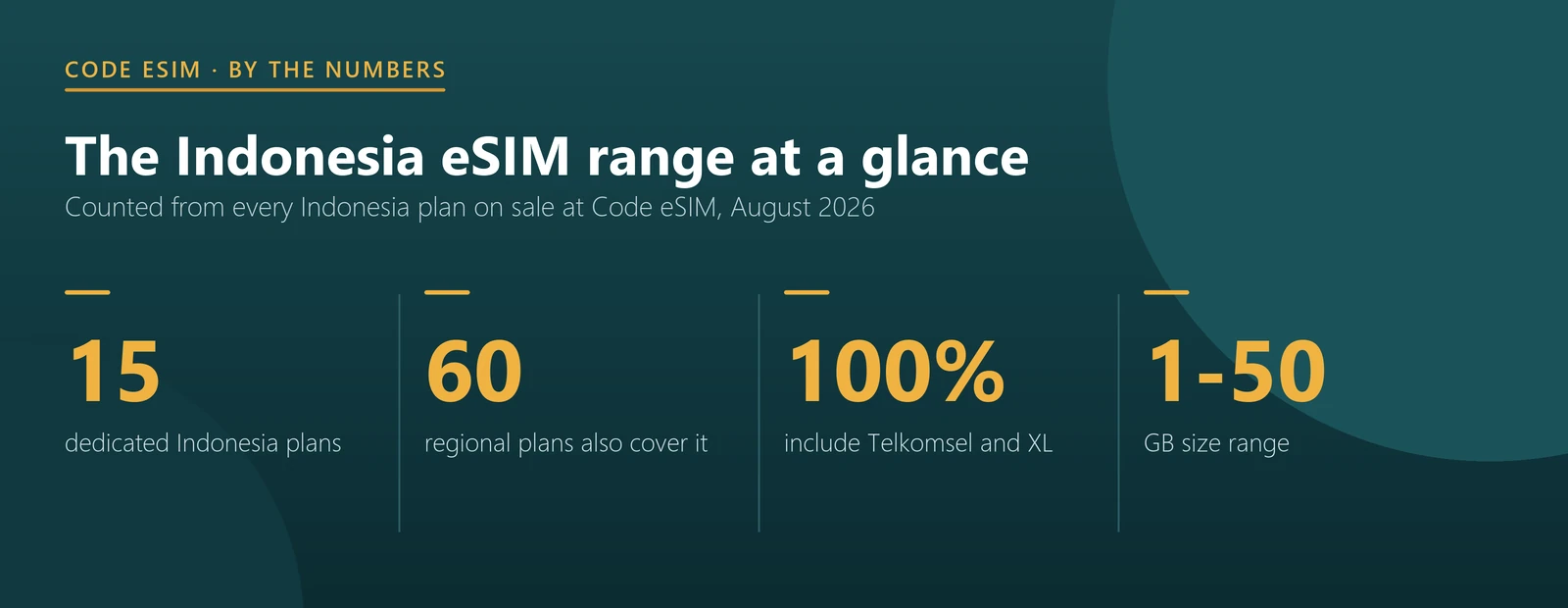
Key facts, from the 15 Indonesia plans on sale in August 2026:
- All 15 include Telkomsel and XL, and some add Smartfren (6), AXIS (4), Indosat Ooredoo (2) or Tri (2) — so your phone has a fallback network, not just one.
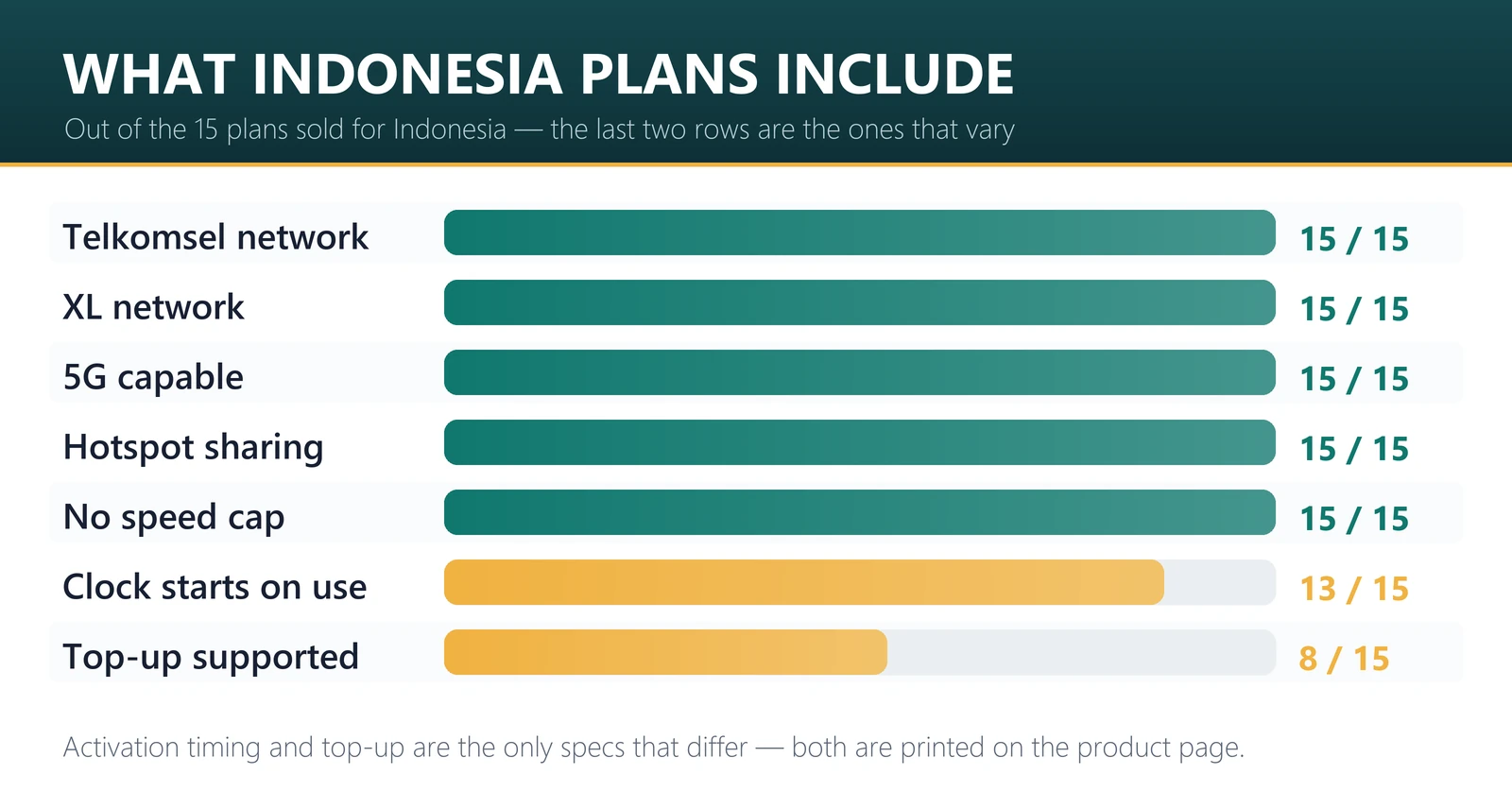
- All 15 are 5G-capable, support hotspot sharing and have no speed cap.
- 13 of 15 start counting when you first use data or first connect. Two start the moment you install. That difference matters more than any other spec on this page.
- Only 8 of 15 support top-up — close to a coin flip, so check before you buy if you might extend.
- Sizes run 1 GB to 50 GB, from about US$3.80. Bigger plans are dramatically better value per gigabyte: roughly $3.80/GB at the 1 GB tier versus about $0.46/GB at 30 GB.
- A further 60 multi-country plans cover Indonesia — more regional choice than almost any destination we sell.
The activation trap: not every Indonesia plan starts the same way
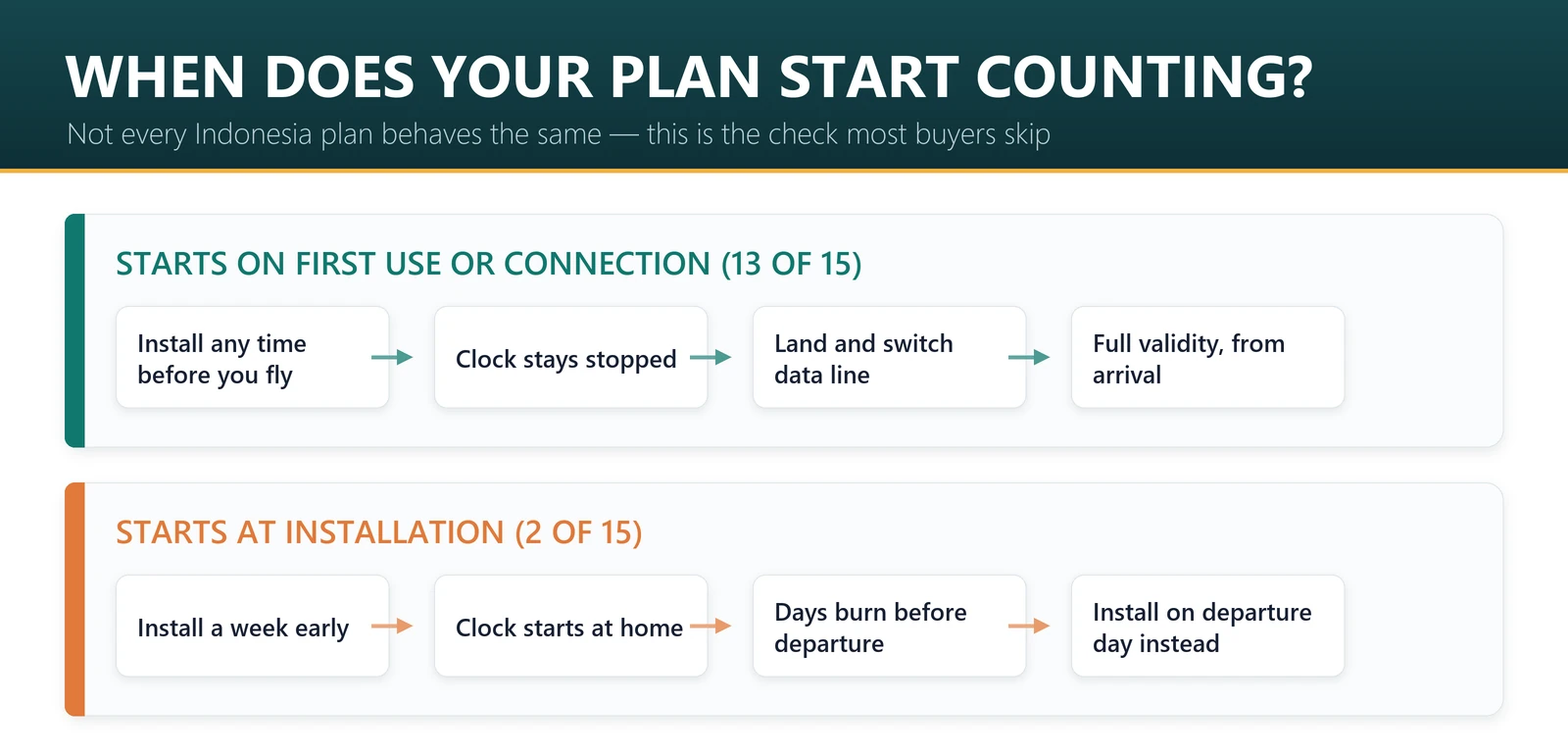
This is the one section to read even if you skip the rest. Travel eSIMs differ in what triggers the validity countdown, and Indonesia is the destination where our own catalogue is least consistent about it:
| Activation policy | Plans | What it means for you |
|---|---|---|
| Activates on first data use | 10 of 15 | Install whenever you like. The clock starts when you actually use data in Indonesia. |
| Activates on first network connection | 3 of 15 | Effectively the same in practice — it starts when the phone registers on an Indonesian network. |
| Activates when the eSIM is installed | 2 of 15 | Install it the day you fly, not a week early. Installing at home starts a 30-day plan running while you are still at home. |
The advice “always install before you fly” is good general guidance and true for most plans — but it is not universally true, and two of our fifteen Indonesia plans are the exception. The safe habit that works for every plan: read the activation line on the product page, then install accordingly. If it says the plan activates on installation, install it on the day of departure with your Wi-Fi still available, not the week before.
How much data do you need in Bali and Indonesia?
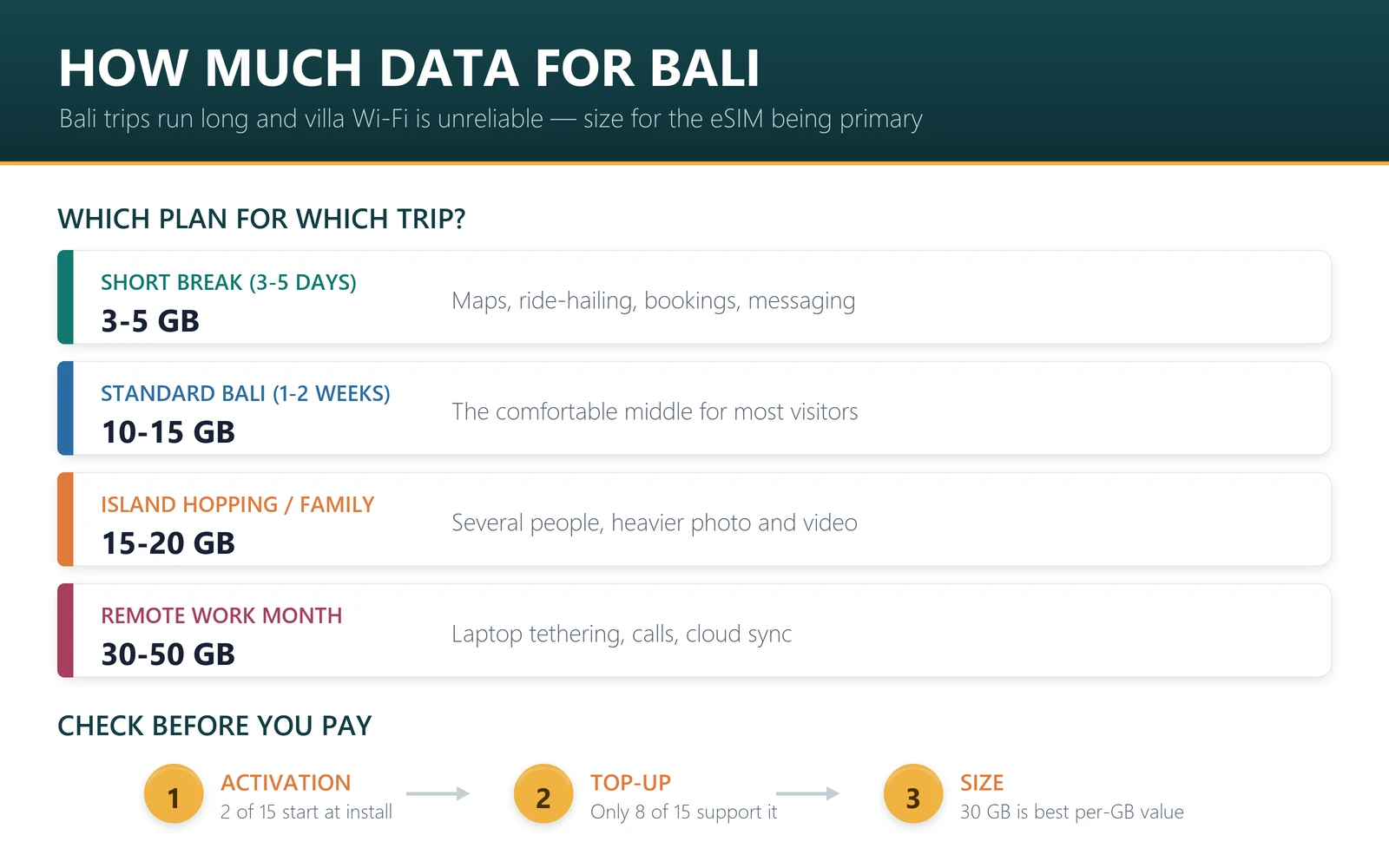
Indonesia trips skew longer than city breaks. A week in a European capital is a week; Bali is routinely two weeks, a month, or an open-ended remote-work stay. Size for the trip you are actually taking:
| Trip type | Suggested data | What it covers |
|---|---|---|
| Short break (3–5 days) | 3–5 GB | Maps, ride-hailing, restaurant bookings, messaging, photos |
| Standard Bali trip (1–2 weeks) | 10–15 GB | The comfortable middle — includes social posting and video calls home |
| Island hopping or family trip | 15–20 GB | Several people coordinating, heavier photo and video sharing |
| Remote work / digital nomad month | 30–50 GB | Laptop tethering, video meetings, cloud sync — the 30 and 50 GB tiers exist for this |
Two Indonesia-specific things push usage up. Ride-hailing is constant — Bali has effectively no public transport for visitors, so you will open a ride app several times a day, every day. And villa Wi-Fi is unreliable in a way hotel Wi-Fi in a city usually is not, so the mobile plan ends up carrying more than you planned. If you are working remotely, assume your eSIM is the primary connection and not the backup.
On value: the small plans are convenient but expensive per gigabyte. At the 1 GB tier you are paying roughly $3.80 per gigabyte; at 30 GB it works out closer to $0.46. If your trip is longer than a few days, the larger plan is usually cheaper than buying twice — and it removes the risk of running out on a plan that turns out not to support top-up.
Coverage: Telkomsel, XL and why two networks beat one
Indonesia is roughly 17,000 islands, and coverage is genuinely uneven across them. That makes the network mix more important here than in a compact single-network market.
| Partner network | In how many plans | Notes |
|---|---|---|
| Telkomsel | 15 of 15 | Listed at 5G on every plan; the widest reach beyond the main tourist areas |
| XL | 15 of 15 | The second network on every plan — solid in cities and tourist zones |
| Smartfren | 6 of 15 | Additional urban fallback |
| AXIS | 4 of 15 | Additional fallback |
| Indosat Ooredoo / Tri | 2 of 15 each | Appear on the widest multi-network plans |
Every plan gives you at least two networks and some give four. That matters because your phone can fall back when one operator is weak in a particular valley, beach or island — which in Indonesia happens often. Telkomsel being on all fifteen is the single most useful fact here: it is the operator most likely to have something usable when you leave the busy strips.
The honest limits, which no eSIM changes:
- Seminyak, Canggu, Ubud, Kuta, Denpasar and the main Jakarta and Surabaya areas are well covered, with 5G in the bigger cities.
- Nusa Penida, the Gili Islands, inland Flores, mountain and jungle areas are patchier. Expect signal to come and go rather than to be absent.
- Boat crossings have no coverage. Ferries to the Gilis and Nusa islands run out of signal partway across, on any SIM. Download your maps and booking confirmations before boarding.
Download offline maps of the areas you plan to explore. This is worth doing in Indonesia even more than elsewhere, because the gaps are geographic rather than temporary.
Dedicated Indonesia plan or an Asia regional plan?
Indonesia has unusually rich regional coverage in our catalogue — 60 multi-country plans include it, from a 3-country Brunei–Indonesia–Malaysia plan up to 21-country APAC and global options. So the choice is real:
| Your itinerary | Best fit | Why |
|---|---|---|
| Bali or Indonesia only | One of the 15 dedicated plans | Best price per gigabyte, and the 30 and 50 GB tiers regional plans rarely match |
| Indonesia + Singapore or Malaysia | A 6- or 7-country Asia plan | Common Southeast Asia routing on one profile |
| Multi-stop Southeast Asia tour | A 12- or 16-country Asia plan | Covers Indonesia alongside Thailand, Vietnam, Japan and more — read the full list |
| Long APAC trip including Australia | The 21-country APAC plan | One profile across the region, higher per-gigabyte cost |
For a Bali-only trip, dedicated wins clearly — the regional plans do not offer the large, cheap 30 and 50 GB tiers that a month in Canggu actually needs. Regional plans earn their premium when you are genuinely crossing borders. If you are unsure whether a single plan covers your whole route, our guide on whether one eSIM works in multiple countries explains how to read a coverage list, and the Asia regional versus country comparison works through the trade-off with routes.
Ready to compare? See current Indonesia eSIM data plans — each product page shows its networks, activation policy, validity and top-up support before you pay.
Local SIM cards, IMEI registration and what an eSIM changes
Indonesia operates an IMEI registration scheme for mobile devices used on Indonesian networks with local SIM cards, administered by the Indonesian authorities. The rules, the registration window and the process have changed over time, and they are set by government policy rather than by any eSIM seller — so if you are planning a long stay, or your trip depends on a specific arrangement, check current official Indonesian guidance before you travel rather than relying on any retailer’s summary, including ours.
What we can state plainly is what a travel eSIM is: a prepaid data product that connects your phone to Indonesian partner networks without a counter visit, without swapping the physical SIM that holds your home number, and without the airport kiosk queue after a long flight. It is data-only, so you do not get an Indonesian phone number.
Bali practicalities worth planning for
- Ride-hailing is your transport. Keep data working at all times — being offline in Bali usually means being stuck, not just uninformed.
- Working remotely? Buy 30 GB or more. Villa and café Wi-Fi is inconsistent enough that your hotspot becomes the real connection. Every Indonesia plan supports hotspot.
- Check top-up before you buy if you are staying a month. Only 8 of 15 plans support it; on the other 7 you would need to buy and install a second plan.
- Keep your home number reachable. Leave your home SIM in the phone with its data roaming off — see the dual SIM guide.
- Download offline maps before island trips. The ferry crossing itself has no signal.
How to install and activate
- Check the activation line on the product page first. If the plan activates on installation, install on your departure day. If it activates on first use or first connection, install any time before you fly.
- Install over Wi-Fi. iPhone: Settings → Cellular → Add eSIM → Use QR Code. Android: Settings → Network & Internet → SIMs → Add eSIM. Label it “Indonesia”.
- Keep your home SIM in the phone for calls and verification texts, with its data roaming switched off.
- After landing, set the eSIM as your data line and turn data roaming on for that line — this is what authorises it to use Telkomsel or XL, and it is not the same as roaming on your home plan.
- If it does not connect, try selecting the network manually — with two or more partner networks available, forcing a different one is often the fix. The full eSIM troubleshooting checklist covers the rest.
Frequently asked questions
What is the best eSIM for Bali?
For a one to two week Bali trip, a dedicated Indonesia plan of 10 to 15 GB over 30 days. Every Indonesia plan we sell includes Telkomsel and XL, is 5G-capable and supports hotspot, so the meaningful differences are size, activation policy and whether top-up is supported — all listed on the product page.
Which network is best in Bali — Telkomsel or XL?
Telkomsel generally has the widest reach once you leave the main tourist areas, which is why it appears on all 15 of our Indonesia plans. XL is also on all 15 and performs well in cities and tourist zones. Because every plan bundles both, your phone can fall back between them rather than being locked to one.
Does my Indonesia eSIM start counting as soon as I install it?
Usually not, but check. 13 of our 15 Indonesia plans start when you first use data or first connect to a network, so installing early is free. Two plans start the moment the eSIM is installed — install those on your departure day, not a week ahead. The activation policy is printed on every product page.
How much data do I need for two weeks in Bali?
10 to 15 GB suits most two-week trips, covering constant ride-hailing, maps, messaging, social posting and video calls home. Choose 30 GB or more if you are working remotely, since villa and café Wi-Fi is inconsistent and your hotspot ends up carrying laptop traffic.
Will my eSIM work on Nusa Penida and the Gili Islands?
Partly. Coverage on the smaller islands is patchier than on mainland Bali, and the ferry crossings themselves have no signal on any SIM. Download offline maps and your booking confirmations before you board, and expect signal to come and go rather than be continuous.
Can I top up my Indonesia eSIM if I run out?
Only on some plans — 8 of our 15 support top-up and 7 do not. If you are staying a month or are unsure how much you will use, either check that the plan supports top-up or buy the larger tier upfront, which is also cheaper per gigabyte.
Do I need to register my phone’s IMEI to use an eSIM in Indonesia?
Indonesia runs an IMEI registration scheme for devices used with Indonesian SIM cards, and the rules are set by the Indonesian authorities and have changed over time. Check current official Indonesian guidance before you travel if you are planning a long stay, rather than relying on any retailer’s summary.
Does an Indonesia travel eSIM give me an Indonesian phone number?
No. Travel eSIMs are data-only unless the product page says otherwise. Keep your home SIM active for calls and verification codes, and use internet-based messaging for everything else.
Bottom line
For Bali, buy a dedicated Indonesia plan sized to a longer trip than you would buy in Europe — 10 to 15 GB for one to two weeks, 30 GB or more if you are working remotely. Every plan bundles Telkomsel and XL, so coverage comes with a fallback built in. Before you install, do the one check most buyers skip: read the activation line, because two of our fifteen plans start counting the moment you install them. And if you might extend, confirm top-up is supported, since almost half the range does not offer it.
Start here: Indonesia eSIM plans. Continuing across Southeast Asia? See Singapore, Malaysia, Thailand, Vietnam, Asia regional or all destinations. New to eSIMs? Start with what is an eSIM and how it works, then check your handset with the eSIM compatibility guide.
Last reviewed August 10, 2026. Plan counts, partner networks, activation policies, validity and top-up support were taken from the Indonesia plans on sale at Code eSIM on that date; the catalogue syncs daily, so the product page is always the authoritative version. Prices move with supplier rates and currency — per-gigabyte figures here are indicative, not quotes. Indonesian device registration rules are set by government policy and can change; confirm current official guidance before you travel.