
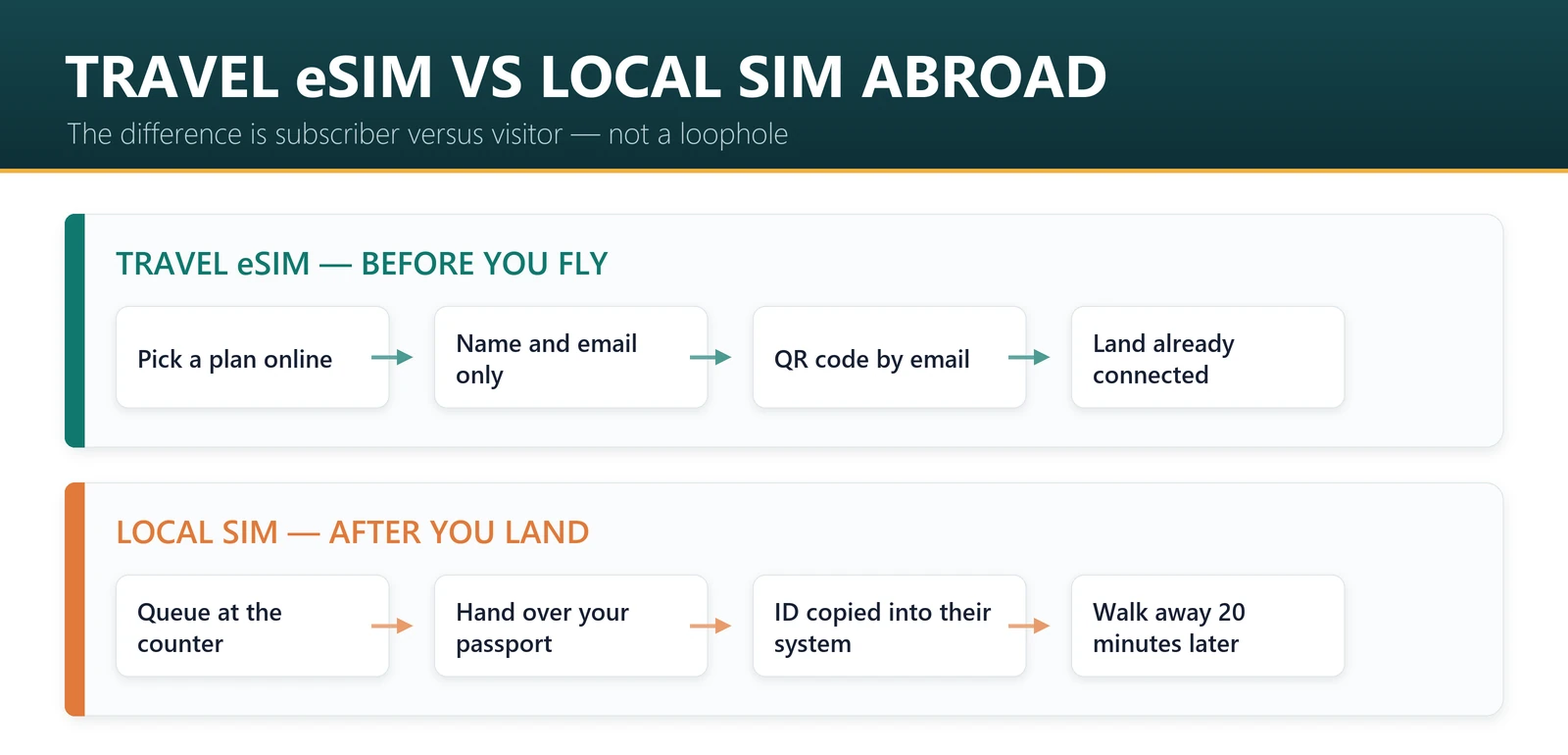
You land after a ten-hour flight, join the queue at the airport telecom counter, and hand over your passport. Someone photographs it, types your details into a terminal, and twenty minutes later you walk away with a SIM card and a copy of your identity document sitting in a database you will never see again.
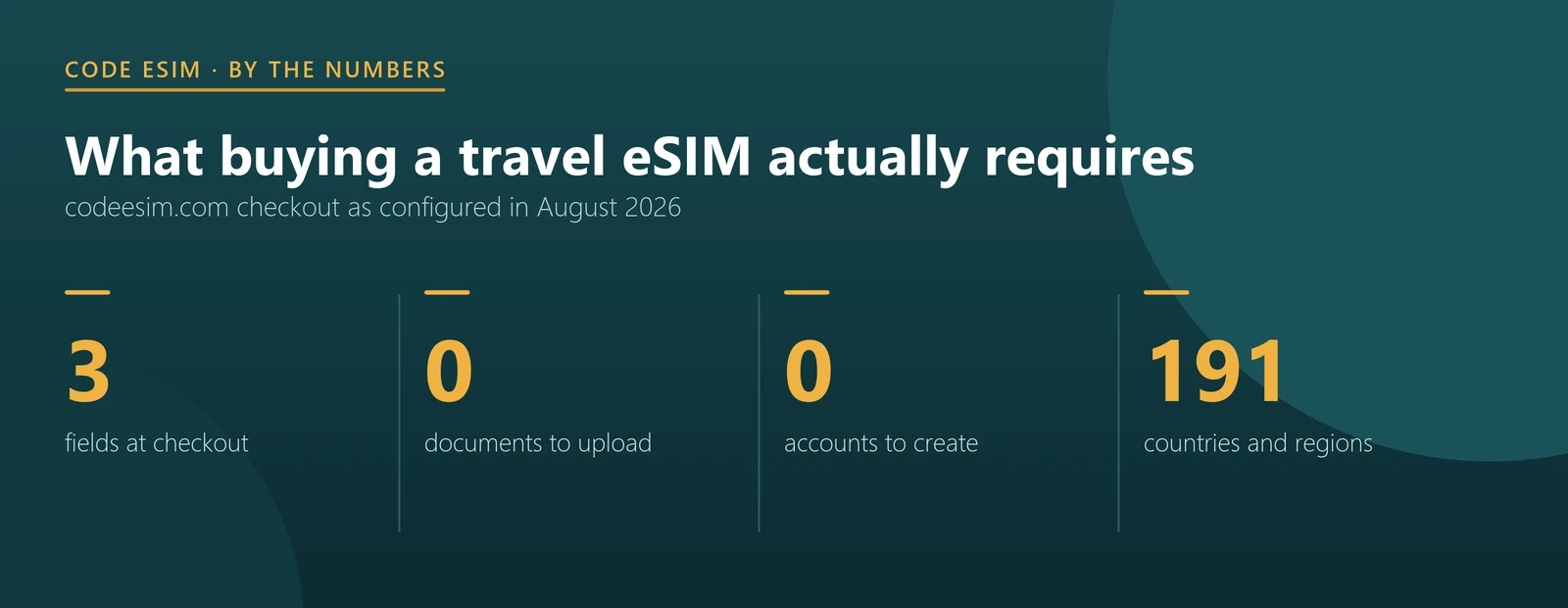
Buying a travel eSIM skips all of that. There is no identity check, no document upload and no KYC step. At our checkout you fill in three fields — first name, last name and email address — and the QR code arrives by email. You do not need to create an account, and businesses buying for a team do not need to pass any KYB or reseller onboarding.
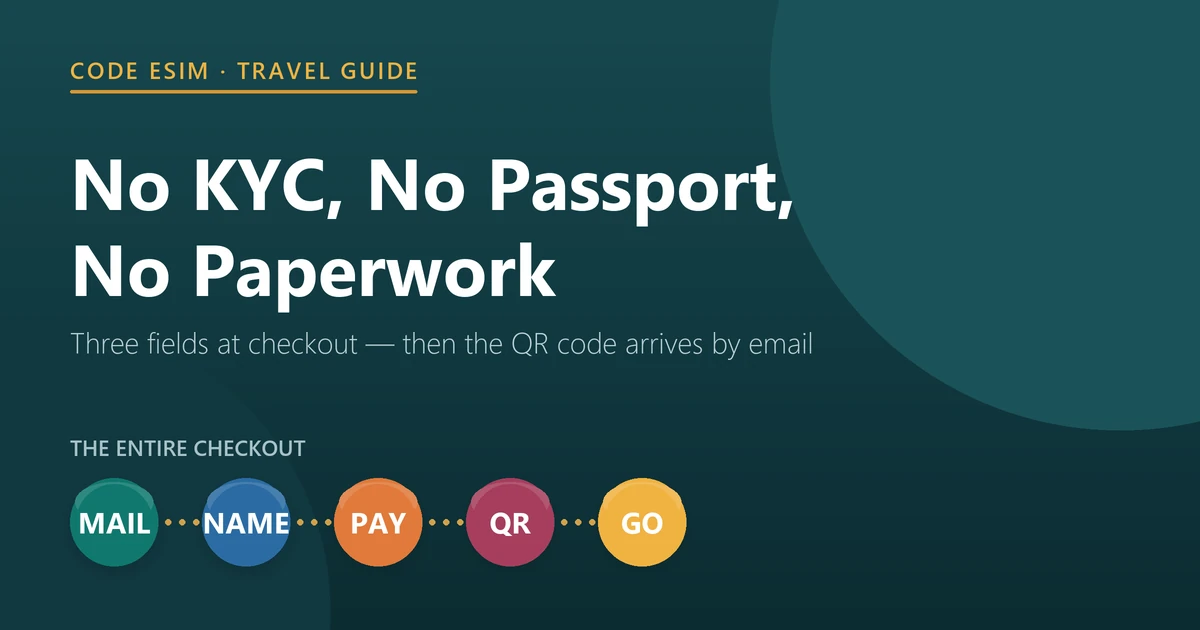
This page explains exactly what we ask for, why a travel eSIM works this way, and — just as important — what “no KYC” does not mean. Anyone selling you anonymity is overselling.
What we actually ask for
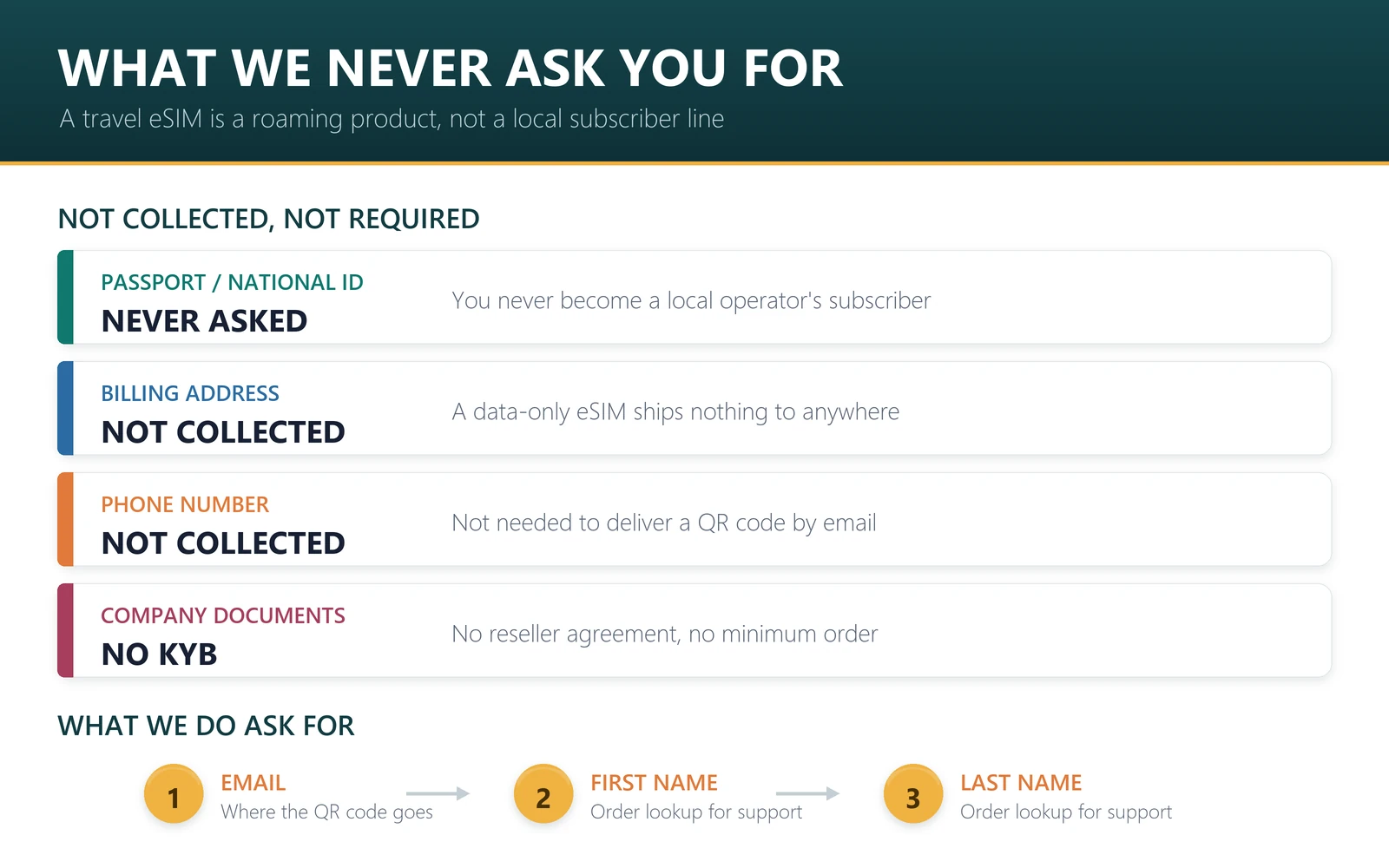
Here is the complete list of what our checkout collects. Not a summary — the whole thing:
| Field | Required? | Why it exists |
|---|---|---|
| Email address | Yes | Where your eSIM QR code and install link are sent |
| First name | Yes | Order identification and support lookup |
| Last name | Yes | Order identification and support lookup |
| Billing address | No — not collected | Removed from checkout; a data-only eSIM ships nothing |
| Phone number | No — not collected | Not needed to deliver a QR code |
| Passport or national ID | No — never asked | You are not becoming a subscriber of a local operator |
| Account registration | No — guest checkout | You can buy without creating any account |
| Company documents | No — never asked | No KYB, no reseller agreement, no business verification |
Our privacy policy states the same thing in the language of data protection: the order information we hold is your name, email address, the plan purchased and payment status. Card numbers are handled by the payment provider and are not stored on this site. The eSIM supplier receives only the parameters needed to issue the profile — not your payment information.
Why a travel eSIM works this way
The reason is not a loophole. It is the difference between being a subscriber and being a visitor.
When you buy a local prepaid SIM in another country, you are signing up as a customer of that country’s mobile operator. You get a local number, you sit on that operator’s books, and in many countries the operator is legally required to tie that line to an identity document. That is why the counter wants your passport.
A travel eSIM does not make you a subscriber of anything local. It is a roaming product: the profile belongs to a mobile operator elsewhere, and when you land, your phone registers on a local network as a visiting roamer — exactly the way your home SIM would if you switched roaming on. International roaming has worked like this since long before eSIM existed. Nobody has ever had to register with a foreign government to use their own phone on holiday.
Two consequences follow directly, and they explain most of what people find surprising:
- You do not get a local phone number. Travel eSIMs are data-only. No local number is exactly why there is no local subscriber registration.
- The plan is prepaid and finite. There is no credit relationship, no monthly bill and no contract, so there is nothing for a credit check to check.
What “no KYC” does not mean
This is the part most pages skip, and it matters more than the sales pitch.
- It is not anonymity. You pay with a card, PayPal or crypto, and your payment provider knows who you are. We hold your name and email. An eSIM is a convenient purchase, not a private one.
- It does not exempt you from local law. Wherever you travel, that country’s rules apply to you and your device. If a destination requires visitors to register a device, that obligation is between you and that country — buying connectivity online does not remove it. Our Indonesia guide covers one example where device registration rules exist and are worth checking before a long stay.
- It is not technical invisibility. Any device on any mobile network is identified by the network using standard identifiers. That is true of a roaming eSIM exactly as it is true of the SIM in your phone right now.
- It is not a way around a country’s rules. Roaming is a licensed, long-established arrangement between operators. Using it is ordinary, not clever.
If a seller markets an eSIM as untraceable, anonymous or a way to avoid a government requirement, treat that as a reason to distrust everything else they tell you. The honest benefit is narrower and still worth a lot: you skip the queue, and you do not hand your passport to a retailer in a country whose data protection regime you have never read.
The privacy benefit, stated precisely
The real advantage is data minimisation — fewer parties holding fewer copies of your identity:
| Who | What they see |
|---|---|
| Code eSIM | Your name, email, which plan you bought, payment status |
| Your payment provider | Your payment identity and the transaction — as with any online purchase |
| The eSIM supplier | Only the parameters needed to issue your profile; not your payment details |
| The local network abroad | A roaming device, as with any international roamer |
| A foreign telecom shop | Nothing — you never visit one |
Compare that with a local prepaid SIM, where a retail agent in an airport concourse photographs your passport and uploads it to a system you cannot audit, delete from, or ask questions about later. That copy tends to outlive your trip.
Buying for a team: no KYB either
Businesses hit a different wall. Buying connectivity for staff often means a corporate account, a signed agreement, company registration documents and a verification process that takes days — which is useless when someone flies on Thursday.
Buying travel eSIMs from us works the same way for a company as for a traveller. There is no business verification, no reseller onboarding and no minimum commitment:
- Buy as many plans as you need in one order — each arrives as its own QR code.
- Send each QR to the person who will use it, or hand the install link to them directly.
- No company documents, no trade licence, no VAT registration check, no account manager call.
- Each traveller installs their own profile; nothing is tied to a central corporate line.
For a team crossing several countries, check the coverage list against every stop before ordering in bulk — our guide on whether one eSIM works in multiple countries explains how to read one properly, so you do not buy twenty plans that stop at the first border.
How the purchase actually goes
- Pick a plan for your destination. Nothing is asked of you while browsing.
- Enter name and email at checkout, and pay. No account, no address, no documents.
- The QR code arrives by email, along with an install link.
- Install over Wi-Fi before you fly, then set the eSIM as your data line after you land.
- Keep your home SIM in the phone for calls and verification codes, with its data roaming off.
The whole flow takes about two minutes and happens before you leave home — which is the practical point. The paperwork you avoid is not just privacy, it is the twenty minutes at a counter after a long flight.
Frequently asked questions
Do I need a passport or ID to buy an eSIM?
No. Buying a travel eSIM requires no passport, no national ID and no document upload. Our checkout collects a first name, last name and email address, and the QR code is delivered to that email. Identity registration applies to local prepaid SIMs, where you become a subscriber of that country’s operator — a travel eSIM connects you as a roaming visitor instead.
Is there a KYC process for travel eSIMs?
Not with us. There is no identity verification step, no selfie check and no document review at any point in the purchase. Your payment provider applies its own checks to the payment itself, as it would for any online purchase.
Do I need an account to buy an eSIM?
No. Guest checkout is enabled, so you can complete a purchase without creating an account or setting a password. An optional account exists if you want to look up past orders, but it is never required to buy.
Does an eSIM make me anonymous?
No, and you should be wary of any seller who says otherwise. Your payment provider knows your payment identity, we hold your name and email, and any device on a mobile network is identified by that network in the ordinary technical sense. The benefit is that you skip identity registration with a foreign retailer, not that you become untraceable.
Why do local SIM cards require ID when eSIMs do not?
Because a local SIM makes you a subscriber of that country’s mobile operator, and many countries require subscriber lines to be registered to an identity document. A travel eSIM is a roaming product: it gives you data on a visiting basis and no local phone number, so no local subscriber registration arises.
Can a business buy eSIMs in bulk without KYB?
Yes. There is no business verification, no reseller agreement and no minimum order. Buy the number of plans you need in a single order, then distribute one QR code per traveller. Check that the plan’s country list covers every destination on the team’s itinerary before ordering in bulk.
What data do you keep about my order?
Your name, email address, which plan you bought and the payment status. Card details are handled by the payment provider and are not stored on this site, and the eSIM supplier receives only what is needed to issue your profile. The full detail is in our privacy policy.
Do I still need to follow local rules in the country I visit?
Yes. Local law applies to you and your device wherever you travel, and some countries operate device registration schemes. Buying connectivity online does not change that. Check official guidance for your destination if you are planning a long stay.
Plans you can buy and install in the next five minutes
No account, no document upload, no waiting for a verification step. The QR code is emailed after payment, and you install it on Wi-Fi before you travel. Prices are from our catalogue on 22 September 2026 and move daily.
| Destination | Plan | Price |
|---|---|---|
| Japan | 10 GB / 15 days | $7.40 |
| Turkey | 12 GB / 30 days | $8.20 |
| Europe | 20 GB / 30 days | $13.03 |
| Australia | 10 GB / 30 days | $7.00 |
| Singapore, Malaysia and Thailand | 30 GB / 30 days | $10.90 |
Worth restating the limit from earlier: this gets you data without paperwork, not anonymity, and not a local phone number. Countries that require registration for a local SIM still require it for a local SIM. A travel eSIM roams rather than registering locally, which is why the question does not arise.
Bottom line
Buying a travel eSIM takes three fields and about two minutes, with no passport, no ID upload, no account and no business verification. That is not a loophole — it is what buying a roaming product has always looked like, and it is why the airport SIM counter was never a necessary step. What it is not is anonymity: your payment provider knows you, we hold a name and an email, and local law still applies wherever you land. Those are the honest boundaries, and any seller who blurs them is telling you something else that is not true either.
Ready to skip the counter? Browse all 191 destinations, or start with Europe, Japan, USA, Thailand or Saudi Arabia. New to eSIMs? Start with what is an eSIM and how it works, check your handset with the compatibility guide, and see how to keep your home number while travelling.
Last reviewed August 12, 2026. Checkout fields, guest checkout and the data listed here reflect codeesim.com as configured on that date and are stated in our privacy policy; the site is operated by Aircode, LLC. Payment providers apply their own checks to payments, which are outside our control. Rules on SIM registration and device registration are set by each country and change over time — confirm current official guidance for your destination.