
You are planning a week in Rome with a morning at the Vatican. You search for an eSIM, and the results show Italy and Vatican City as two separate destinations. So you buy both. You have just paid twice for the same network — every plan sold under our Italy name already covers Vatican City and San Marino on the same profile.
Short answer: most travel eSIMs cover more countries than their name suggests, because mobile coverage follows roaming agreements between carriers, not political borders. Here is what that looks like in real numbers, from our own live catalogue in August 2026:
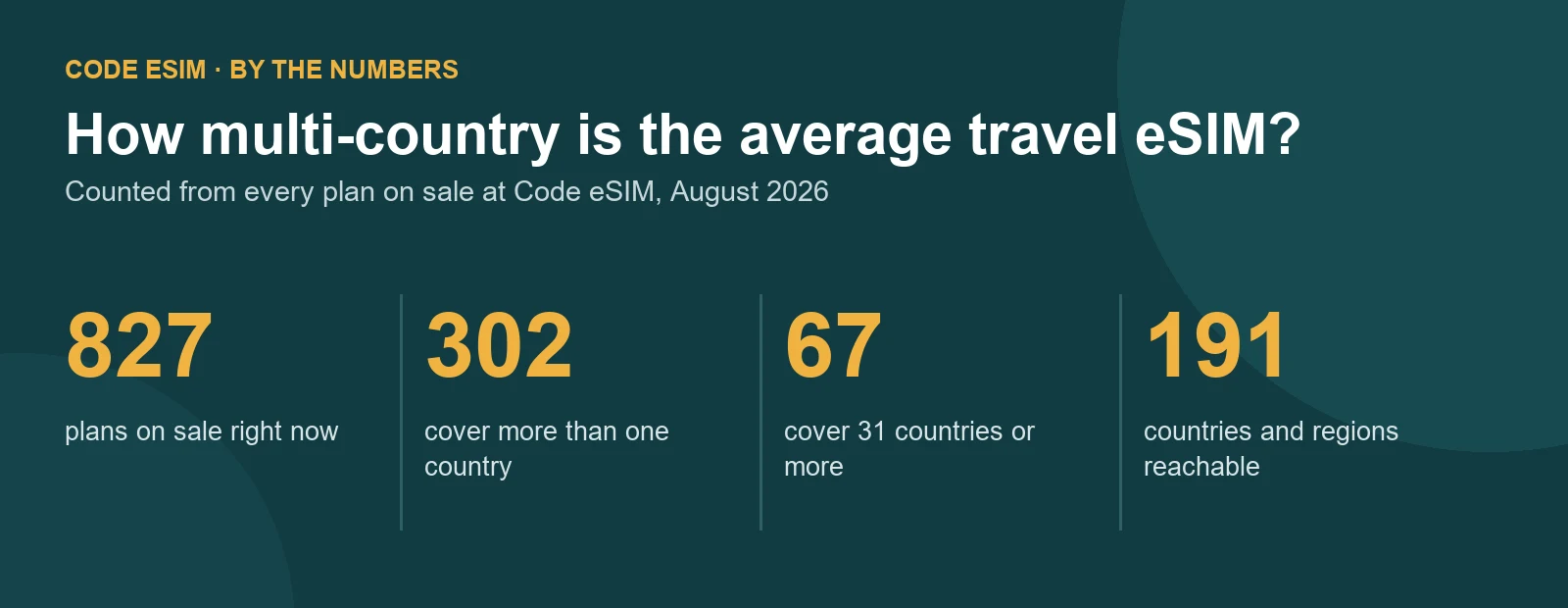
- Of 827 plans currently on sale, 302 cover more than one country, and 67 of those cover 31 countries or more.
- 83 plans cover France — and not one of them is France-only. The same is true for Italy (79 plans) and Switzerland (54 plans).
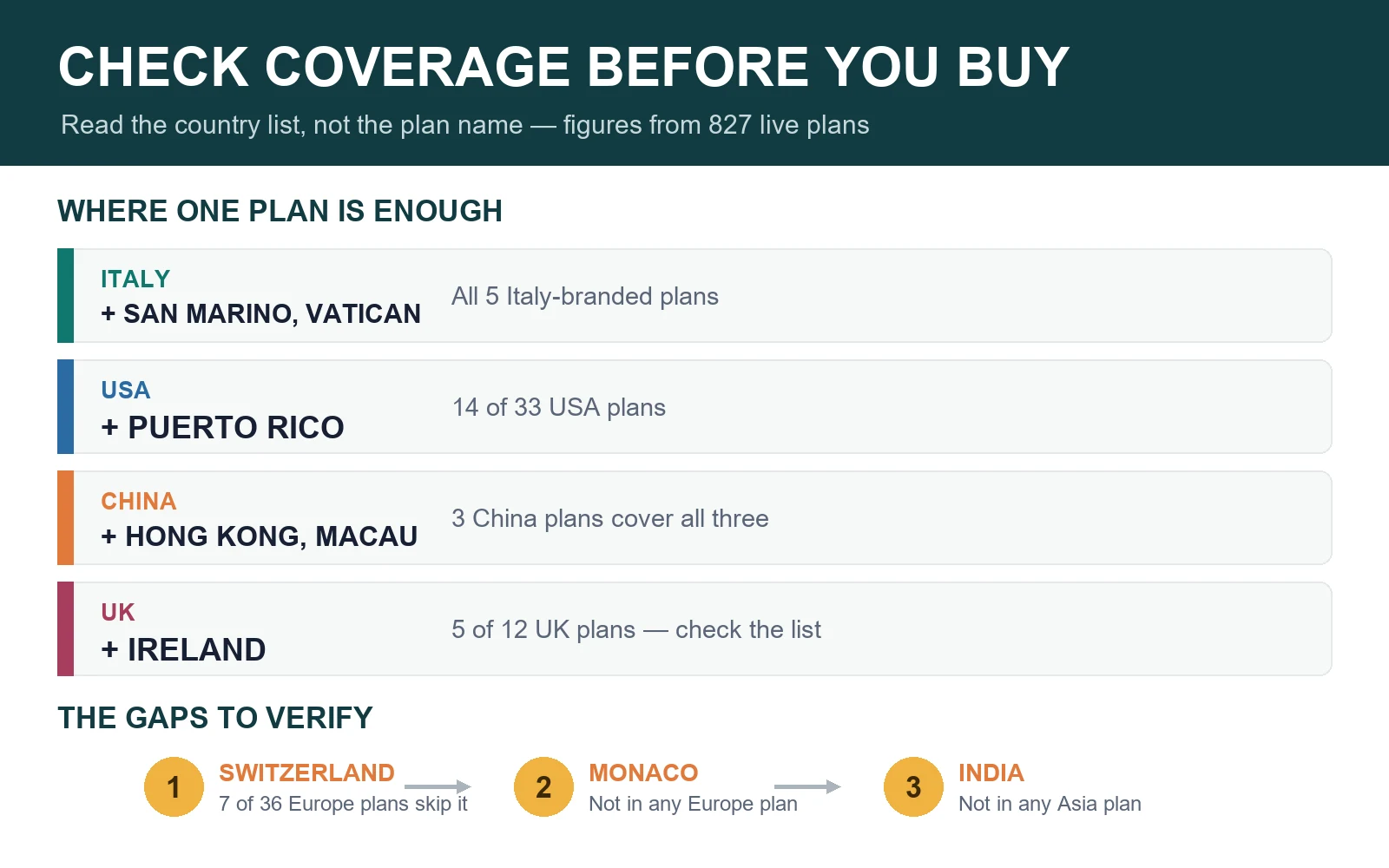
- All 5 Italy-branded plans include San Marino and Vatican City — as do 37 of the 79 plans that cover Italy in total — so a separate micro-state eSIM is never worth buying.
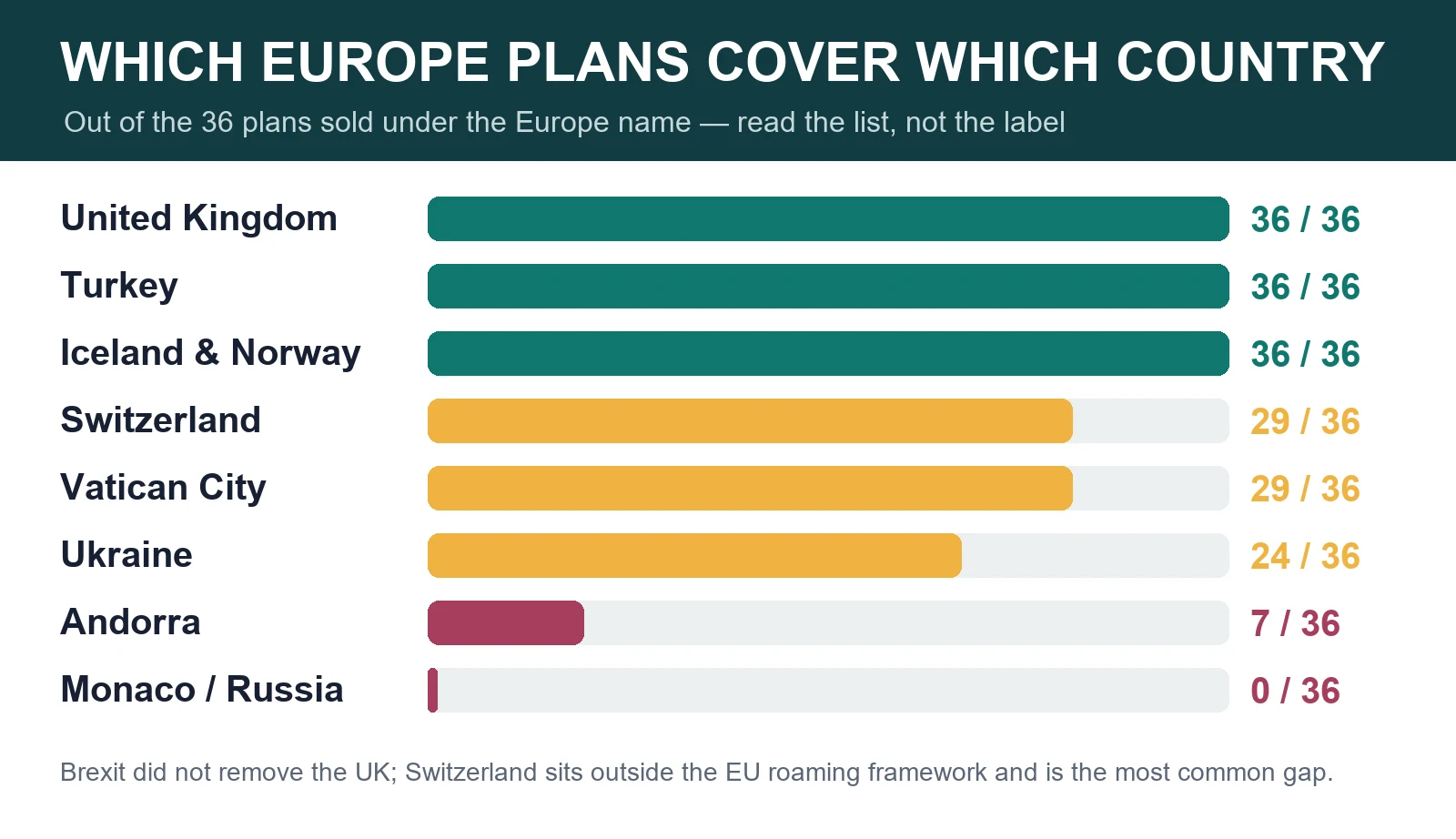
- But coverage is not automatic: 7 of the 36 plans we sell under the Europe name do not include Switzerland, and none of them cover Monaco or Russia.
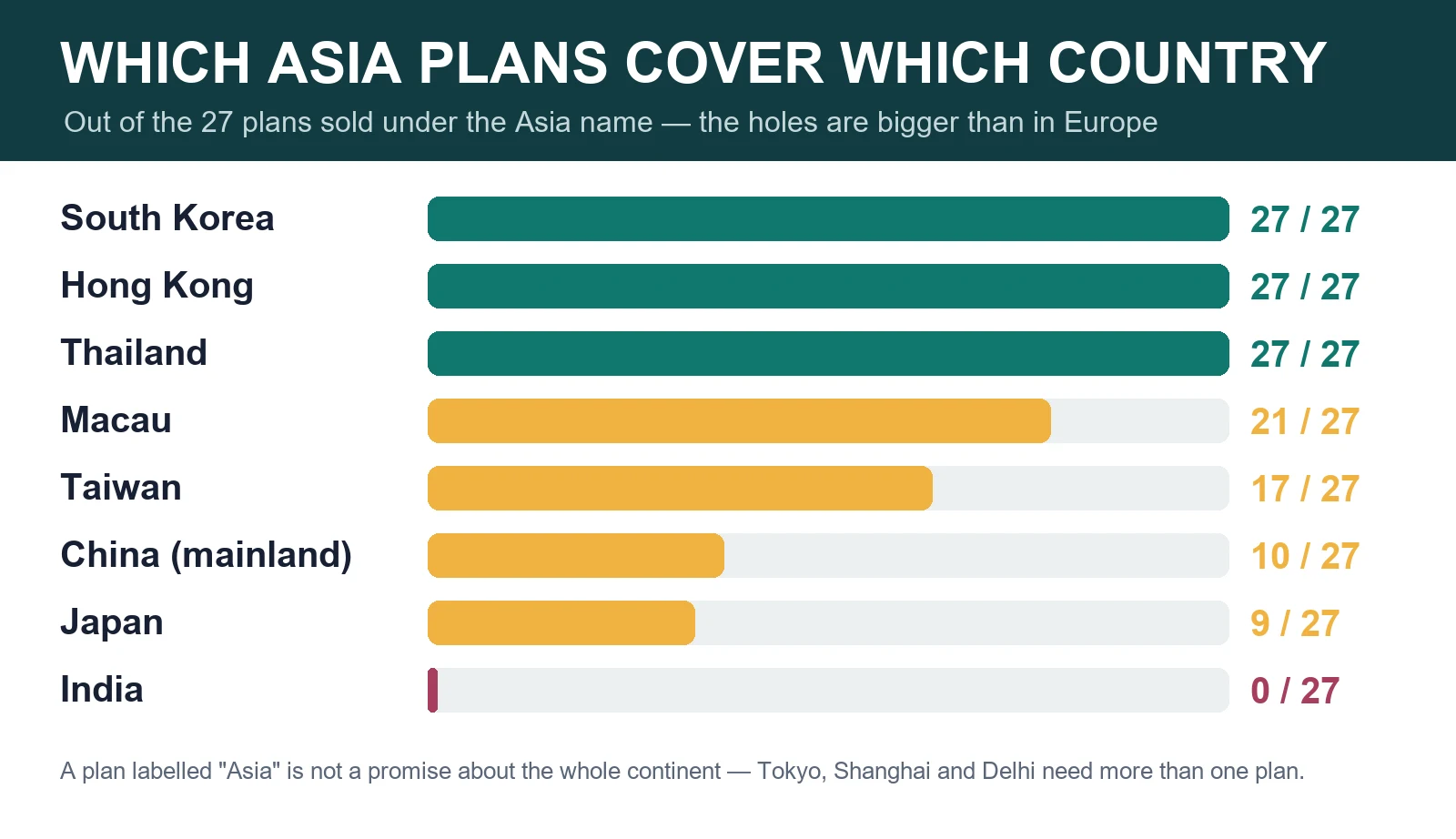
- In Asia the gaps are wider: only 10 of 27 Asia plans include mainland China, and none include India.
Why eSIM coverage confuses almost everyone
An eSIM is not tied to a country. It is tied to a set of networks. When you install a travel eSIM, your phone is authorised to roam on specific partner carriers, and the list of countries you see on a product page is simply the list of places where those partners have agreements in force.
That produces two effects that feel illogical if you are thinking in terms of maps:
- Small neighbours ride along for free. Vatican City and San Marino have no separate mobile infrastructure of consequence — phones there connect to Italian networks. A plan sold for Italy therefore works, whether or not the seller advertises it.
- Big neighbours often do not. Switzerland sits in the middle of Europe but is outside the EU roaming framework, so it has to be negotiated separately. One plan in our own catalogue covers 36 European countries — including Liechtenstein, which shares a customs union with Switzerland — and still does not cover Switzerland itself.
There is also a commercial reason the confusion persists. Search volume drives how eSIM sites build their catalogues, so if enough people search for “Vatican City eSIM” every month, a listing page tends to appear for it — even when the underlying product is identical to the Italy plan the same visitor already has open in another tab. The listing exists because of the search, not because the network works that way.
Where one plan already covers you
These are real coverage groupings from our catalogue as of August 2026. If your route stays inside one row, one plan is enough.
| If you are going to… | You are also covered in… | How many of our plans do this |
|---|---|---|
| Italy | San Marino, Vatican City | All 5 Italy-branded plans (37 of 79 plans covering Italy) |
| United States | Puerto Rico (and US Virgin Islands on some) | 14 of 33 US plans |
| China | Hong Kong, Macau | 3 China plans (plus 8 that add Japan and Korea) |
| United Kingdom | Ireland | 5 of 12 UK plans |
| Spain | Portugal | All 5 “Spain and Portugal” plans |
| Germany | Austria | All 5 “Germany and Austria” plans |
| Greece | Cyprus, Turkey | All “Greece Cyprus Turkey” plans |
| Australia | New Zealand | All “Australia and NZ” plans |
The pattern worth internalising: single-country plans are the exception, not the rule. Across the whole catalogue, 525 plans cover exactly one country and 302 cover several — but for several major destinations, the single-country version simply does not exist. Every plan that covers France, Italy or Switzerland also covers at least one neighbour. If you were mentally budgeting for one eSIM per country on a European trip, you are probably over-buying.
Planning a multi-country route? Compare regional options on our Europe eSIM plans, Asia eSIM plans and Americas eSIM plans pages — each product page lists every country it covers, in full.
Where you genuinely need a second plan
This is the half that most guides skip, so here it is with the same data. Within the 36 plans we sell under the Europe name, coverage of these places varies:
| Destination | Covered by | What that means for you |
|---|---|---|
| United Kingdom | 36 of 36 Europe plans | Safe. Brexit did not remove the UK from travel eSIM coverage. |
| Turkey | 36 of 36 | Safe, despite sitting outside the EU. |
| Iceland, Norway | 36 of 36 | Safe. |
| Switzerland | 29 of 36 | Check the list. Roughly one in five Europe plans skips it. |
| Ukraine | 24 of 36 | Check the list. |
| Vatican City | 29 of 36 | Covered by every Italy-branded plan, but only some Europe plans. |
| Andorra | 7 of 36 | Usually not covered. Verify before a Pyrenees trip. |
| Monaco, Russia | 0 of 36 | Not covered at all. Plan separately. |
Asia has the same structure with bigger holes. A plan labelled “Asia” is not a promise about the whole continent, and a Tokyo–Shanghai–Delhi itinerary is not something a single regional plan can carry today. Across the 27 plans we sell under the Asia name:
| Destination | Covered by | What that means for you |
|---|---|---|
| South Korea, Hong Kong, Thailand | 27 of 27 Asia plans | Safe on any Asia plan. |
| Macau | 21 of 27 | Check the list, especially with a Hong Kong side trip. |
| Taiwan | 17 of 27 | Check the list. |
| China (mainland) | 10 of 27 | Barely a third. Verify explicitly, or buy a China plan. |
| Japan | 9 of 27 | Barely a third. A Japan plan is often the better buy. |
| India | 0 of 27 | Not covered at all. Always needs its own plan. |
For those routes, either pick a plan whose country list explicitly names all your stops, or buy per country. Our Asia regional vs country eSIM comparison walks through the trade-off with route examples.
How to check coverage in 60 seconds before you buy
Do not rely on the plan’s name. The name is marketing; the country list is the product. Three checks:
- Write down every stop, including transit. An overnight in Zurich or a two-day stop in Dubai counts as a destination, even if you think of it as part of the flight.
- Open the plan page and read the full country list. Every plan on our site shows the complete list of covered countries and the partner networks it uses. If a stop on your list is missing, that plan will not work there — no matter how regional the name sounds.
- Check the smallest places last, and hardest. Micro-states, islands and overseas territories are where coverage lists diverge most: Puerto Rico is included in 14 of our 33 US plans, Andorra in 7 of 36 Europe plans. These are also the ones travellers assume are automatic.
If a destination browse is easier than a plan-by-plan comparison, the destinations directory lists all 191 countries and regions we cover, and each destination page shows only the plans that actually include it.
What happens at the border itself
If your plan covers both sides, nothing. Your phone drops the network it was using and registers on a partner carrier in the new country, the same way any roaming SIM does. There is no second QR code, no reinstall, and no action needed from you beyond keeping data roaming enabled for the eSIM line — that toggle is what authorises the phone to use a partner network at all, and switching it off is the single most common reason a valid multi-country plan appears to “stop working” after a border crossing.
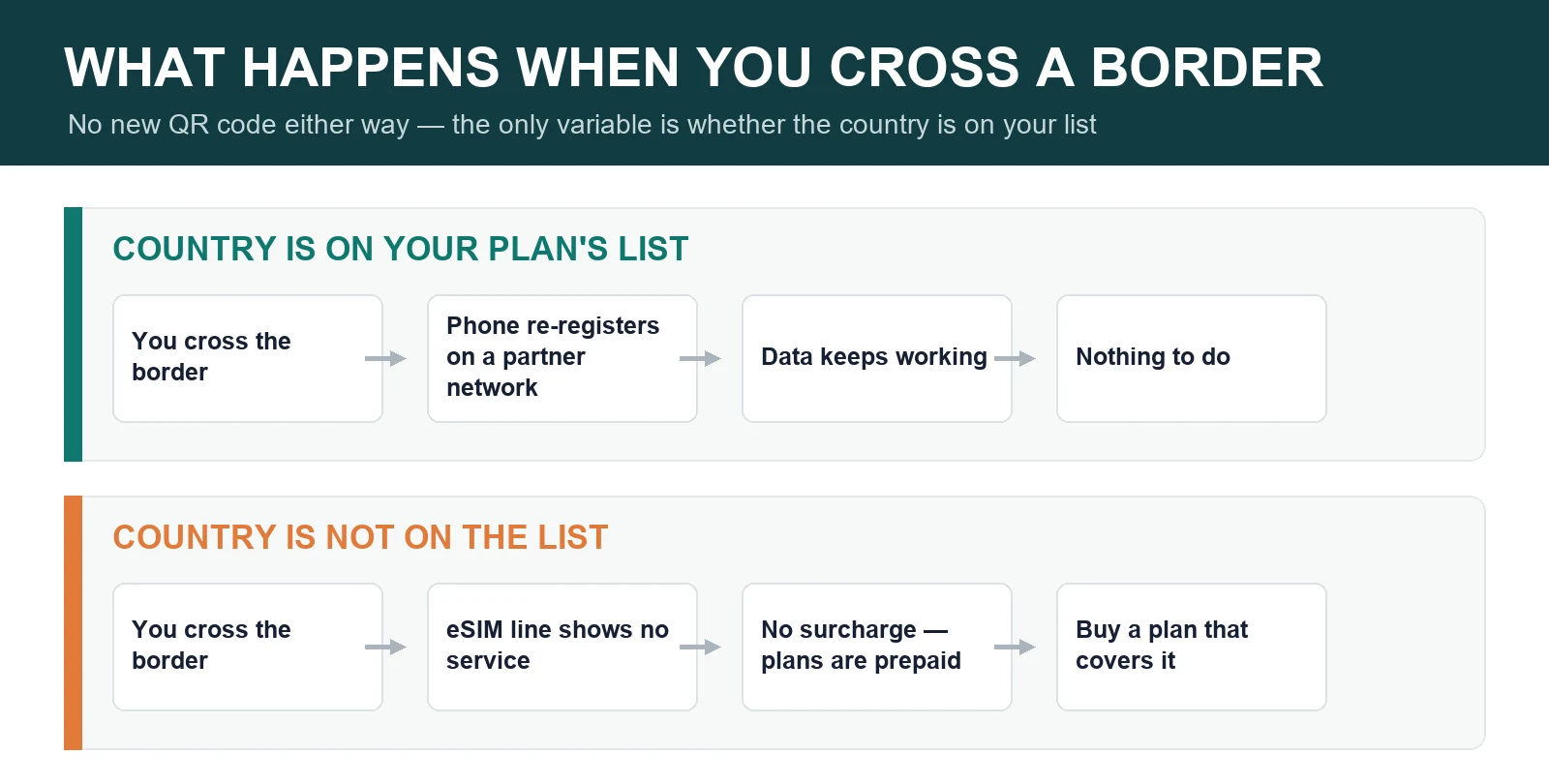
If your plan does not cover the new country, you will simply have no service on that line. Your data does not silently continue at a surcharge, and you are not billed for the gap — travel eSIMs are prepaid, so there is no metered overage to run up. That is genuinely safer than leaving your home SIM roaming, but it does mean an uncovered stop leaves you offline until you buy something else. If data stops after a crossing and you believe the country is covered, work through the eSIM troubleshooting checklist before buying a second plan.
Frequently asked questions
Does one eSIM work in multiple countries?
Often yes. Around 37% of the plans we sell cover more than one country, and regional plans routinely cover 30 or more. What matters is not whether the plan is “multi-country” in principle but whether its published country list includes every stop on your route.
Do I need a separate eSIM for Vatican City or San Marino?
No. Both are served by Italian networks, and all five plans we sell under the Italy name cover all three on one profile. If you see them sold separately anywhere, that is a listing built for search traffic, not a different product. One caveat: some multi-country plans that include Italy — “France and Italy”, for example — do not extend to the micro-states, so check the list if you are buying a combined plan rather than an Italy one.
Does a UK eSIM work in Ireland?
Only if the plan says so. They are separate countries with separate networks, so it depends entirely on the plan: 5 of our 12 UK plans include Ireland, and the other 7 are Britain-only. Read the country list rather than assuming the two islands travel together.
Is Switzerland included in a Europe eSIM?
Usually, but not always — 29 of our 36 Europe plans cover it. Switzerland is outside the EU roaming framework, so it is negotiated separately and is one of the most common gaps in European plans. Check it explicitly if your route includes Zurich, Geneva or an Alpine leg.
Will one Asia eSIM cover China, Japan and India?
No single regional plan in our catalogue does that today. Only 10 of 27 Asia plans include mainland China, 9 include Japan, and none include India. For a route spanning all three, combine plans or buy per country.
Do I need to do anything when I cross a border?
No, provided the new country is on your plan’s coverage list. The phone re-registers on a local partner network automatically. Keep data roaming switched on for the eSIM line — that setting is what lets it use partner networks, and it is not the same as roaming on your home SIM.
What happens if I enter a country my plan does not cover?
The eSIM line simply has no service there. Because travel eSIMs are prepaid, you are not charged extra and there is no bill shock, but you will be offline on that line until you buy a plan that covers the country.
Is one regional plan cheaper than several country plans?
It depends on the route. For three or more countries in one trip, a regional plan is usually simpler and cheaper per gigabyte. For two countries where you will spend most of the time in one, two country plans can work out better. Compare the per-gigabyte price on both before deciding.
Plans that already cover more than one country
If your route crosses a border, compare these specific multi-country plans rather than buying two single-country profiles. Prices are from our catalogue on 22 September 2026 and move daily — each plan page is the live version.
| Route | Plan | Price |
|---|---|---|
| Singapore, Malaysia and Thailand | 30 GB / 30 days | $10.90 |
| Australia and New Zealand | 20 GB / 30 days | $19.94 |
| Hong Kong, Macau and mainland China | 15 GB / 180 days | $14.60 |
| Greater China and Taiwan | 10 GB / 30 days | $9.00 |
| Europe, many countries | 20 GB / 30 days | $13.03 |
Two of these are worth a second look on price alone. The Singapore, Malaysia and Thailand plan carries 30 GB for less than most single-country 20 GB plans, and the Australia and New Zealand plan costs about 90 cents more than New Zealand on its own. A wider profile is not automatically the more expensive one.
Whichever you pick, open its coverage table and find every country on your itinerary by name before paying — that is the 60-second check described above.
Bottom line
Buy for your route, not for the map. Most travellers over-buy, purchasing a separate eSIM for every country when the plan they already chose covers half the trip — while the same travellers under-check the handful of places that genuinely fall outside regional coverage, like Switzerland, Andorra and Monaco in Europe, or China, Japan and India in Asia. List your stops, read the full country list on the plan page once, and buy the smallest number of plans that covers all of them.
Start with your destination: Europe, Asia, Italy, United Kingdom, USA, Japan or all 191 destinations. New to eSIMs? Start with what is an eSIM and how it works, then check your phone with the eSIM compatibility guide.
Last reviewed August 10, 2026. Coverage figures in this article were counted from the 827 plans on sale at Code eSIM on that date; our catalogue syncs daily and partner agreements change, so the country list shown on each product page is always the authoritative version. Plan names are set by the network providers and do not always reflect full coverage — read the list, not the label.