
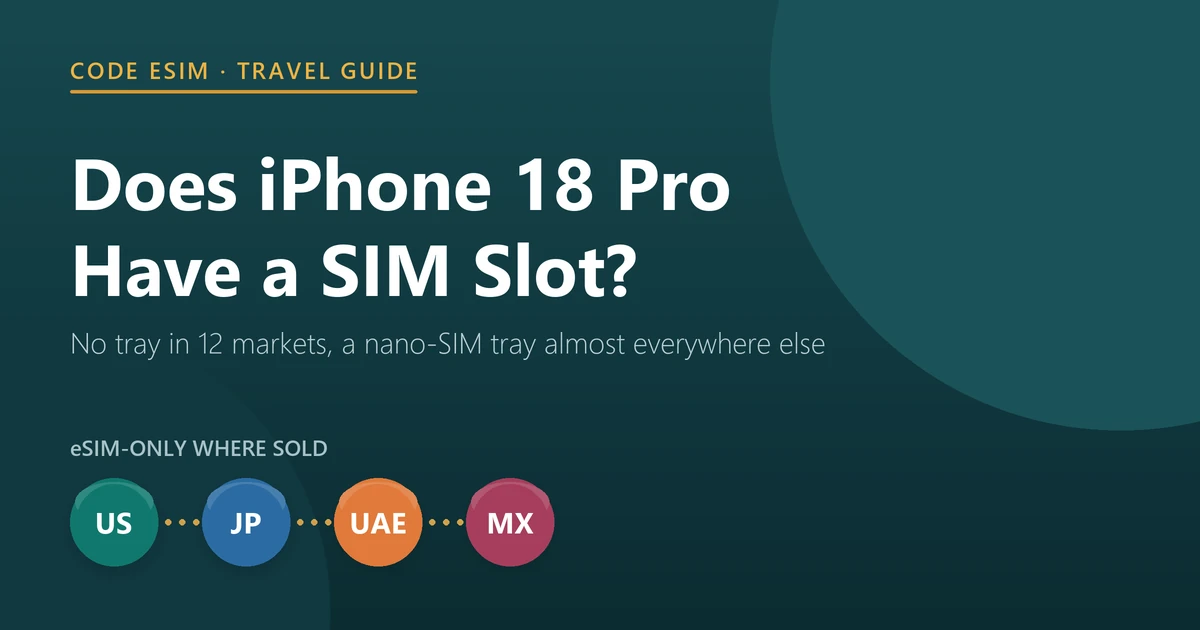
It depends on where the phone is sold. iPhone 18 Pro and iPhone 18 Pro Max have no SIM card slot in 12 markets: Bahrain, Canada, Guam, Japan, Kuwait, Mexico, Oman, Qatar, Saudi Arabia, the UAE, the US and the US Virgin Islands. Almost everywhere else, Apple sells a version with a nano-SIM tray as well as eSIM. In China mainland, the tray takes two nano-SIM cards.
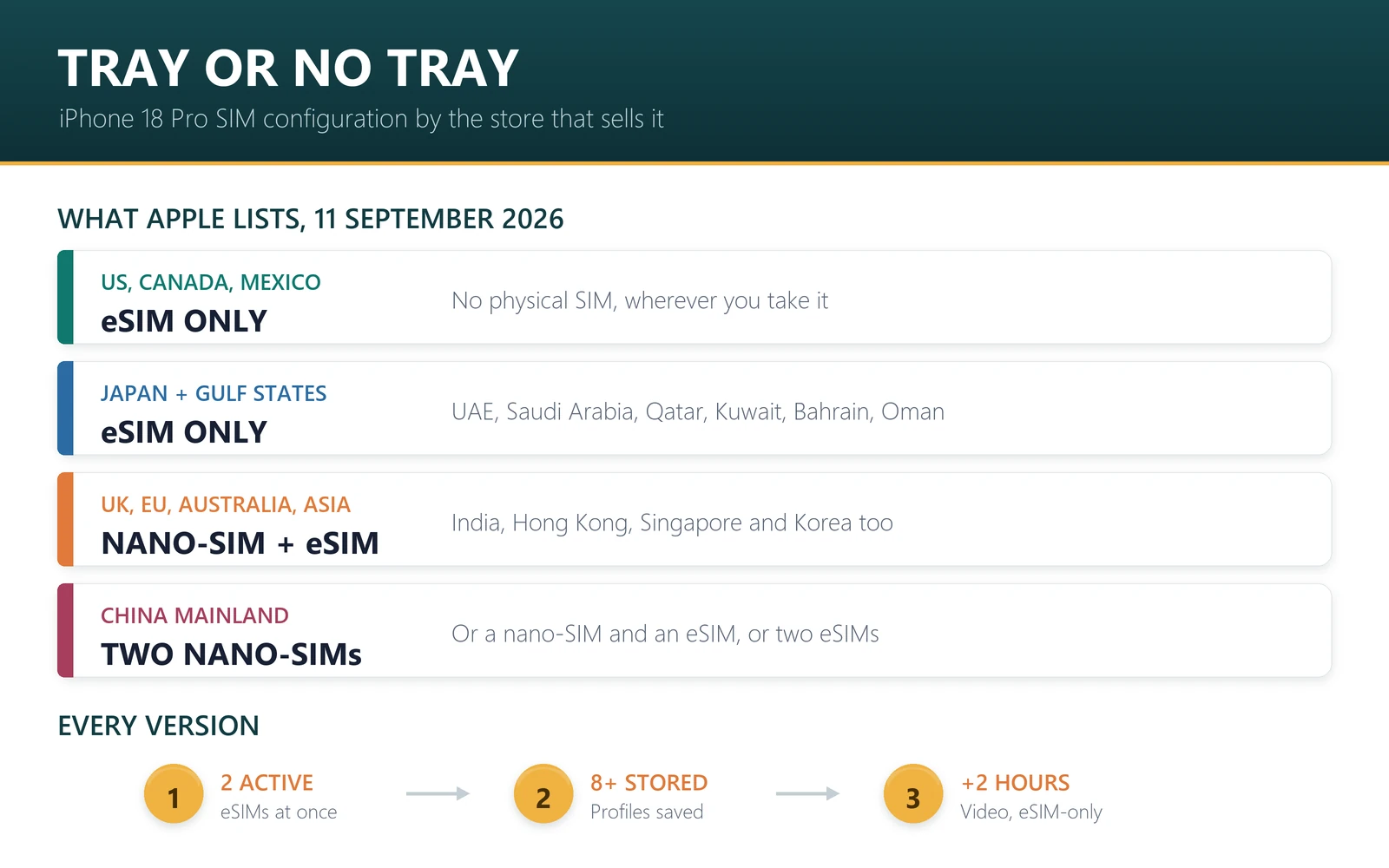
The market list comes from Apple’s own launch announcement on 9 September 2026. We then read the SIM line on 29 of Apple’s regional specification pages on 11 September, the day before pre-orders open, to confirm what each store actually lists. The table below is the result.
One detail catches people out: the design follows the store, not the owner. An iPhone 18 Pro bought in New York and used in London still has no tray. If you travel, move abroad or buy a phone on a trip, that matters more than any camera spec.
- eSIM-only markets: 12, per Apple’s announcement.
- Nano-SIM tray plus eSIM: all 22 other regional Apple stores we checked, including the UK, Germany, France, Australia, India, Hong Kong, Singapore and South Korea.
- Every version: two eSIMs active at once, eight or more stored.
- Battery: Apple says the eSIM-only versions get about two extra hours of video playback.
- Dates: pre-orders from 12 September; in stores from 18 September in more than 65 countries, and from 25 September in 20 more.
Where iPhone 18 Pro has no SIM tray
Apple names the eSIM-only markets in its iPhone 18 Pro announcement. Its US technical specifications describe those models as Dual eSIM and “not compatible with physical SIM cards”. The UK specifications, by contrast, list Dual SIM with a nano-SIM and an eSIM.
| Where it is sold | SIM configuration Apple lists | Takes a physical SIM? |
|---|---|---|
| United States, Canada, Mexico | Dual eSIM (two active, eight or more stored) | No |
| Japan | Dual eSIM | No |
| United Arab Emirates, Saudi Arabia | Dual eSIM | No |
| Qatar, Kuwait, Bahrain, Oman | eSIM-only, per Apple’s announcement | No |
| Guam, US Virgin Islands | eSIM-only, per Apple’s announcement | No |
| United Kingdom, Ireland | Dual SIM (nano-SIM and eSIM), with Dual eSIM support | Yes, one |
| France, Germany, Italy, Spain, Netherlands, Switzerland | Dual SIM (nano-SIM and eSIM) | Yes, one |
| Australia, New Zealand | Dual SIM (nano-SIM and eSIM) | Yes, one |
| India | Dual SIM (nano-SIM and eSIM) | Yes, one |
| Hong Kong, Taiwan, South Korea | Dual SIM (nano-SIM and eSIM) | Yes, one |
| Singapore, Malaysia, Philippines, Thailand, Vietnam | Dual SIM (nano-SIM and eSIM) | Yes, one |
| Brazil, Türkiye, Apple’s Latin America store | Dual SIM (nano-SIM and eSIM) | Yes, one |
| China mainland | Dual SIM: two nano-SIMs, or a nano-SIM and an eSIM, or two eSIMs | Yes, up to two |
Two caveats sit behind that table. Apple’s specification pages for Qatar, Kuwait, Bahrain and Oman returned “Page Not Found” when we checked, so for those four the announcement is the only source. Apple also does not name the 20 countries that get the phone on 25 September. If you are buying in one of them, read the SIM line on that country’s Apple specifications page first.
China mainland is its own case. Apple’s Chinese specifications page says eSIM activation there is limited to specific model numbers and is done in person at China Mobile, China Telecom or China Unicom stores with ID. We cover that separately in which mainland China iPhones support eSIM.
Why Apple removed the tray in some countries
Apple’s explanation is about battery, not convenience. The eSIM-only versions “feature an even larger battery, taking advantage of the space formerly occupied by the physical SIM to provide two additional hours of video playback”, according to the announcement. Apple rates those versions at up to 36 hours of video playback on iPhone 18 Pro and up to 45 hours on iPhone 18 Pro Max.
What Apple does not explain is why the eSIM-only versions go to these 12 markets and not to others. We are not going to guess. What we can say is what the split means for you. In the UK, Europe, Australia and most of Asia, you can still choose the tray version. In North America, Japan and the Gulf, you cannot.
For context, Apple’s announcement says eSIM is supported by more than 500 carriers worldwide. That count covers carriers, not every plan they sell, so check your own plan rather than your carrier’s name.
Which iPhones still have a SIM tray in 2026?
iPhone 18 Pro is not the only model with a split. We read the SIM line for the rest of Apple’s current lineup on the US, Japan and China mainland stores, and on seven stores that sell tray versions: the UK, Germany, Australia, India, Hong Kong, Singapore and South Korea.
| Model | US | Japan | UK, Germany, Australia, India, Hong Kong, Singapore, South Korea | China mainland |
|---|---|---|---|---|
| iPhone 18 Pro / Pro Max | eSIM only | eSIM only | Nano-SIM + eSIM | Two nano-SIMs, or nano-SIM + eSIM, or two eSIMs |
| iPhone 17 | eSIM only | eSIM only | Nano-SIM + eSIM | Two nano-SIMs |
| iPhone 17e | eSIM only | eSIM only | Nano-SIM + eSIM | Nano-SIM + eSIM |
| iPhone Air | eSIM only | eSIM only | eSIM only | eSIM only |
| iPhone Duo | eSIM only | eSIM only | eSIM only | eSIM only |
Two things stand out. iPhone Air and iPhone Duo are eSIM-only in every store we checked, China mainland included. Apple’s Duo announcement calls it an “eSIM-only design worldwide”; we unpack what the eSIM-only foldable means for travel. And every iPhone Apple currently sells in the US, including iPhone 16, is eSIM-only. If you want a physical SIM in 2026, you are choosing between iPhone 18 Pro, iPhone 17 and iPhone 17e, from a store that still sells the tray version.
Travelling with an iPhone 18 Pro? Every version runs a travel eSIM alongside your home line. Find a data plan for your destination; each plan page shows the partner network, the activation rule and hotspot support before you buy.
What a SIM tray still does for a traveller
For most short trips the tray makes no difference, because a travel eSIM does the job on both versions. It matters in the situations where a physical card is still the easier tool.
| Situation abroad | Version with a tray | eSIM-only version |
|---|---|---|
| Data for a one- or two-week trip | Travel eSIM, or a local SIM card | Travel eSIM |
| A local phone number for a long stay | Buy a prepaid SIM card on arrival | Only if a local carrier sells eSIM to visitors, which can mean showing a passport |
| Keeping your home number reachable | Home SIM in the tray, travel eSIM for data | Home eSIM and travel eSIM, both active |
| Your phone breaks and you borrow one | Move the SIM card across in seconds | The home line needs a carrier transfer; a travel eSIM usually cannot move |
| An eSIM install fails at the airport | A local SIM card is the fallback | Airport or hotel Wi-Fi to troubleshoot |
The right-hand column is mostly about local numbers. Travel eSIMs are almost always data-only: of the 830 plans on sale in our catalogue on 11 September 2026, 12 include calls and 6 include SMS. On an eSIM-only phone, the realistic setup is your home line for calls and verification codes, plus a travel eSIM for data. Our eSIM vs physical SIM comparison goes through the trade-offs in more detail.
Setting up a travel eSIM on an eSIM-only iPhone 18 Pro
The steps are the same on both versions; the eSIM-only one simply gives you no fallback if you skip them. Apple’s guide to using eSIM while travelling covers the settings. This is the order that avoids problems.
- Check the phone is unlocked. Go to Settings, General, About. Next to Carrier Lock, an unlocked iPhone shows “No SIM Restrictions”.
- Read the plan’s activation line before you buy. Of our 830 plans, 683 start on first data use, 106 on first network connection and 41 as soon as the eSIM is installed. When an eSIM starts counting explains the difference.
- Install on Wi-Fi before you fly, then leave the travel line switched off. The installation guide walks through the screens.
- On arrival, turn the travel line on. From iOS 26, iPhone may prompt you to “Turn On Travel eSIM” and choose Travel eSIM Only or Travel eSIM and Current eSIM. Keeping both leaves your home number reachable, but Apple notes your home eSIM can still incur roaming fees.
- Make the travel eSIM your data line in Settings, Cellular, Cellular Data. Apple says FaceTime and iMessage keep working on your home line.
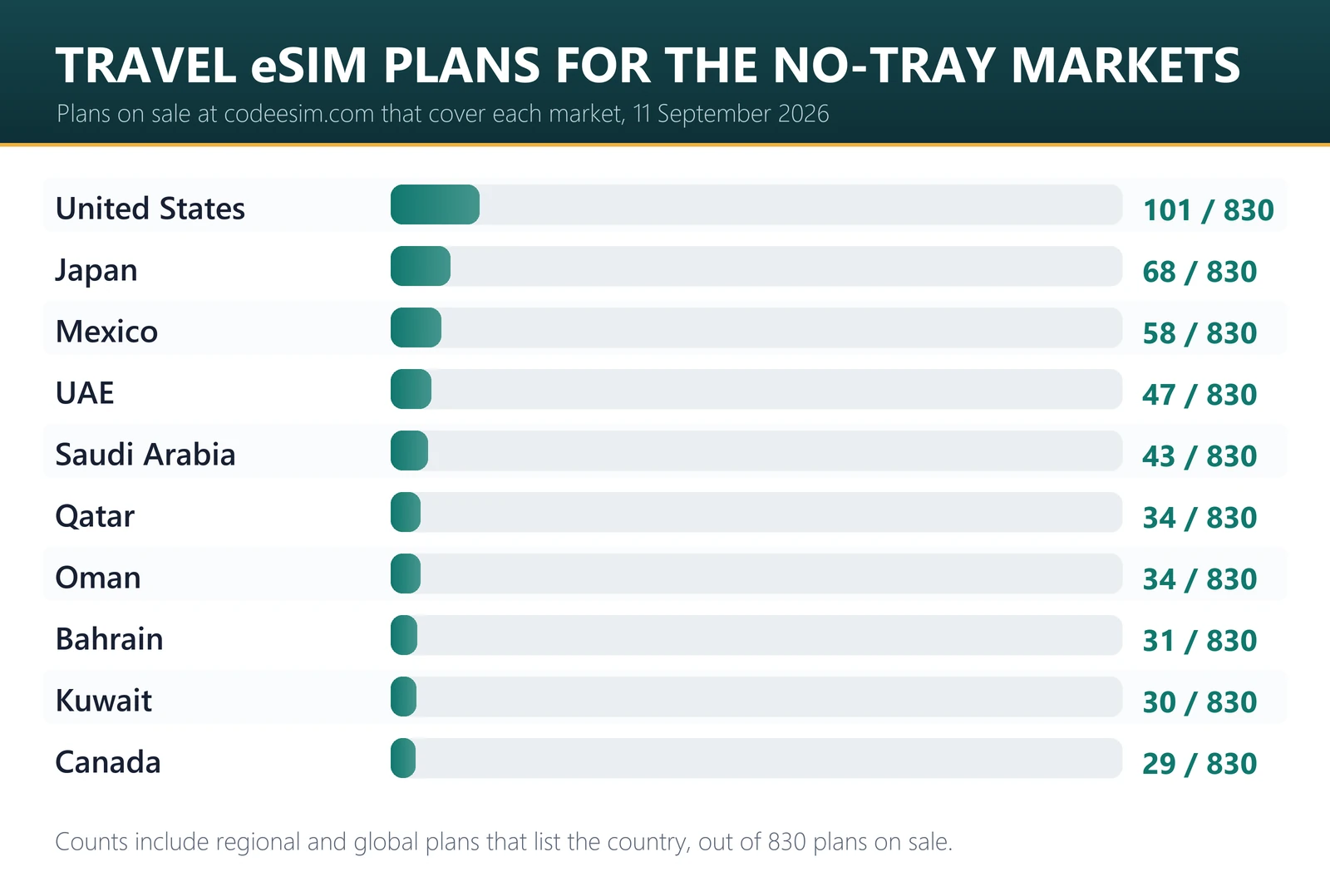
If the trip is to one of the eSIM-only markets themselves, there is plenty of choice. On 11 September 2026, 101 of our 830 plans covered the US, 68 Japan, 58 Mexico, 47 the UAE and 43 Saudi Arabia, counting regional plans that list the country. Start from Japan, the US or the UAE, and see how to keep your home number with a travel eSIM. Upgrading from an older iPhone first? Read how to transfer your eSIM to iPhone 18 Pro.
How to tell which version you have
If the phone is in your hand, look at the frame. A version with a tray has a small SIM tray with a pinhole for the eject tool. An eSIM-only version has none.
If you are buying second-hand or from a reseller, ask for the model number before paying. It is in Settings, General, About; tap the part number to reveal it. Apple’s US specifications list iPhone 18 Pro as model A3472 and iPhone 18 Pro Max as A3473. Those US versions are eSIM-only, so a phone showing either number will not take a SIM card, wherever it is being sold now. Apple’s cellular page lists other model numbers for other markets; our guide to iPhone 18 Pro model numbers by country maps all four, A3472, A3713, A3714 and A3715, with their bands. Our guide to buying iPhone 18 Pro abroad covers the other checks, including carrier lock and bands.
How we checked, and what this cannot tell you
The market list is from Apple’s announcement of 9 September 2026. On 11 September 2026 we read the SIM Card section of the iPhone 18 Pro technical specifications on 35 Apple regional websites. 29 loaded: 6 listed Dual eSIM only (US, Canada, Mexico, Japan, UAE and Saudi Arabia), 22 listed a nano-SIM plus eSIM, and China mainland listed dual SIM with nano-SIM support. The Qatar, Kuwait, Bahrain, Oman and South Africa pages returned “Page Not Found”, and the Macao page did not show specifications. The rest of the lineup was checked the same way on 10 stores.
What this cannot tell you: Apple can change configurations, and resellers sometimes import versions made for other countries, so the SIM line on your local Apple page is not a guarantee about a phone in a shop window. Check the model number. Catalogue counts are ours, from the 830 plans on sale at codeesim.com on 11 September 2026. We have not handled an iPhone 18 Pro.
To cite this page: Code eSIM, “Does iPhone 18 Pro Have a SIM Card Slot?”, checked against Apple regional specification pages on 11 September 2026.
Frequently asked questions
Does iPhone 18 Pro have a SIM card slot?
It depends where it was sold. Versions sold in the US, Canada, Mexico, Japan, the UAE, Saudi Arabia, Qatar, Kuwait, Bahrain, Oman, Guam and the US Virgin Islands are eSIM-only. Apple’s stores in the UK, Europe, Australia, India, Hong Kong, Singapore and South Korea sell a version with a nano-SIM tray plus eSIM.
Is iPhone 18 Pro Max eSIM-only in the US?
Yes. Apple’s US specifications list iPhone 18 Pro and iPhone 18 Pro Max as Dual eSIM, with two active eSIMs and eight or more stored, and say they are not compatible with physical SIM cards. Every iPhone Apple currently sells in the US is eSIM-only.
Does the UK iPhone 18 Pro have a SIM tray?
Yes. Apple’s UK specifications list Dual SIM with a nano-SIM and an eSIM, plus Dual eSIM support, so you can run a SIM card and an eSIM together or two eSIMs. Apple’s Irish, French, German, Italian, Spanish, Dutch and Swiss pages list the same configuration.
Can I put a physical SIM in a US iPhone 18 Pro?
No. There is no tray, and taking the phone to another country does not change that. If your home carrier still issues only physical SIM cards, ask whether it can move your line to eSIM before you buy. Apple notes that some carriers can convert a physical SIM to an eSIM.
Why is iPhone 18 Pro eSIM-only in some countries?
Apple says the eSIM-only versions use the space once taken by the SIM tray for a larger battery, adding about two hours of video playback. It has not explained why those versions go to these 12 markets rather than others, and the tray version remains on sale in most of the world.
Does the eSIM-only iPhone 18 Pro have better battery life?
By Apple’s figures, yes. It rates the eSIM-only versions at up to 36 hours of video playback on iPhone 18 Pro and up to 45 hours on iPhone 18 Pro Max, and describes that as two additional hours compared with the versions that keep a SIM tray.
Can a travel eSIM work on any iPhone 18 Pro version?
Yes, as long as the phone is carrier-unlocked. Both versions support two active eSIMs, so a travel eSIM can carry data while your home line stays on for calls and codes. To check, open Settings, General, About: Carrier Lock should read No SIM Restrictions.
Which iPhones still have a SIM tray in 2026?
In the UK, Germany, Australia, India, Hong Kong, Singapore and South Korea, iPhone 18 Pro, iPhone 17 and iPhone 17e come with a nano-SIM tray. iPhone Air and iPhone Duo are eSIM-only in every Apple store we checked, including China mainland.
Bottom line
iPhone 18 Pro is two phones sharing a name. Bought in North America, Japan or the Gulf, it is eSIM-only and gains a little battery. Bought in the UK, Europe, Australia or most of Asia, it keeps a nano-SIM tray. For a typical trip, both work the same way: home line on, travel eSIM for data. The tray only earns its place if you buy local SIM cards, swap phones often or have a carrier that still does not offer eSIM, so decide that before you decide where to buy.
Last reviewed 11 September 2026. iPhone specifications, SIM configurations, pricing and availability are from Apple’s announcement and regional technical specification pages, read on that date and subject to change. Apple, iPhone and iPhone 18 Pro are trademarks of Apple Inc.; this article is independent editorial commentary and is not affiliated with, sponsored by or endorsed by Apple. Illustrations are our own.