
Heading to Dubai or Abu Dhabi and wondering which eSIM to buy? This guide covers what actually matters for the UAE: how much data to buy, coverage across the emirates, what to know about calling apps before you land, and the short unlimited plans that suit a Dubai layover. Everything here is checkable on the product page before you pay.
Key facts at a glance:
- A typical UAE tourist uses 500 MB to 1 GB per day — maps, ride-hailing, translation and photo sharing.
- For a one-week Dubai trip, 5–10 GB is comfortable; a long layover is better served by a 1-day unlimited plan.
- Coverage in Dubai, Abu Dhabi and Sharjah is dense 5G/4G; expect weaker signal on desert safaris and remote coastal roads.
- The UAE regulates voice and video calling over the internet, and the rules change — check the current position before you rely on any calling app.
- Travel eSIMs route data through a partner network, and the IP routing location is listed on each product page — worth reading before purchase.
Quick answer: how much data do you need in the UAE?
Pick from how you actually travel, not from the headline price per gigabyte:
- Long layover (6–14 hours): a 1-day unlimited or 1 GB plan is usually enough for maps, ride-hailing and messaging between terminals and the city.
- Short break (3–4 days): 3–5 GB covers navigation, bookings, social posts and translation.
- One week: 5–10 GB is the comfortable middle for most tourists.
- Two weeks or business travel with hotspot: 10–20 GB or more, and confirm hotspot support before buying.
If you want the reasoning behind these numbers, our travel data usage guide breaks down what each app consumes per hour — maps are cheap, video is what drains a plan.
Compare current options on the UAE eSIM plans page.
Coverage across the emirates
The UAE has some of the densest mobile infrastructure in the region, and the places tourists spend time are well covered:
- Dubai: Downtown, Marina, JBR, Deira, Palm Jumeirah, Expo City and both airports (DXB and DWC) are strong 5G/4G areas.
- Abu Dhabi: Corniche, Saadiyat, Yas Island and the airport are similarly well served.
- Sharjah, Ajman and the northern emirates: reliable in urban areas and along the main highways.
- Desert safaris and Hatta: coverage thins out in dune areas and mountain roads. Download offline maps before you go and save your tour operator details locally.
- Metro, malls and hotels: generally solid, with Wi-Fi widely available as a fallback.
Before you pay, confirm the plan lists the United Arab Emirates specifically. If you bought a wider Middle East regional plan, check that the UAE is on the country list and that validity covers your whole stay.
The Dubai layover case
Dubai is one of the world’s busiest transit hubs, and a long layover is its own use case. If you have 8–12 hours and plan to leave the airport, you need data from the moment you clear immigration: metro routes, taxi and ride-hailing apps, mall and attraction bookings, and getting back to the terminal on time.
For this, a 1-day unlimited plan is usually better value than a small fixed bundle — you are using data intensively for a short window, and you avoid watching a 1 GB allowance drain while navigating. Install it before you board your inbound flight so it is ready when you land.
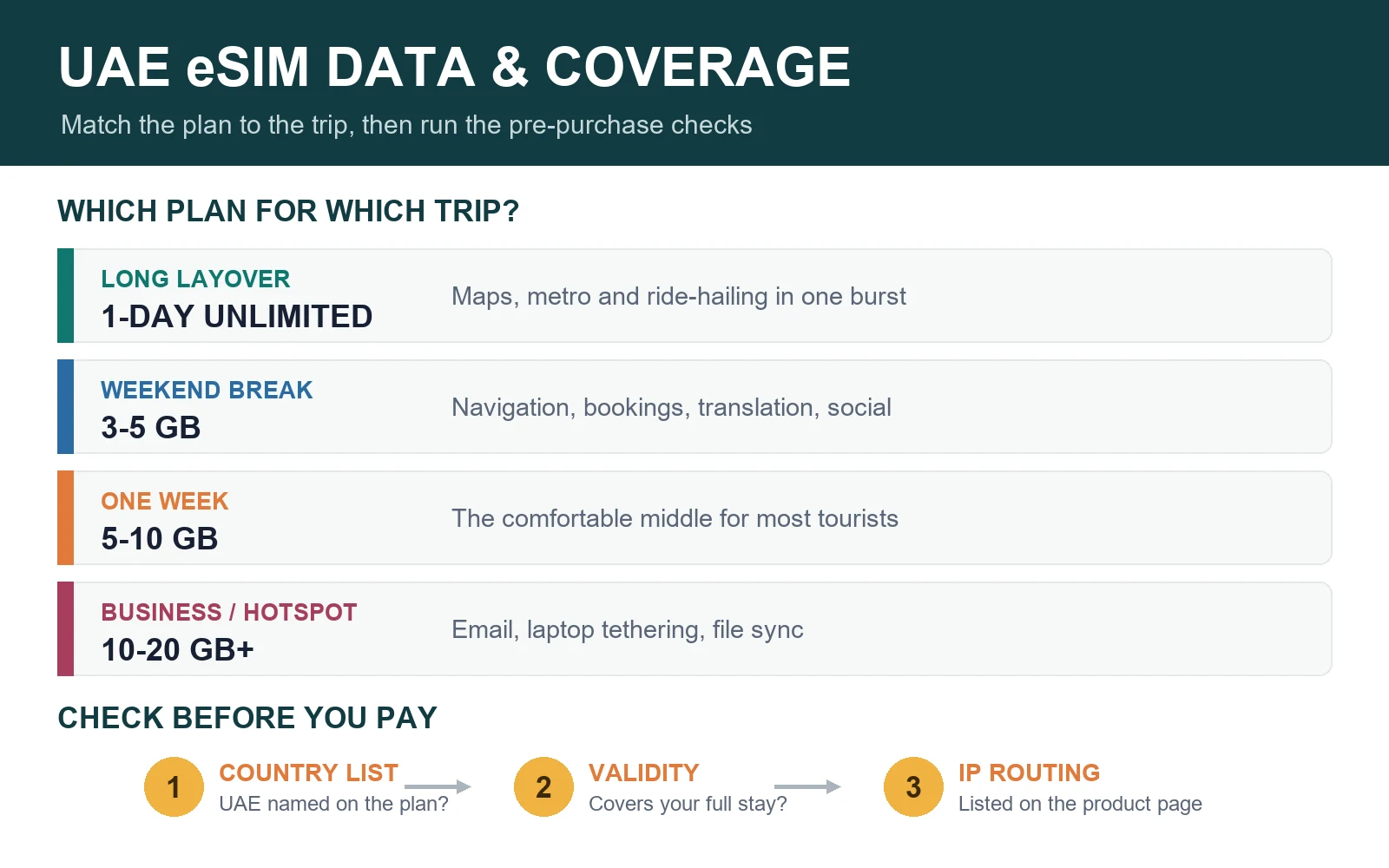
Data sizes by trip type
| Trip type | Typical use | Suggested plan |
|---|---|---|
| Long layover | Maps, metro, ride-hailing, messaging | 1-day unlimited, or 1 GB |
| Weekend break | Navigation, bookings, social posts, translation | 3–5 GB |
| One-week holiday | All of the above plus photo sharing and browsing | 5–10 GB |
| Business trip | Email, calls over data, laptop hotspot, file sync | 10–20 GB with hotspot support |
| Long stay or remote work | Heavy daily use, video calls, tethering | 20 GB+ or an unlimited option |
Calling apps in the UAE: what travelers should know
This is the question visitors ask most often about the UAE, and it deserves a careful answer rather than a promise.
The UAE regulates voice and video calling delivered over the internet. Which services are permitted, and under what conditions, is set by the national telecom regulator (the TDRA) and has changed over time. Because of that, no travel eSIM seller — including us — can guarantee that a specific calling app will work during your trip.
What you can do:
- Check the current position before you travel on official UAE government or TDRA sources, which are the only authoritative reference.
- Have a fallback. Regular phone calls over your home SIM always work (at your carrier’s roaming voice rate), and locally licensed calling apps are an alternative many residents and visitors use.
- Read the IP routing line on the product page. Travel eSIMs connect through a partner network, and some route data through an overseas gateway rather than a local one. Our UAE plans list this field explicitly — several route via the UK, Ireland or Western Europe. This is a technical property of the plan, not a guarantee about any particular app or service.
- Do not rely on a single channel for anything critical. Agree with family or colleagues on a backup contact method before you fly.
Text messaging over the internet — WhatsApp messages, iMessage, email, social apps — is not the same as voice and video calling, and is generally not the subject of these rules.
eSIM vs roaming vs a local SIM in the UAE
| Option | Best for | Trade-off |
|---|---|---|
| Travel eSIM | Tourists, layovers, business trips; instant setup | Data-only; no local UAE number unless stated |
| Home carrier roaming | Very short trips, or if roaming is already included | Day passes commonly run US$10–16 per day |
| Local tourist SIM | Longer stays; travelers who need a UAE number | Requires ID registration and a shop or kiosk visit |
For a week in Dubai, a roaming day pass at roughly $12 per day is about $84, while a comparable travel eSIM is typically a fraction of that. Our roaming vs eSIM cost comparison shows the full math.
Setup: install before you fly
- Check your phone supports eSIM and is carrier-unlocked — see the compatibility check guide.
- Buy and install over Wi-Fi before departure, following the installation guide. Airport Wi-Fi is often too weak to download a profile reliably.
- Keep your home SIM in the phone for calls and bank verification texts, with its data roaming switched off.
- After landing, select the eSIM as your data line and enable data roaming for that line — this is what lets it connect to the local partner network.
If it does not connect immediately, work through the eSIM troubleshooting checklist — the fix is usually one toggle.
Common mistakes to avoid
- Buying only for Dubai when your trip includes Oman or Saudi Arabia. Check the country list, or choose a regional plan that covers the full route.
- Underestimating a layover. Navigation plus ride-hailing plus translation burns through a tiny bundle faster than expected.
- Installing at the airport. Install on stable Wi-Fi before you fly.
- Assuming calling apps behave as they do at home. See the section above and have a fallback.
- Deleting the eSIM mid-trip. Most QR codes install once only and cannot be reinstalled.
UAE eSIM FAQ
How much data do I need for a week in Dubai?
For most tourists, 5 to 10 GB covers a week of maps, ride-hailing, bookings, translation, messaging and social posts. Choose more if you upload video, use a laptop hotspot or make frequent video calls.
Is an eSIM better than roaming for a Dubai trip?
Usually yes on cost. Carrier roaming day passes commonly run US$10 to 16 per day, so a week is around $84, while a comparable travel eSIM is typically far less. Roaming can still make sense for a very short trip or if your plan already includes it.
Can I use WhatsApp calling in the UAE?
The UAE regulates voice and video calling over the internet, and the rules have changed over time, so no seller can guarantee that a specific app will work. Check current official UAE or TDRA guidance before you travel, and keep a fallback such as regular calls on your home SIM. Text messaging over apps is generally treated differently from voice and video calling.
Does a UAE travel eSIM give me a local phone number?
Most travel eSIMs are data-only and do not include a UAE number unless the product page says so. Keep your home SIM active for calls and verification codes while data runs through the eSIM.
Will my eSIM work in both Dubai and Abu Dhabi?
Yes. A plan that covers the United Arab Emirates works across the emirates, including Dubai, Abu Dhabi and Sharjah, on the same profile. There is nothing to change when you travel between them.
What is the best eSIM plan for a Dubai layover?
For a long layover where you leave the airport, a 1-day unlimited plan is usually better value than a small fixed bundle, because navigation and ride-hailing are used intensively over a short window. Install it before your inbound flight so it is ready on arrival.
Bottom line
For most UAE trips, buy a data-only travel eSIM sized to the trip — a 1-day unlimited plan for a layover, 3 to 5 GB for a weekend, 5 to 10 GB for a week — install it on Wi-Fi before departure, and keep your home SIM for calls with its data roaming off. Check the country list and the IP routing line on the product page before paying, and verify current UAE guidance on internet calling if that matters to your trip.
Ready to compare? Start with UAE eSIM data plans. Continuing your journey? See eSIM plans for Europe, Thailand, Japan and all destinations. New to eSIMs? Start with what is an eSIM and how it works.
Last reviewed July 24, 2026. Coverage, plan terms and IP routing vary by provider and are listed on each product page. Rules on internet-based calling in the UAE are set by the national regulator and can change — confirm current guidance from official UAE government sources before you travel. Device support varies by phone model; see Apple Support: Use eSIM while traveling internationally.