
Looking for a data eSIM Thailand plan before your trip? This guide explains how to choose a Thailand eSIM for Bangkok, Phuket, Chiang Mai, islands and multi-city travel in 2026. The goal is simple: arrive with mobile data ready, avoid airport SIM queues, and know what to check before paying.
Thailand is one of the easiest destinations for mobile data, but travelers still run into the same problems: buying too little data, installing the eSIM too late, choosing a plan that does not support hotspot, or discovering that the phone is locked. Use this guide as a practical checklist before you choose an eSIM for Thailand travel.
Quick answer: what is the best Thailand eSIM for travel?
The best Thailand eSIM is the plan that matches your trip length, expected data use, device compatibility and hotspot needs. For most tourists, a prepaid data-only Thailand travel eSIM is enough for maps, translation, ride-hailing, hotel check-in, messaging, social media and light browsing.
A good starting point:
- Short city trip, 3 to 5 days: 3GB to 5GB can work for maps, messaging and light browsing.
- One-week Thailand trip: 5GB to 10GB is safer for Bangkok plus Phuket, Chiang Mai or island travel.
- Two weeks or more: 10GB to 20GB gives more room for photos, short videos, hotspot and work apps.
- Remote work or frequent video: choose a larger data plan and confirm hotspot support before purchase.
If you are comparing search results for Thailand data eSIM, data eSIM Thailand or eSIM data Thailand, focus less on the headline price and more on coverage, validity, activation rules, hotspot policy and whether your phone is unlocked.
Why use a Thailand eSIM instead of buying a SIM card after arrival?
A travel eSIM is useful because you can buy online and install the digital SIM profile without handling a physical card. You can keep your home SIM in the phone for calls, banking verification or emergency SMS while using the Thailand eSIM for mobile data.
Compared with buying a local tourist SIM at the airport or in a shop, an eSIM can save time after a long flight. It also avoids swapping tiny SIM cards in a taxi queue or hotel lobby. Local physical SIM cards can still be a good option for travelers who need a Thai phone number, but many tourists only need data.
Thailand eSIM coverage: Bangkok, Phuket, Chiang Mai and islands
Most travelers use mobile data heavily in the same places: Bangkok, Phuket, Chiang Mai, Pattaya, Krabi, Koh Samui, Koh Phangan and other beach or island routes. In major cities and popular tourist zones, mobile data is usually practical for maps, messaging and bookings. In rural areas, mountain routes, ferries, national parks and smaller islands, speed and signal can vary by local network and terrain.
Before you buy, check whether the plan page clearly lists Thailand as the destination. If the plan is a regional Asia eSIM, confirm that Thailand is included and that the validity covers your full itinerary.
Start from the destination page here: Thailand eSIM data plans.
How much data do you need in Thailand?
Your Thailand eSIM data need depends on how you travel. Navigation and messaging are light. Video, cloud backup and hotspot are heavy. Hotels, cafes and coworking spaces often provide WiFi, but you should not rely on public WiFi for every ride, booking or payment moment.
| Traveler type | Typical use | Suggested data range |
|---|---|---|
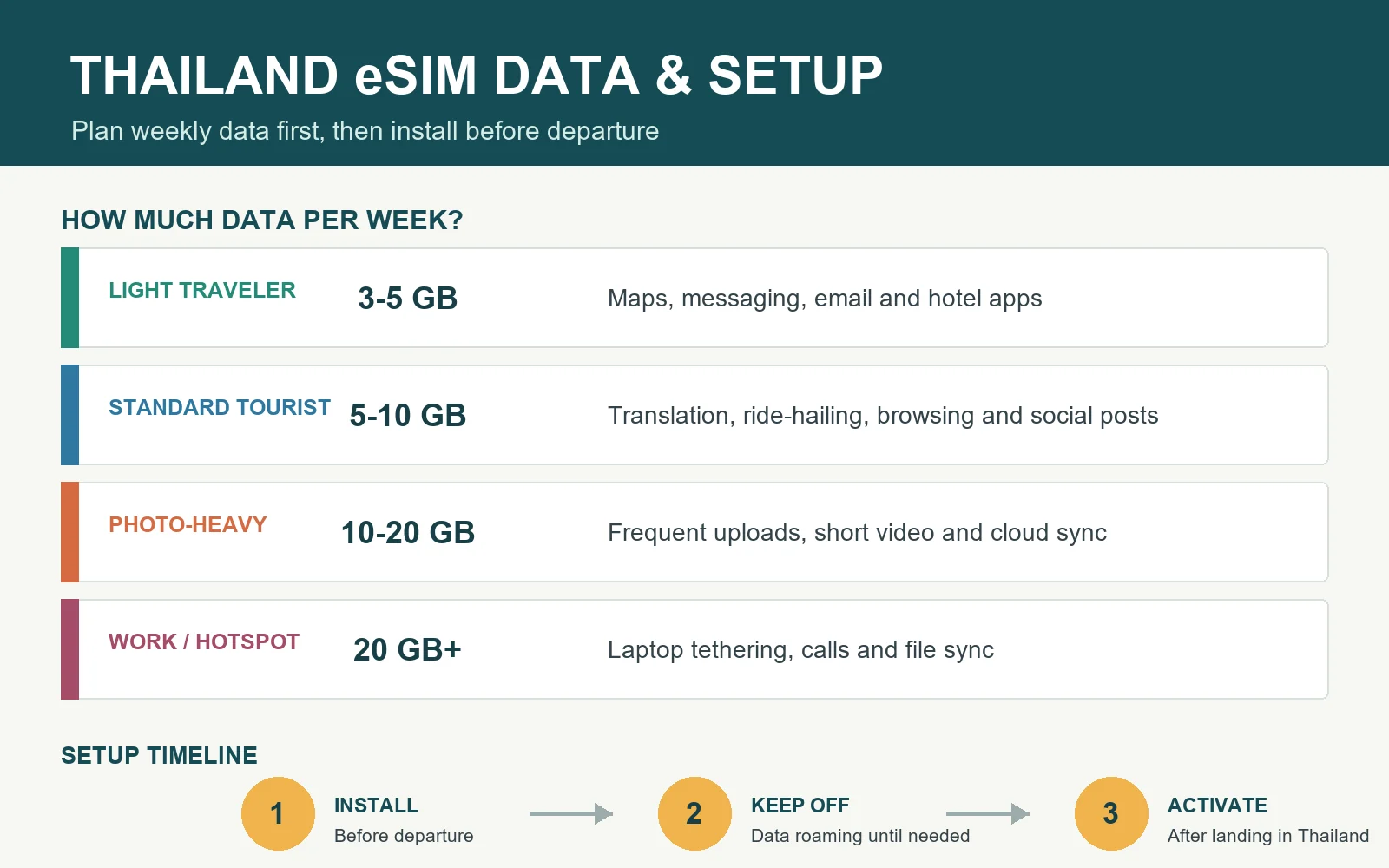
| Light traveler | Maps, WhatsApp, Line, email, hotel apps | 3GB to 5GB per week |
| Standard tourist | Maps, translation, social posts, ride-hailing, browsing | 5GB to 10GB per week |
| Photo-heavy traveler | Frequent uploads, reels, short video, cloud sync | 10GB to 20GB |
| Work or hotspot user | Laptop tethering, calls, file sync, coworking backup | 20GB or larger, if available |
Tip: turn off automatic photo/video backup on mobile data unless you deliberately bought a larger plan. Streaming one long video session can use more data than a full day of maps and messaging.
When should you install your Thailand travel eSIM?
In most cases, install the eSIM while connected to reliable WiFi before your flight, then turn on the Thailand eSIM data line after landing. This avoids trying to scan a QR code with unstable airport WiFi. However, always check the product details because some plans start their validity at installation, while others start at first network connection.
Use this setup flow:
- Check that your phone supports eSIM and is carrier unlocked.
- Buy the Thailand eSIM before departure.
- Install on WiFi using the QR code or manual activation details.
- Keep your home SIM as the default line for calls or SMS if needed.
- After arrival in Thailand, choose the travel eSIM for mobile data.
- Enable data roaming if the provider instructions require it.
For step-by-step setup, use the eSIM installation guide.
Phone compatibility checklist
Do not buy any eSIM until your phone passes these checks:
- The phone supports eSIM.
- The phone is carrier unlocked.
- You can see an EID or an Add eSIM option in settings.
- Your operating system is updated enough to install an eSIM profile.
- The plan supports your destination and device type.
iPhone users should also pay attention to purchase region. Some iPhones sold in mainland China have special eSIM rules. If you are unsure, read the mainland China iPhone eSIM support guide before buying a Thailand plan.
For a broader device check, start with the eSIM compatibility checklist.
Thailand eSIM vs pocket WiFi vs local SIM
| Option | Best for | Trade-off |
|---|---|---|
| Thailand eSIM | Solo travelers, couples, fast setup, keeping home SIM active | Usually data-only; no local phone number unless stated |
| Local physical SIM | Travelers who need a Thai phone number or in-person setup | Requires SIM swap, shop visit and registration process |
| Pocket WiFi | Groups sharing one connection | Extra device to charge, carry and return |
| International roaming | Maximum convenience through home carrier | Can be expensive or limited after fair-use thresholds |
If you are deciding between eSIM and pocket WiFi for a family or group trip, read the broader comparison: eSIM vs Pocket WiFi for international travel.
Bangkok, Phuket and Chiang Mai use cases
Bangkok
Bangkok is where mobile data is most useful from the first hour. You may need data for airport transfer, ride-hailing, BTS/MRT routes, hotel check-in, maps, restaurant bookings and mobile payments. A Thailand eSIM installed before arrival is especially convenient at Suvarnabhumi or Don Mueang airport.
Phuket, Krabi and islands
Beach and island trips often involve ferries, taxi apps, tour operators and hotel transfers. Coverage can be strong in tourist zones and weaker on boats, remote beaches or hilly areas. Download offline maps and keep booking details saved locally.
Chiang Mai and northern Thailand
Chiang Mai city is usually straightforward for mobile data, but mountain roads, villages and national parks can vary. If you plan to use maps on scooter routes or day trips, choose a plan with enough data and keep offline navigation ready.
Common mistakes to avoid
- Buying by price only: check validity, destination coverage and activation rules.
- Installing too late: install on stable WiFi before travel unless the plan says validity starts immediately.
- Ignoring hotspot: if you need laptop data, confirm hotspot support before purchase.
- Forgetting roaming: many travel eSIM profiles require data roaming to be enabled for that line.
- Deleting the eSIM too soon: some QR codes are single-use and cannot be reinstalled after deletion.
Thailand eSIM FAQ
Is a Thailand eSIM good for tourists?
Yes. A Thailand eSIM is practical for tourists who mainly need mobile data for maps, messaging, ride-hailing, translation, hotel apps and travel research.
Does a Thailand eSIM include a Thai phone number?
Most travel eSIMs are data-only unless the product page clearly says calls, SMS or a local number are included.
Can I use hotspot with a Thailand eSIM?
Sometimes. Hotspot support depends on the provider and plan. Check the product page before buying if laptop tethering matters.
Can I install the eSIM before flying to Thailand?
Usually yes, and it is often safer to install on WiFi before departure. Check whether validity starts at installation or first network connection.
What if my eSIM does not connect after landing?
Check that the Thailand eSIM is selected for mobile data, data roaming is enabled if required, airplane mode has been toggled off and on, and the APN instructions match the provider guide. If it still fails, contact support with screenshots and your device model.
Bottom line
For most travelers, the best Thailand eSIM in 2026 is a prepaid data plan that covers your full trip, supports your unlocked phone, and gives enough data for maps, messaging, booking apps and occasional hotspot. A 5GB to 10GB plan is a sensible middle ground for many one-week tourist trips; heavier users should choose more.
Ready to compare plans? Start with Thailand eSIM for travel. If Thailand is part of a wider Asia itinerary, also check nearby guides for Japan eSIM, Korea eSIM and China eSIM.
Sources reviewed July 9, 2026: Tourism Authority of Thailand, True-dtac tourist SIM information, and Apple Support: Use eSIM while traveling internationally. Network availability, device support and plan terms can change by provider and location.