
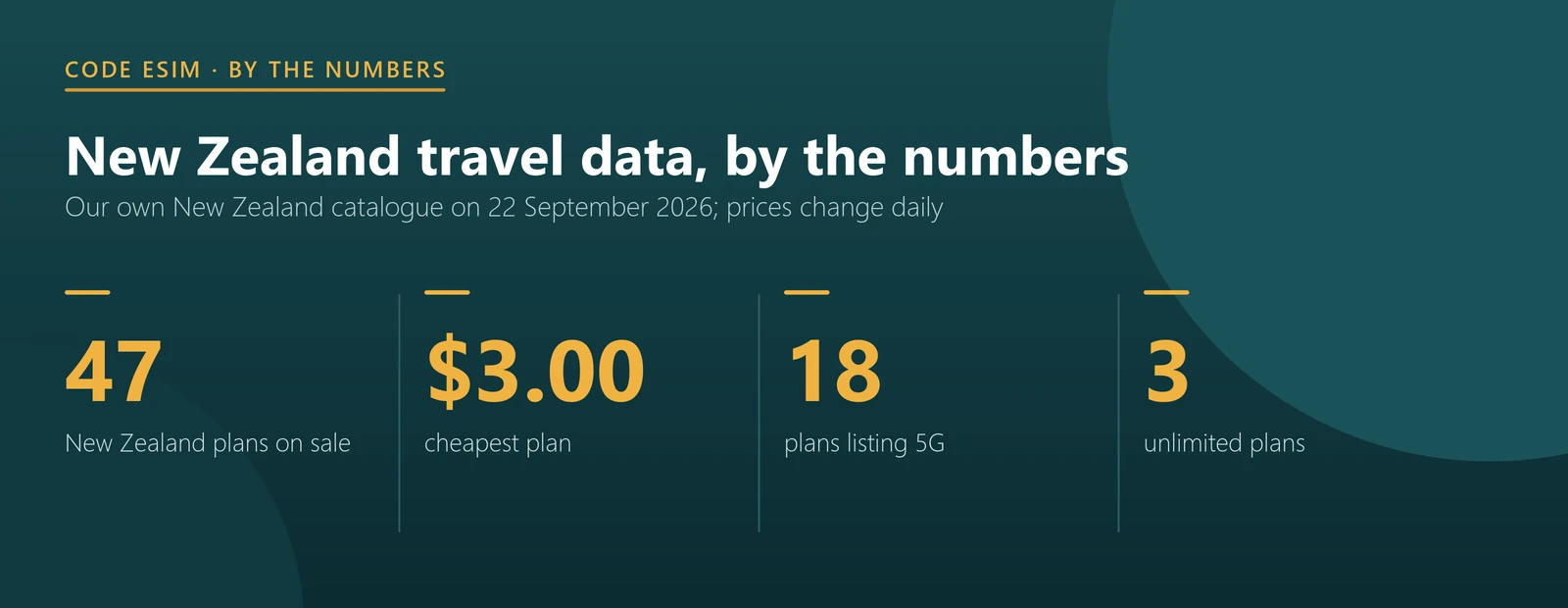
For two weeks in New Zealand, most travellers need 10–20 GB, and a travel eSIM lands on One NZ, Spark or 2degrees — the same three networks a local SIM uses. Our catalogue has 47 New Zealand plans as of 22 September 2026, starting at $3.00, with 18 of them offering 5G and 3 offering unlimited data.
New Zealand is a driving country. Very few visitors stay in one city — the trip is Auckland to Rotorua, or Queenstown to Milford Sound, or three weeks in a campervan working down both islands. That shapes everything: your data gets spent on navigation, weather, campsite bookings and checking whether a pass is open, often in places where the nearest town is an hour away.
It also means the honest headline is about coverage gaps rather than speed, and we will get to that before recommending anything.
- Two weeks for most people: 10–20 GB, with navigation running most days.
- Networks: One NZ, Spark or 2degrees, depending on the plan.
- Prices: from $3.00, with plans up to 40 GB and up to 365 days.
- 5G: 18 of our 47 New Zealand plans include it, concentrated in the main centres.
- Going to Australia too? Our Australia + NZ 20 GB plan is $19.94 against $19.04 for NZ alone — 90 cents for a whole extra country.
If Australia is on the same trip, check the combined plan first
A large share of New Zealand itineraries include Australia, and the pricing on that combination is worth knowing before you buy anything.
| Plan | Data | Price | Covers |
|---|---|---|---|
| New Zealand 20 GB / 30 days | 20 GB | $19.04 | New Zealand only |
| Australia & NZ 20 GB / 30 days | 20 GB | $19.94 | Both countries |
| New Zealand 10 GB / 30 days | 10 GB | $10.30 | New Zealand only |
| Australia & NZ 10 GB / 30 days | 10 GB | $12.00 | Both countries |
At the 20 GB size the difference is 90 cents. At 10 GB it is $1.70. Either way, if there is any chance of a Sydney stopover or a week on the Gold Coast, the combined plan removes the decision entirely — and a trans-Tasman stopover is common enough that it is worth checking your ticket before you buy the single-country plan. Our Australia eSIM guide covers that side of the trip, including why the network you land on matters more there.
Ready to sort it out? Compare New Zealand eSIM plans — 47 of them, from $3.00 — or see Oceania plans if the trip covers both countries.
Coverage: the honest version
New Zealand’s networks cover where people live, which is not the same as where visitors go.
The main centres and the state highways between them are well served, and 5G is available in Auckland, Wellington, Christchurch and other urban areas. But the country is long, mountainous and thinly populated in exactly the places tourists drive to. Expect dead zones through parts of Fiordland, on the West Coast, over alpine passes such as the Haast, in the Catlins, and on stretches of road between South Island towns. Some of the most photographed places in the country have no signal at all.
No travel eSIM changes this, and neither does a local SIM — the towers are not there. Anyone claiming full coverage of New Zealand is describing a map of the population, not the terrain.
What actually helps is preparation rather than a bigger plan. Download offline maps for both islands before you leave a city. Save your accommodation addresses and booking references rather than relying on retrieving them later. Check road and pass conditions while you still have signal, especially in winter. And if you are freedom camping or hiking, treat a personal locator beacon — which most outdoor hire shops rent — as the safety device, not your phone.
How much data do you need in New Zealand?
Size the plan from behaviour, not fear. A normal tourist uses 500 MB to 1 GB a day, but New Zealand pushes the navigation component up: you are driving most days, often for hours, with maps and weather running.
| Trip length | Light: cities, Wi-Fi at night | Normal tourist | Heavy: video, hotspot, working |
|---|---|---|---|
| 1 week | 3–5 GB | 5–10 GB | 15–20 GB |
| 2 weeks | 5–10 GB | 10–20 GB | 30–40 GB |
| 3 weeks or campervan | 10–15 GB | 20–30 GB | 40 GB or unlimited |
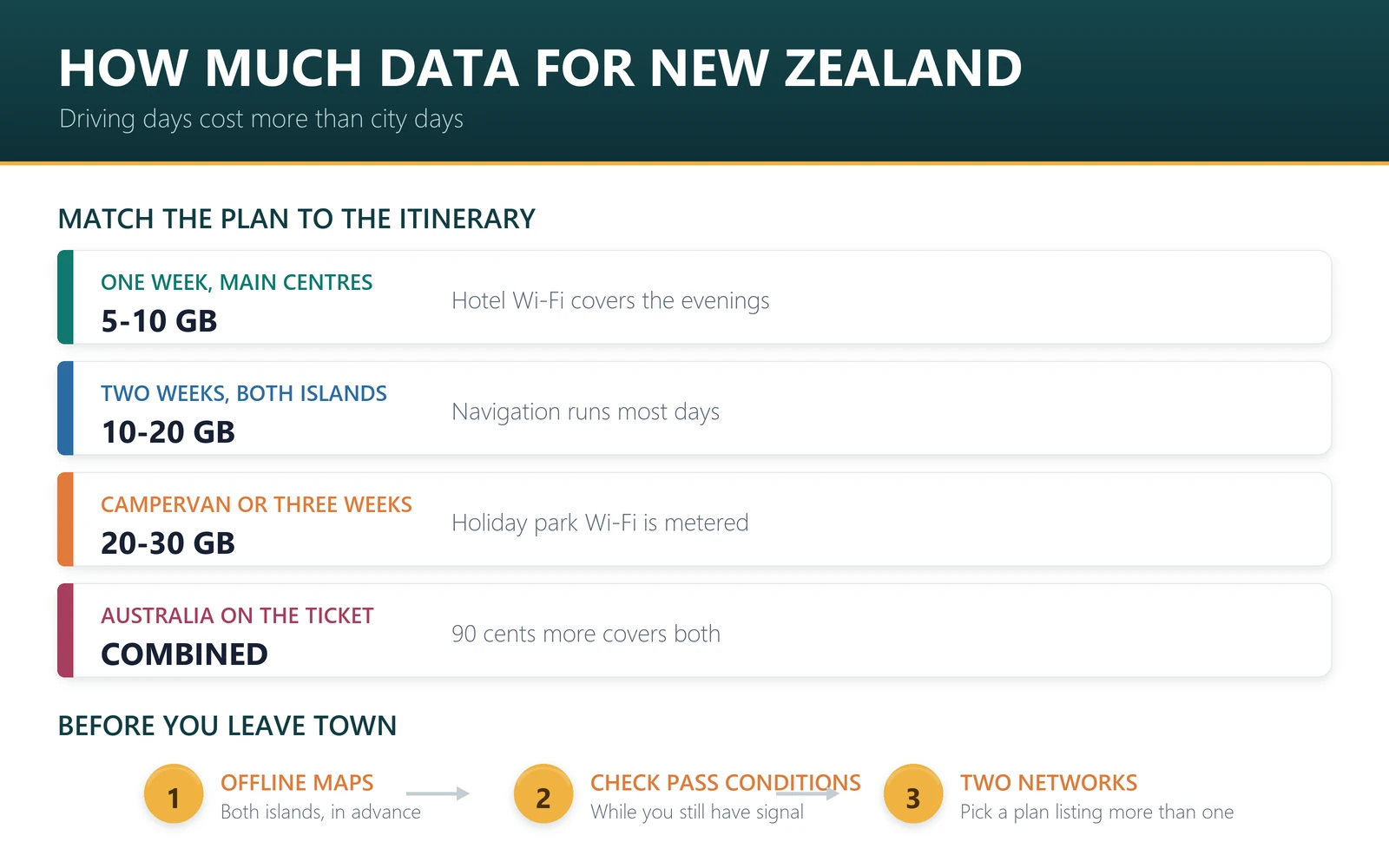
Campervan travellers should size up. Holiday park Wi-Fi is often metered, slow or charged per device, so you will lean on mobile data far more than a hotel-based traveller would. Add roughly 30% margin on top of the table, and if you run short you can top up an active eSIM without reinstalling anything.
Which New Zealand network will you land on?
| Network | Tech | Share of our New Zealand plans |
|---|---|---|
| One NZ | 5G | 30 of 47 plans (64%) |
| Spark | 5G | 24 of 47 plans (51%) |
| 2degrees | 5G | 11 of 47 plans (23%) |
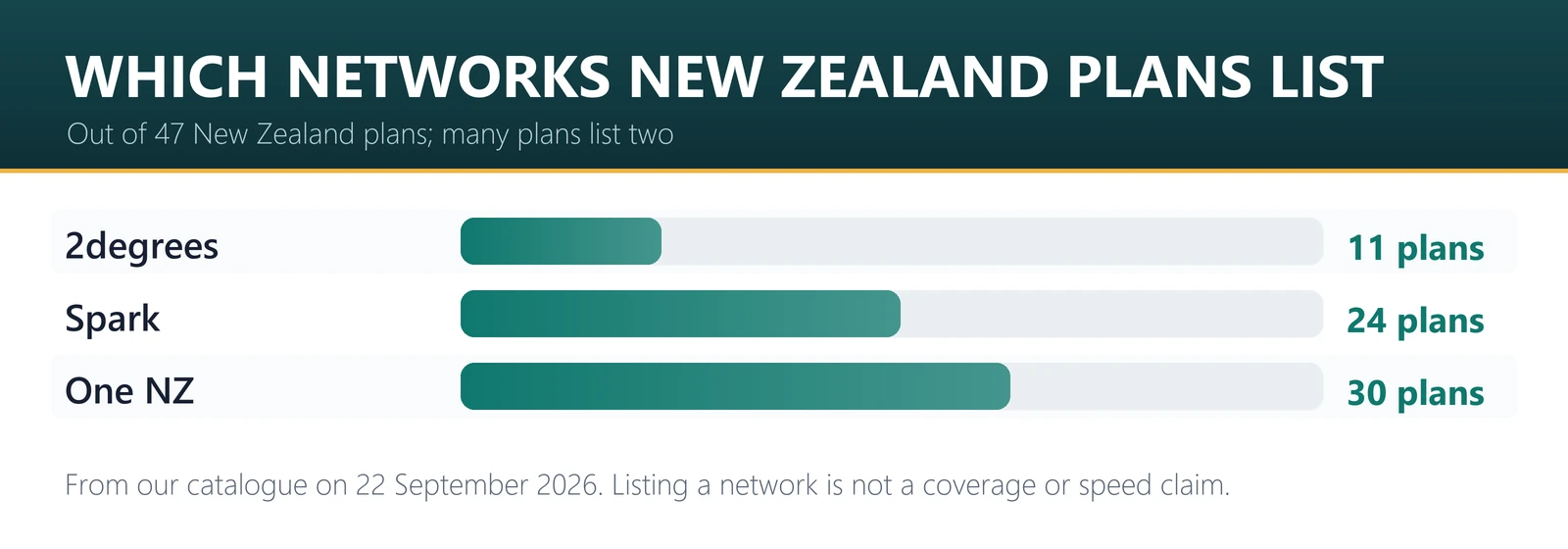
One NZ and Spark have the broadest rural reach; 2degrees is strongest in urban areas. On a trip that leaves the cities — which is most New Zealand trips — prefer a plan listing more than one network, so the profile can select whichever has a tower on that stretch of highway. Each plan page states which networks it uses.
When you should not buy a travel eSIM
If you are staying more than a month, working here, or need a New Zealand number for bookings and deliveries, buy a local prepaid SIM. They are sold in supermarkets and phone shops, they are inexpensive, and a local number is genuinely useful for calling DOC campsites, i-SITE offices and small operators who may not answer an overseas number.
For a one to three week trip where you need maps, weather, bookings and the ability to be reached on your own number, the travel eSIM is simpler — and it works from the moment you land at Auckland or Christchurch rather than after a queue.
Choosing a plan by trip type
| Trip | What to buy | Why |
|---|---|---|
| Stopover or a few days | 1 GB / 14 days | Maps and messages for a short stay. |
| One week, main centres | 5 GB / 30 days | Comfortable with hotel Wi-Fi in the evenings. |
| Two weeks, both islands | 10 GB / 30 days | The standard trip, with navigation running most days. |
| Campervan or three weeks | 20 GB / 30 days | Holiday park Wi-Fi is metered; you will use mobile data. |
| Short trip, no counting | Unlimited / 10 days | One of our three unlimited New Zealand plans. |
| Australia on the same ticket | Australia & NZ 20 GB / 30 days | 90 cents more than NZ alone, covers both countries. |
How to install and activate
Buy before you fly, install on home Wi-Fi, and leave the profile switched off until you land. Installation needs internet; activation does not.
iPhone: open the QR code email on a second screen, then Settings → Cellular → Add eSIM → Use QR Code. Keep your home line as the default for calls and texts, and switch mobile data to the travel plan after landing.
Android: Settings → Network & internet → SIMs → Add eSIM, then scan the same code. Samsung, Pixel and Xiaomi word it slightly differently; the flow is the same.
Most of our New Zealand plans start counting validity on first data use rather than at purchase, so installing early does not burn days — each plan page states its policy. Your own number stays reachable on your primary SIM, which is the main reason to use a travel eSIM rather than swapping to a local SIM. Check the phone is carrier-unlocked and eSIM-capable on our compatibility list first, and if it does not connect, the troubleshooter covers the usual causes.
Frequently asked questions
Does a New Zealand eSIM work in Australia?
Not unless the plan lists Australia. A New Zealand-only plan stops at the border. Combined Australia and NZ plans exist and cost very little more — 90 cents at the 20 GB size — so check your itinerary before buying a single-country plan.
Is there mobile coverage in Fiordland and on alpine passes?
Often not. Parts of Fiordland, the West Coast, alpine passes and stretches between South Island towns have no signal from any operator. Download offline maps and check road conditions while you still have coverage.
How much data do I need for two weeks in New Zealand?
Most travellers land between 10 and 20 GB. Navigation runs for hours on driving days, which is most days here. Campervan travellers should size up because holiday park Wi-Fi is usually metered or slow.
Which network is best in New Zealand?
One NZ and Spark have the broadest rural reach; 2degrees is strongest in cities. For road trips, choose a plan listing more than one network so the profile can pick whichever has a tower on that stretch.
Do you have unlimited plans for New Zealand?
Yes, three, with validity from 5 to 15 days. They suit short trips where you would rather not track usage. For a two or three week trip, a 20 GB metered plan is usually better value.
Can I use it in a campervan as a hotspot?
Most of our New Zealand plans support hotspot sharing, and each plan page states it. Tethering several devices in a van consumes quickly, so size up — 20 GB or more is realistic for a two-week campervan trip.
When does the validity period start?
On most of our New Zealand plans, on first data use rather than at purchase, so you can install days ahead. Each plan page states its activation policy, so check there rather than assuming.
Plan counts, prices and network shares here are from our own catalogue on 22 September 2026. Prices move daily with supplier pricing, so the comparison figures above are a snapshot — re-check them against the New Zealand plans page before buying. Coverage descriptions reflect each operator’s published rural reach, not a guarantee of signal at a specific spot.
New Zealand is the trip where the plan matters less than the preparation. Buy something that lists two networks, size it for the driving, download the maps before you leave town, and accept that the best views come with no bars.