
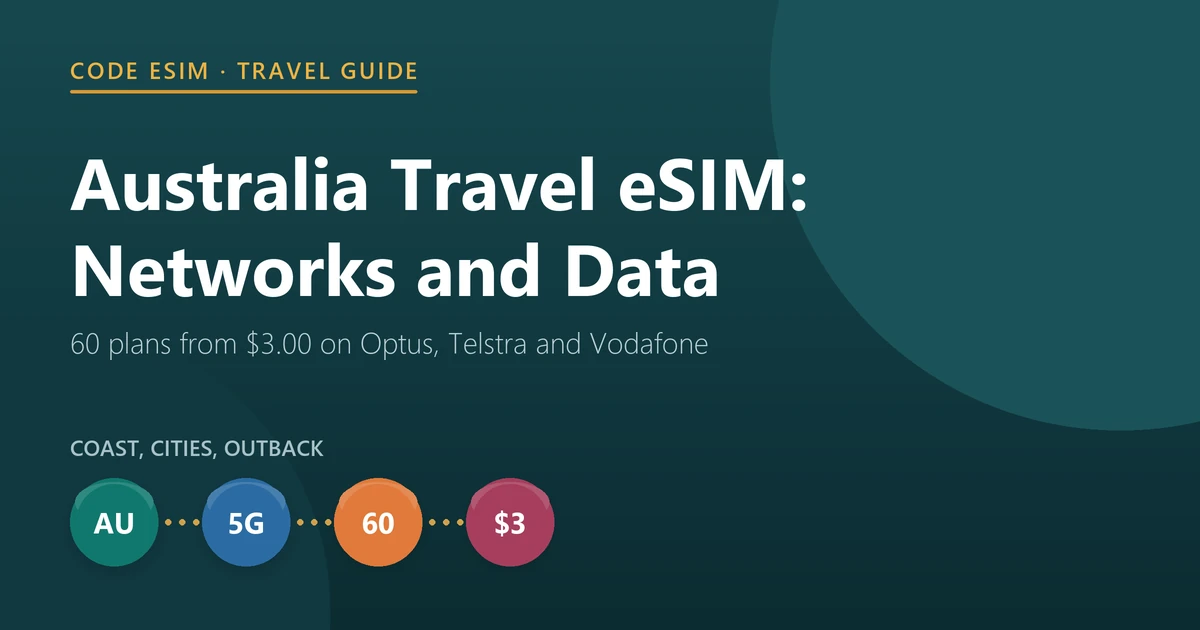
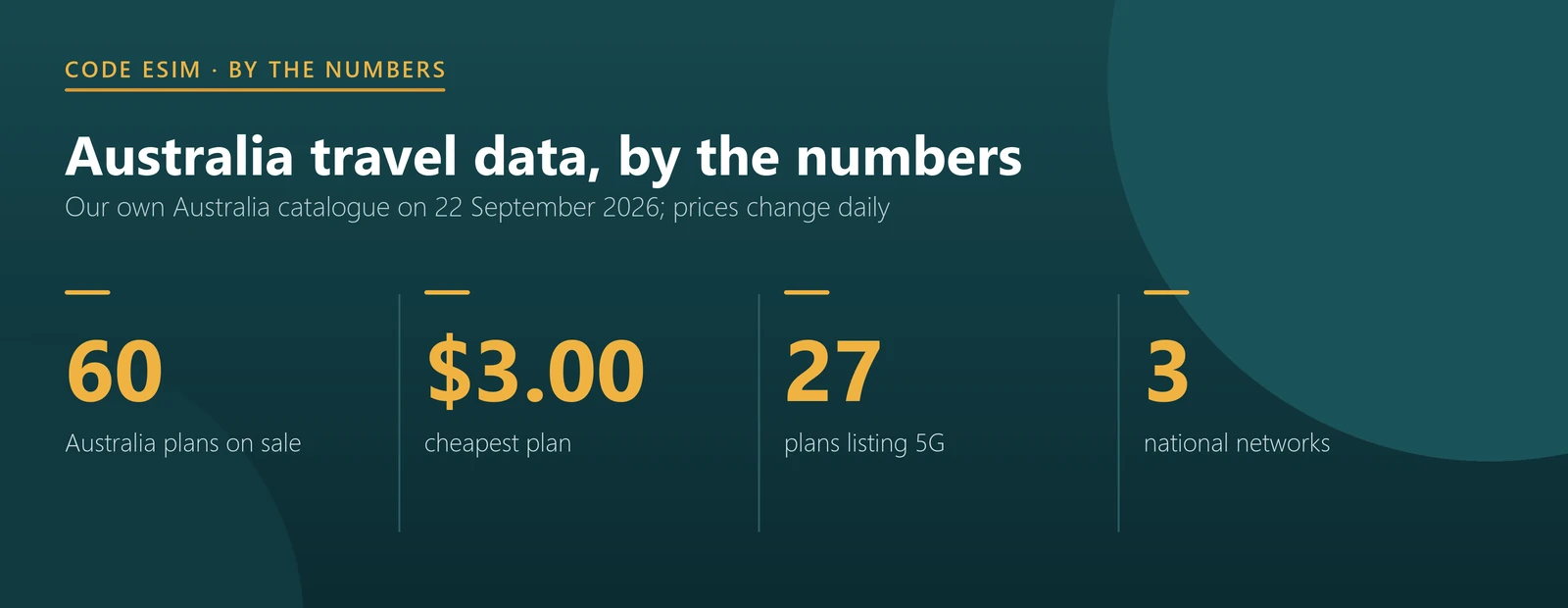
For two weeks in Australia, most travellers need 10–20 GB, and a travel eSIM lands on Optus, Telstra or Vodafone — the same three networks a local SIM uses. Our catalogue has 60 Australia plans as of 22 September 2026, starting at $3.00, with 27 of them offering 5G where the network provides it.
Australia punishes bad connectivity planning more than most destinations, because of distance. Sydney to Perth is a five-hour flight — further than London to Cairo. The Great Ocean Road, the Blue Mountains and the drive to Uluru all put you hours from a town. Data stops being about Instagram and starts being about which petrol station is still open, whether the road is closed for bushfire, and how far the next town actually is.
- Two weeks for most people: 10–20 GB, or 2–3 GB a day if video and hotspot are part of your routine.
- Networks: Optus, Telstra or Vodafone, depending on the plan you buy.
- Prices: from $3.00, with plans up to 50 GB and up to 365 days.
- 5G: 27 of our 60 Australia plans include it where available.
- 3G is gone: Australia switched off its 3G networks in 2024. A phone without VoLTE will not connect, no matter whose eSIM you buy.
How much data do you need in Australia?
Size the plan from behaviour, not fear. A normal tourist uses 500 MB to 1 GB a day: maps, messaging, translation, a few uploads. Video changes that, and hotspotting a laptop changes it again. Australian trips also run long — two and three week itineraries are the norm, not the exception — so the daily figure compounds.
| Trip length | Light: maps, chat, hotel Wi-Fi at night | Normal tourist | Heavy: video, hotspot, working |
|---|---|---|---|
| 1 week | 3–5 GB | 5–10 GB | 15–20 GB |
| 2 weeks | 5–10 GB | 10–20 GB | 30–50 GB |
| 1 month | 10–20 GB | 20–30 GB | 50 GB or unlimited |
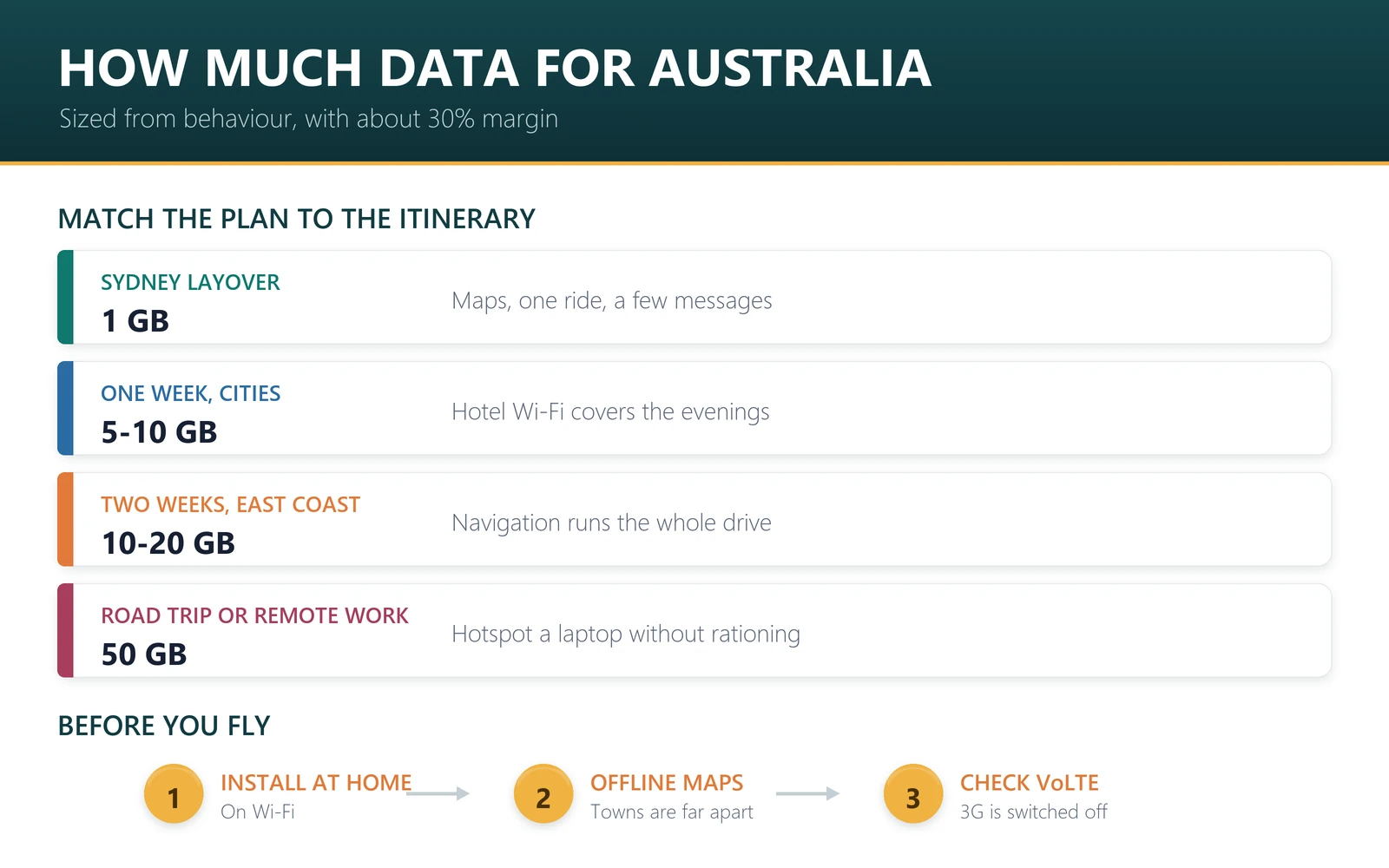
Add roughly 30% margin. Australian accommodation Wi-Fi is inconsistent once you leave the capital cities, and a caravan park with a 2 GB nightly cap will push you back onto mobile data exactly when you assumed you would be offloading. If you are hiring a car, add more: navigation runs the whole time you drive, and offline maps of a state the size of Queensland are large downloads in themselves.
Running out mid-trip is not a disaster — you can top up an active eSIM without changing anything on the phone — but it is cheaper to buy the right size once than to stack small packs.
Ready to sort it out? Compare Australia eSIM plans — 60 of them, from $3.00 — or see Oceania if New Zealand is on the same trip.
Which Australian network will you actually land on?
This is the question that decides whether your trip works, and most eSIM listings hide it. Australia has three mobile networks. Everything else — Boost, Amaysim, Aldi Mobile, Woolworths — is a reseller on top of one of them.
| Network | Tech | Share of our Australia plans |
|---|---|---|
| Optus | 5G | 53 of 60 plans (88%) |
| Telstra | 5G | 11 of 60 plans (18%) |
| Vodafone | 5G | 11 of 60 plans (18%) |
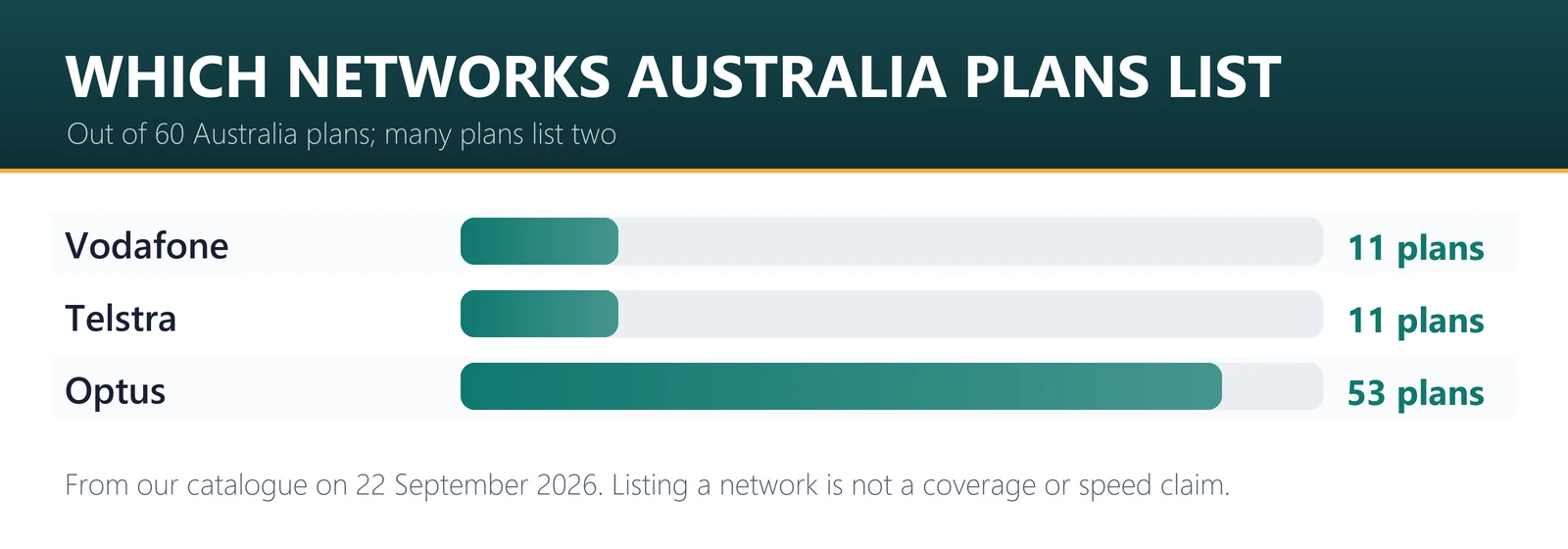
Some plans list more than one network, which is why the percentages add up past 100 — those profiles can select whichever of the three is strongest where you are standing.
In Sydney, Melbourne, Brisbane, Perth, Adelaide and along the populated coast, all three perform well and the difference is academic. You will get 5G in the CBDs and solid 4G everywhere else. Every plan page on this site lists its network in the plan details table, so you can check before paying rather than after landing — for example the 10 GB / 30 day RoamVault plan states its network and its activation policy on the page itself.
The outback is where this gets real
Here is the part most guides skip, and it is the reason to read the network table above rather than sorting by price.
Telstra has spent decades building coverage into regional and remote Australia, and it still reaches places the other two do not. Optus is strong in cities and along major highways but thins out faster inland. Vodafone is the most city-weighted of the three. So the honest position is this: if your trip is Sydney, Melbourne, Cairns and the coast, any of our Australia plans is fine. If you are driving the Stuart Highway, crossing the Nullarbor, or staying on a remote property, a Telstra-based plan is materially better — and there are only eleven of those in our catalogue.
Two things follow from that. First, filter by network, not by price, if remote travel is on the itinerary. Second, no prepaid travel plan of any brand gives you continuous coverage in the red centre, because the towers are not there. Download offline maps before you leave a town, tell someone your route, and treat satellite messaging — not a data plan — as the actual safety layer if you are going properly remote.
That is also the case where we would tell you not to buy from us: if your trip is mostly remote-area driving and you need the widest possible coverage with voice calls included, a local Telstra prepaid SIM bought at an airport or a Telstra shop will beat every travel eSIM, including ours. Travel eSIMs win on price, on instant delivery and on keeping your own number reachable — not on outback reach.
Australia switched off 3G — check your phone before you fly
Australia’s three carriers closed their 3G networks during 2024. Nothing runs on 3G there any more, and the fallback that used to rescue old or unlocked-from-another-market handsets simply does not exist.
Practically, this means your phone needs to support 4G or 5G on Australian bands and it needs VoLTE, because voice calls now run over the data network. Most phones sold since roughly 2019 are fine. The ones that are not tend to be older handsets, or models bought in a different region whose band support does not fully match. Check the bands your model supports and confirm it is carrier-unlocked, then run through our device compatibility list before you buy anything.
The Australian Communications and Media Authority and each carrier publish guidance on the shutdown and on which devices are affected; if you are travelling with an older phone, check the carrier’s own page rather than trusting a retailer’s summary.
Choosing a plan by trip type
| Trip | What to buy | Why |
|---|---|---|
| Long layover in Sydney | 1 GB / 7 days | Enough for maps, a ride and messages. Do not buy a month you will not use. |
| One week, cities only | 5 GB / 30 days | Covers a normal tourist week with margin for patchy hotel Wi-Fi. |
| Two weeks, east coast | 20 GB / 30 days | The standard Australia trip. Navigation-heavy days are covered. |
| Road trip or working remotely | 50 GB / 30 days | Hotspot a laptop without rationing. Cheaper per GB than stacking packs. |
| Short trip, heavy video | Unlimited / 10 days | When you would rather not think about a counter at all. |
| Australia and New Zealand together | A regional Oceania plan | One profile for both countries beats installing two. |
If New Zealand is a separate leg rather than a side trip, compare the dedicated New Zealand plans against the regional option — sometimes two focused plans cost less than one broad one.
How to install and activate
Buy before you fly, install on home Wi-Fi, and leave the profile switched off until you land. Installation needs internet; activation does not.
iPhone: open the QR code email on a second screen, then go to Settings → Cellular → Add eSIM → Use QR Code. Once installed, leave Data Roaming on for that profile and keep your home line as the default for calls and texts. On landing, switch mobile data to the travel plan.
Android: Settings → Network & internet → SIMs → Add eSIM, then scan the same code. Wording varies by manufacturer — Samsung, Pixel and Xiaomi each phrase it slightly differently — but the flow is the same.
Most of our Australia plans start counting validity on first data use rather than at purchase, so installing early does not burn days. The plan page states which policy applies. Your own number stays reachable on your primary SIM throughout, which is the main reason to use a travel eSIM rather than swapping to a local SIM. If something does not connect on arrival, the step-by-step troubleshooter fixes the common causes in a couple of minutes, and you can check remaining data any time on the usage page.
What this costs against roaming
The comparison that matters is not eSIM against local SIM, it is eSIM against doing nothing and letting your home plan roam. Out-of-bundle roaming in Australia is charged per day or per megabyte depending on your operator, and two weeks of daily roaming fees routinely exceeds the price of a 20 GB travel plan several times over. We have written up how roaming charges actually work in 2026 if you want to check your own operator’s terms before deciding.
Travellers coming from Japan or elsewhere in Asia on the same trip may find a broader regional plan works out better than two country plans — the same logic we walk through in the Japan eSIM guide.
Frequently asked questions
Does an Australian eSIM work in New Zealand?
No. An Australia-only plan stops at the border. New Zealand needs either its own plan or a regional Oceania profile that lists both countries on the plan page. Check the coverage table before you buy if both are on the itinerary.
Which network is best for Australia?
In the cities, all three are fine and you should buy on price and data size. Outside them, Telstra reaches furthest, Optus is next, and Vodafone is the most urban. If your trip includes remote driving, choose a Telstra-based plan specifically.
Will my phone work in Australia now that 3G is off?
If it supports 4G or 5G on Australian bands and has VoLTE, yes. Phones from roughly 2019 onwards generally qualify. Older handsets, or models bought for a different region, are the risk cases — check the bands and confirm the phone is carrier-unlocked.
How much data do I need for two weeks in Australia?
Most travellers land between 10 and 20 GB. Go higher if you will hotspot a laptop, stream, or drive long distances with navigation running. Go lower only if you will genuinely be on Wi-Fi most evenings.
Can I keep my own phone number?
Yes. The eSIM is a second line for data. Your home SIM stays active for calls and texts, so verification codes still arrive. Just keep mobile data pointed at the travel plan so you do not roam by accident.
When does the validity period start?
On most of our Australia plans, on first data use rather than at purchase — so you can install days ahead. The activation policy is stated on each plan page, so check there rather than assuming.
Is a local Australian SIM cheaper?
For a long stay with heavy calling, sometimes yes, and a Telstra prepaid SIM also buys you better remote coverage. For a trip of two or three weeks where you mainly need data and want your own number to keep working, a travel eSIM is usually cheaper and takes two minutes instead of a shop visit.
Plan counts, prices and network shares here are from our own catalogue on 22 September 2026. Prices move daily with supplier pricing, so the figures are a snapshot and the Australia plans page is the live version. Network coverage claims describe each carrier’s own published footprint; for the 3G shutdown and affected devices, check the carrier’s own page rather than a retailer summary.
Australia is a country where the gap between “I have signal” and “I do not” is measured in hundreds of kilometres. Get the network right for where you are actually going, size the data for the driving rather than the sightseeing, and the rest of the trip takes care of itself.