
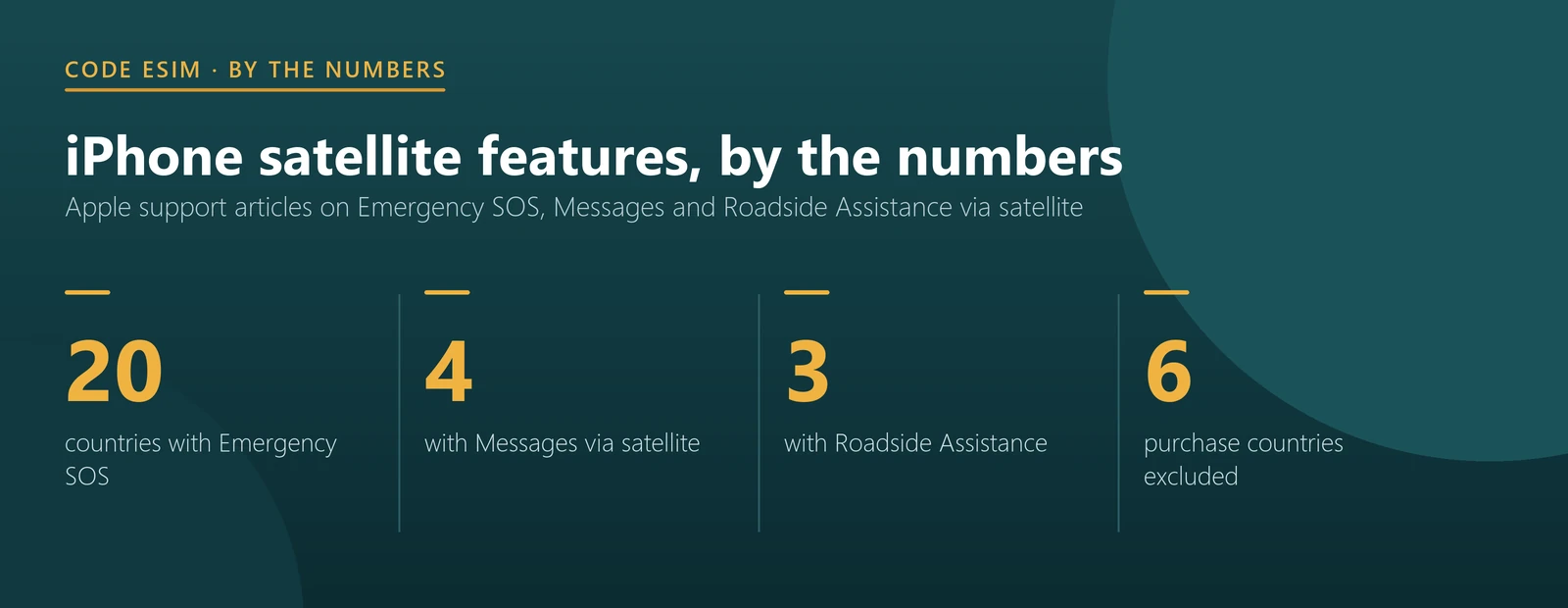
iPhone Emergency SOS via satellite works in 20 countries, and visitors can use it there too. Apple lists Andorra, Australia, Austria, Belgium, Canada, France, Germany, Iceland, Ireland, Italy, Japan, Luxembourg, Mexico, the Netherlands, New Zealand, Portugal, Spain, Switzerland, the UK and the US. Its support article says international travellers visiting one of them “can use the feature while visiting”.
The other satellite features cover far less ground. Messages via satellite works only in the US, Canada, Mexico and Japan. Roadside Assistance via satellite works only in Australia, the UK and the US. And there is a catch that has nothing to do with where you are: Apple says satellite connectivity “isn’t offered on iPhone models purchased in Armenia, Belarus, China mainland, Kazakhstan, Kyrgyzstan, and Russia”, while iPhones bought in Hong Kong and Macao get it only on iPhone 16e and later.
- Emergency SOS via satellite: 20 countries, 14 of them in Europe.
- Messages via satellite: US, Canada, Mexico, Japan.
- Roadside Assistance via satellite: Australia, UK, US (including Puerto Rico).
- Not offered at all on iPhones bought in six countries, including China mainland and Russia.
- Cost: free for two years after activating an iPhone 14 or later, per Apple.
Where each iPhone satellite feature works
From Apple’s support articles on Emergency SOS via satellite, Messages via satellite and Roadside Assistance via satellite, read on 15 September 2026. The last column is the emergency number Apple lists for calling or texting in each country.
| Country | Emergency SOS | Messages | Roadside | Emergency number |
|---|---|---|---|---|
| United States | Yes | Yes | Yes | 911 |
| Canada | Yes | Yes | No | 911 |
| Mexico | Yes | Yes | No | 911 |
| Japan | Yes | Yes | No | 110, 118, 119 |
| United Kingdom | Yes | No | Yes | 999 or 112 |
| Australia | Yes | No | Yes | 000 |
| Ireland | Yes | No | No | 999 or 112 |
| France | Yes | No | No | 112, 15, 17, 18 and others |
| Germany | Yes | No | No | 112, 110 |
| Italy | Yes | No | No | 112, 113, 115, 118, 1530 |
| Spain | Yes | No | No | 112 (call) |
| Portugal | Yes | No | No | Not listed by Apple |
| Netherlands | Yes | No | No | Not listed by Apple |
| Belgium | Yes | No | No | 100, 101 |
| Luxembourg | Yes | No | No | 112, 113, 12112, 12113 |
| Austria | Yes | No | No | 112, 133, 144 |
| Switzerland | Yes | No | No | 112 (call) |
| Andorra | Yes | No | No | 112 |
| Iceland | Yes | No | No | 112 |
| New Zealand | Yes | No | No | 111 |
Apple’s Emergency SOS coverage also extends to a list of islands and territories, including Madeira, the Azores, the Balearic and Canary Islands, Corsica, Sicily and Sardinia, the Isle of Man, Guadeloupe, Martinique, Puerto Rico, San Marino, Vatican City and the US Virgin Islands. Anywhere not in the table, including the rest of Asia, South America, Africa, the Middle East and Scandinavia outside Iceland, Apple does not list Emergency SOS via satellite as available.
The purchase-country catch
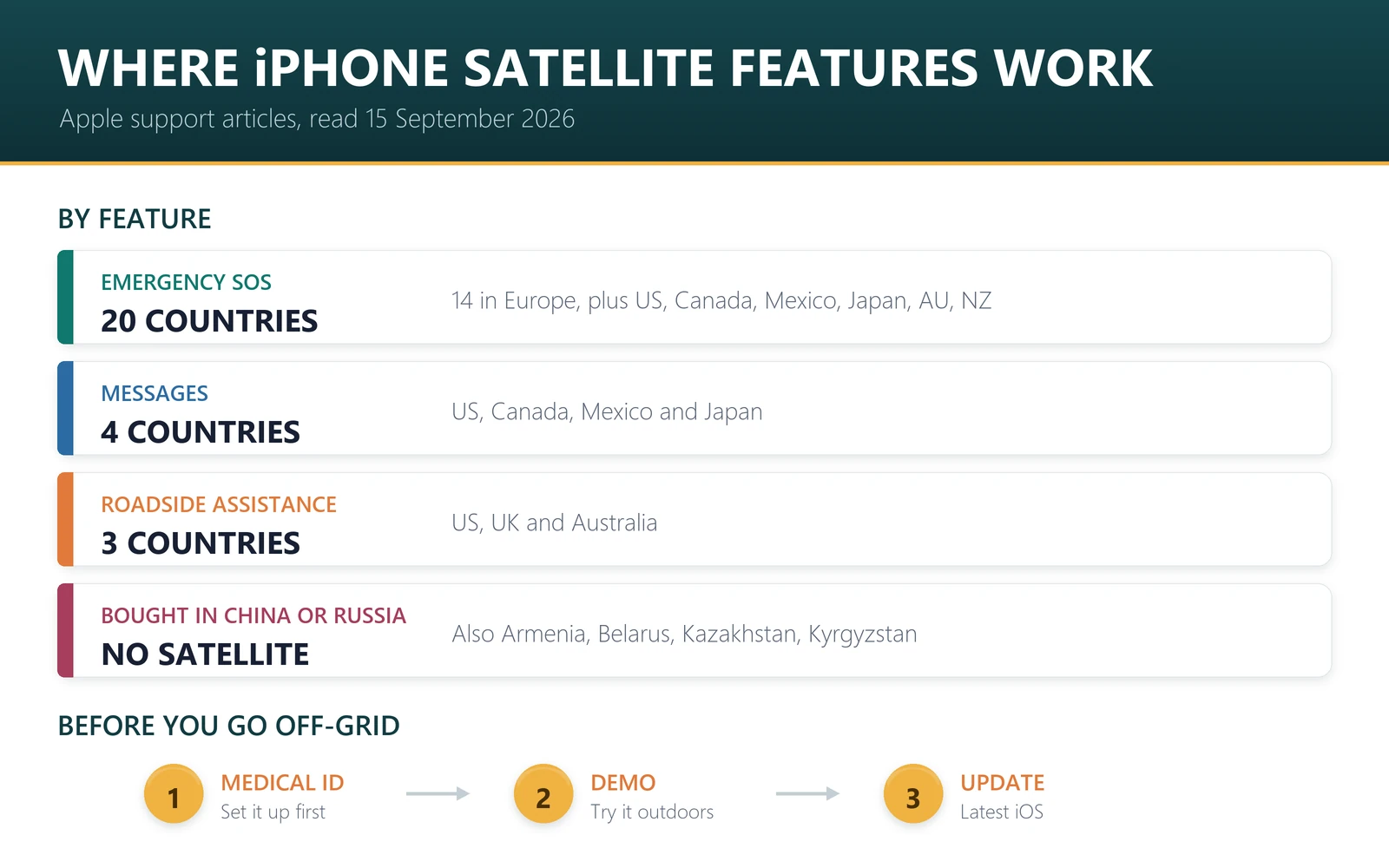
Satellite features depend on two locations: where you are, and where the iPhone was bought. Apple’s rule for travellers has an exception built in: visitors can use the feature “except if they bought their iPhone in certain countries or regions”.
| Where the iPhone was bought | Satellite connectivity |
|---|---|
| Armenia, Belarus, China mainland, Kazakhstan, Kyrgyzstan, Russia | Not offered, wherever you take the phone |
| Hong Kong, Macao | Only on iPhone 16e and later, so yes on iPhone 17, iPhone 18 Pro and iPhone Duo; no on iPhone 16 and earlier |
| Everywhere else | Offered on iPhone 14 or later, in the countries where each feature is available |
The model number does not settle this on its own. An iPhone 18 Pro bought in Kazakhstan is the same global A3714 model sold in the UK, but Apple does not offer satellite connectivity on it. If you are buying a phone second-hand or abroad and satellite SOS matters to you, ask where it was originally sold. Our guide to iPhone 18 Pro model numbers by country shows which version is sold where, and buying iPhone 18 Pro abroad covers the other checks.
What you need for each feature
| Feature | iPhone | Minimum iOS | Other requirements |
|---|---|---|---|
| Emergency SOS via satellite | iPhone 14 or later | iOS 16.1 (US, Canada) to iOS 26.4 (Andorra, Iceland), varying by country | No cellular or Wi-Fi coverage |
| Messages via satellite | iPhone 14 or later | iOS 18 (US, Canada, Japan); iOS 18.4 (Mexico) | An active SIM; iMessage turned on before you lose coverage; SMS depends on your carrier |
| Roadside Assistance via satellite | iPhone 14 or later | iOS 17 (US, UK); iOS 18.4 (Australia) | An active SIM; providers are AAA or Verizon in the US, Green Flag in the UK, and NRMA, RACV, RACQ, RAA, RAC, RACT and AANT in Australia |
On cost, Apple says Emergency SOS, Messages and Roadside Assistance via satellite are each free for two years after activating an iPhone 14 or later. With iPhone 18 Pro, Apple also extended free access by an additional year for iPhone 14, 15 and 16 users who activated their device in a supported country before midnight PT on 9 September 2026. Roadside providers may charge for the help itself; Apple says their pricing, if any, is given before help is dispatched.
How it works in practice
A satellite connection is slow and fussy by design. From Apple’s guide to connecting to a satellite:
- You must be outside with a clear view of the sky and horizon. Dense foliage, hills, canyons and tall buildings can block it.
- Messages take time: about 30 seconds in ideal conditions, and over a minute under light or medium foliage.
- High latitudes may not work: Apple says connections might fail above 62° latitude, such as northern parts of Alaska.
- Messages via satellite is text only: no photos, videos, audio messages, stickers or group messages.
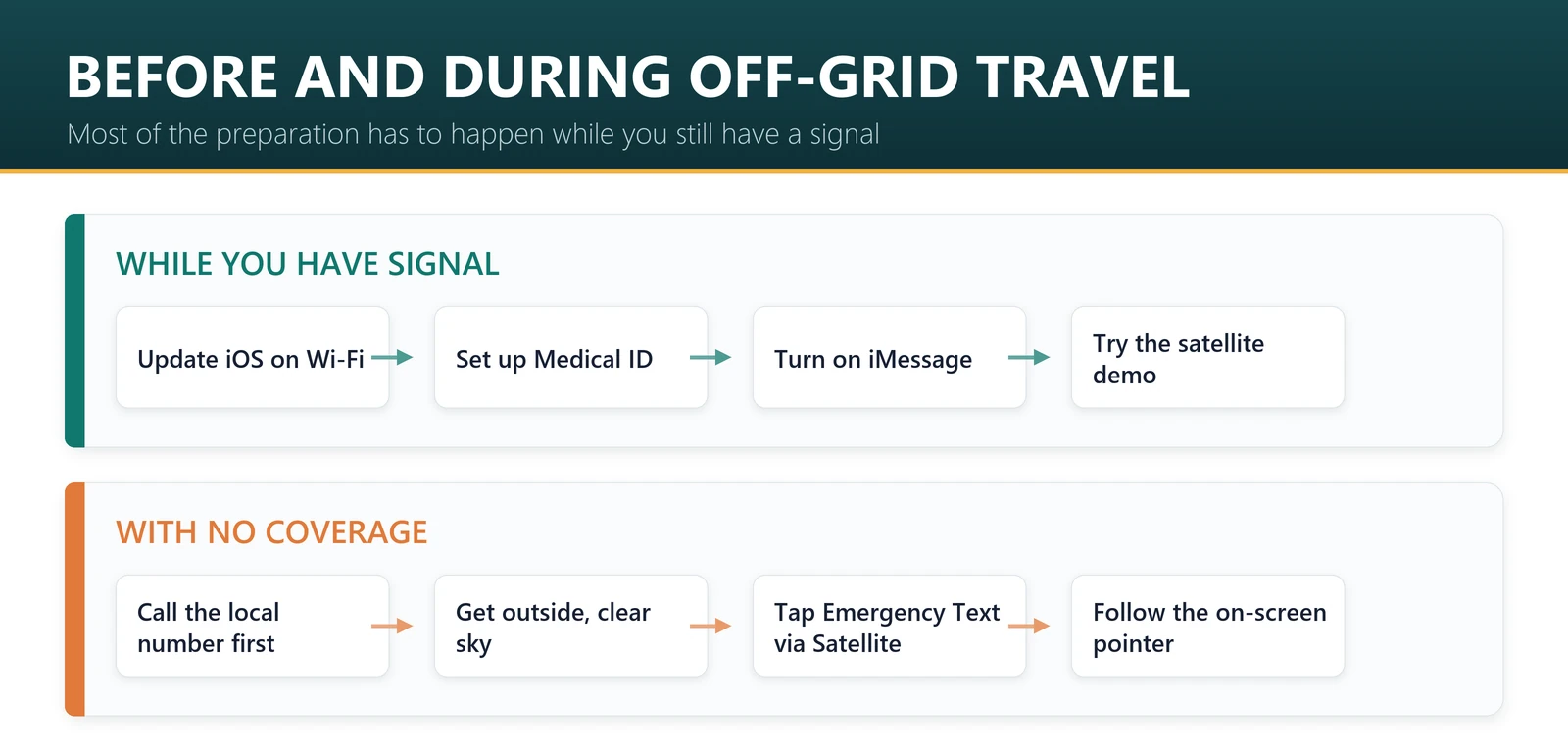
- Call first: Apple advises trying the local emergency number first, because a call may connect even without your usual network.
If you text emergency services via satellite, your emergency contacts can be notified. Contacts with a non-Apple phone or without iOS 16.4 or later receive an SMS from a number Apple lists by region: AppleSOS in Australia, 767911 in the US and Canada, SOS112 (767112) in Europe, 0005990037 in Japan and 27911 in Mexico. They need to reply YES within 48 hours to keep receiving updates.
Satellite SOS is not a data plan
It is worth being clear about what satellite features replace, and what they do not. They are for moments with no cellular or Wi-Fi coverage at all. They do not load maps, booking apps, ride-hailing or anything else that needs the internet, and Messages via satellite covers only four countries.
For ordinary connectivity abroad, including in every satellite SOS country, you still need a mobile plan. In our catalogue of 830 plans on sale on 15 September 2026, 101 cover the US, 80 each cover the UK and France, 71 cover Germany, 68 cover Japan, 58 cover Mexico, 57 cover Australia, 44 cover New Zealand and 29 cover Canada, counting regional plans that list the country. The two work together: a travel eSIM for the trip, satellite features for the stretch of road or trail where nothing else reaches.
Planning a road trip or hike abroad? Get connected for the parts of the trip that do have coverage: US, Australia, New Zealand, Iceland, Japan or Europe, or browse all destinations.
Before you go off-grid abroad
- Update iOS on Wi-Fi before you leave. Apple’s minimum versions vary by country, and keyword shortcuts need current software.
- Set up Medical ID and emergency contacts in the Health app. They can only be shared if they exist before you need them.
- Turn on iMessage if you are going somewhere with Messages via satellite.
- Try the demo: Control Center, the Cellular button, then Satellite and Try Demo. You need to be outside, and in a country where the feature is available.
- Note the local emergency number from the table above.
- Keep your travel line on until you genuinely lose coverage; our guide to using a travel eSIM with your home number covers the line settings.
Carrying an Apple Watch Ultra 4 or a cellular Series 12? Apple lists carrier-supported satellite features for those too; Apple Watch abroad explains what watch connectivity can and cannot do on a trip.
Sources, and what this cannot tell you
Country lists, iOS versions, emergency numbers and purchase-country rules are from Apple’s support articles on Emergency SOS via satellite (published 22 July 2026), Messages via satellite (15 May 2026), Roadside Assistance via satellite (4 November 2025) and connecting to a satellite, plus Apple’s iPhone 18 Pro announcement of 9 September 2026, all read on 15 September 2026. Apple’s Messages via satellite article lists five purchase countries without satellite connectivity, omitting Kyrgyzstan; its other satellite articles list six, and we use the longer list.
We have not tested satellite features in any country. Apple says availability depends on regulatory approvals and can change. In a real emergency, always try the local emergency number first. Catalogue counts are ours, from the plans on sale at codeesim.com on 15 September 2026.
To cite this page: Code eSIM, “iPhone satellite SOS by country”, compiled from Apple support articles on 15 September 2026.
Frequently asked questions
Does iPhone Emergency SOS via satellite work abroad?
Yes, in the 20 countries where Apple offers it. Apple says international travellers visiting those countries can use the feature, unless their iPhone was bought in Armenia, Belarus, China mainland, Kazakhstan, Kyrgyzstan or Russia. iPhones bought in Hong Kong or Macao need to be iPhone 16e or later.
Which countries have iPhone Emergency SOS via satellite?
Apple lists Andorra, Australia, Austria, Belgium, Canada, France, Germany, Iceland, Ireland, Italy, Japan, Luxembourg, Mexico, the Netherlands, New Zealand, Portugal, Spain, Switzerland, the UK and the US, plus territories such as the Canary Islands, Puerto Rico and the US Virgin Islands.
Where does Messages via satellite work?
Only in the United States, Canada, Mexico and Japan. It needs iPhone 14 or later with iOS 18, or iOS 18.4 in Mexico, an active SIM, and iMessage turned on before you lose coverage. Photos, videos and group messages are not supported over satellite.
Does iPhone satellite SOS work in China?
China mainland is not on Apple’s list of countries where Emergency SOS via satellite is available. Separately, Apple says satellite connectivity is not offered on iPhones purchased in China mainland, so a mainland iPhone does not get satellite features in any country.
Does satellite SOS work on an iPhone bought in Hong Kong?
On newer models, yes. Apple says that for iPhones bought in Hong Kong and Macao, satellite connectivity is offered only on iPhone 16e and later. A Hong Kong iPhone 17, iPhone 18 Pro or iPhone Duo qualifies; a Hong Kong iPhone 16 does not.
Is iPhone satellite SOS free?
Apple says it is free for two years after activating an iPhone 14 or later. With iPhone 18 Pro’s launch, Apple extended free access by an additional year for iPhone 14, 15 and 16 users who activated in a supported country before midnight PT on 9 September 2026.
Does iPhone satellite SOS work in Southeast Asia?
Not according to Apple’s list. In Asia, Japan is the only country where Emergency SOS via satellite is available; Australia and New Zealand also have it. Thailand, Vietnam, Indonesia, Singapore and the Philippines are not listed.
Can tourists use Roadside Assistance via satellite?
Yes, in Australia, the UK and the US. Apple says international travellers visiting those countries can use it, unless the iPhone was bought in one of the excluded countries. It needs an active SIM, and roadside providers may charge for their service.
Bottom line
If your trip is to North America, Japan, Australia, New Zealand or most of Western Europe, your iPhone can text emergency services by satellite, and you do not need to be a resident to use it. Messages and roadside help by satellite are far more limited. Check where your iPhone was bought before relying on any of it, set up Medical ID before you leave, and treat satellite as the backstop for places with no signal, not a replacement for a data plan.
Last reviewed 15 September 2026. Availability, requirements and purchase-country rules are from Apple’s support articles, read on that date and subject to change. Apple, iPhone and Apple Watch are trademarks of Apple Inc.; this article is independent editorial commentary and is not affiliated with, sponsored by or endorsed by Apple. Illustrations are our own.