
There is a sentence in every delivery email we send that most eSIM retailers bury in a help article: the QR code can only be installed once. It is not a limitation we invented, and it is not something we enjoy putting in front of a customer who has just paid. But it is the honest centre of this comparison, because it is the one place where a strip of plastic still beats the newer technology outright.
The eSIM-versus-physical-SIM question usually gets answered as convenience versus tradition, which is not wrong so much as incomplete. The differences are asymmetric: eSIM wins the parts of a trip that happen before you leave and while everything is going well, and physical SIM wins two specific situations that only matter when something goes wrong or when you need to be treated as a local rather than a visitor. Knowing which of those you are likely to hit is the whole decision.
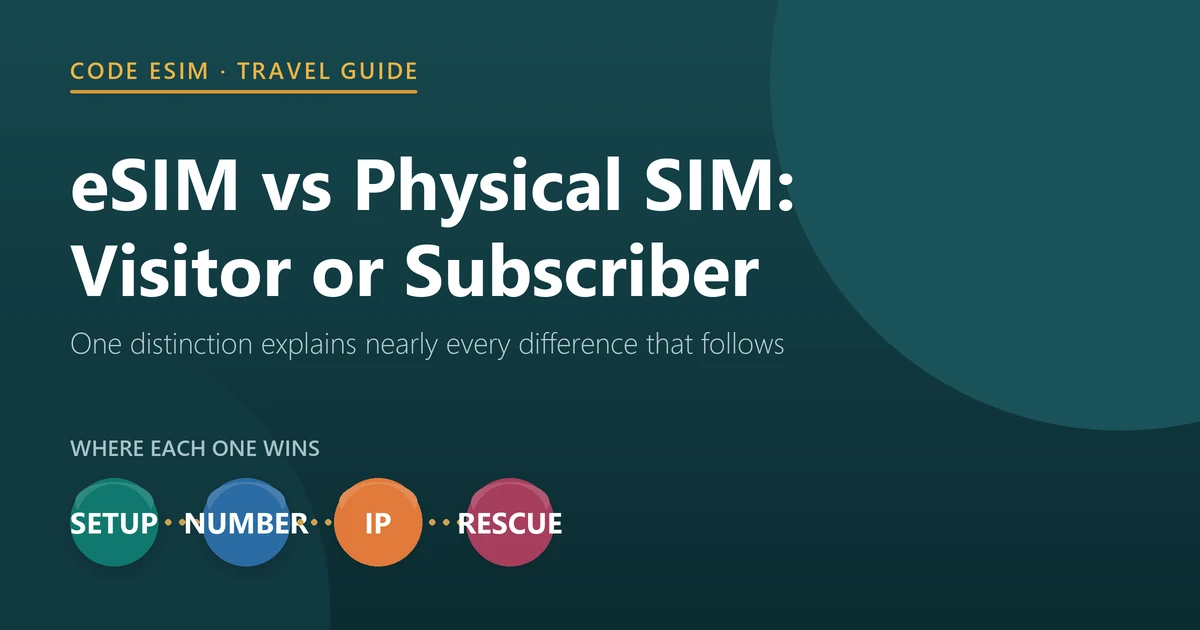
One distinction explains everything else
A local physical SIM makes you a subscriber of an operator in that country. You get a local number, you appear on that operator’s books, and in most countries the line is registered against an identity document at the point of sale.
A travel eSIM makes you a visitor. The profile is issued by an operator somewhere else, and when you land your phone registers on a local partner network as a roamer — the same mechanism your home SIM uses if you switch roaming on, and one that has existed for decades before eSIM was invented.
Almost every practical difference below is a consequence of that single distinction rather than of the hardware. It is worth holding onto, because it also predicts things this article does not cover: why one requires paperwork and the other does not, why one gives you a phone number and the other does not, and why their failure modes are so different.
1. Getting connected: eSIM, decisively
This is the difference everyone already knows, and it is real. Buying a travel eSIM takes a name, an email address and a payment; the profile arrives by email and installs over Wi-Fi at home before you fly. There is no counter, no queue after a long flight, and no identity document handed to a retailer in a country whose data protection regime you have never read.
Local prepaid SIMs are typically registered to a passport or national ID at the point of sale. That is not sinister — it is how subscriber lines are regulated in much of the world — but it costs you twenty minutes and a copy of your passport in someone else’s system.
The caveat worth stating: installing an eSIM needs an internet connection. Doing it at home on Wi-Fi is trivial. Doing it at an airport with no connectivity, because you did not install before flying, is exactly the situation the product is supposed to prevent.
2. A local phone number: physical SIM, and it is not close
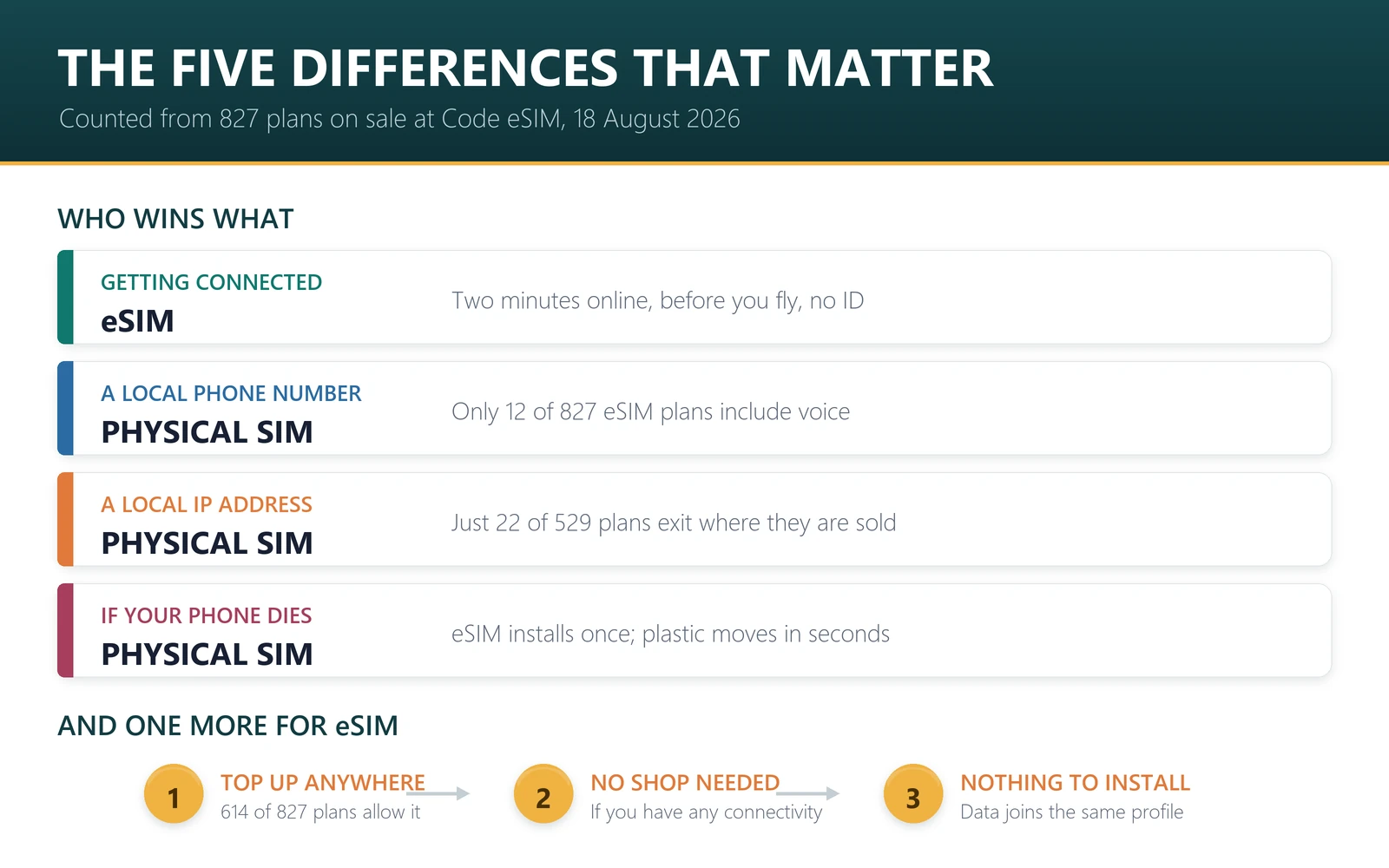
Travel eSIMs are overwhelmingly data-only, and we can put a number on it rather than hand-waving. Of the 827 plans on sale in our catalogue on 18 August 2026, 12 include any voice service and 6 include SMS. That is 98.5% of the range with no phone number attached at all.
Most travellers never notice, because messaging and calls now happen over data. You notice when something wants a local number specifically: registering for a domestic ride-hailing or delivery app, a restaurant booking system that sends a confirmation code, a parcel locker, occasionally a bank or government portal at your destination. In those moments a data-only plan cannot help you, and a local SIM solves it instantly.
If your trip depends on being reachable on a local number, that is a genuine reason to buy a physical SIM — or to buy both, which is what a fair number of long-stay travellers end up doing.
3. Where your traffic reaches the internet: physical SIM, if it matters to you
A local SIM breaks out locally: your IP address belongs to the country you are standing in, and websites treat you as someone who is there. A travel eSIM is normally home-routed, meaning your data is carried back to the issuing operator and surfaces on its gateway, wherever that is.
The scale of this surprised us when we measured our own range. Of 529 single-country plans, 22 exit in the country they are sold for. For the other 507, your traffic reaches the internet somewhere else — most often the UK or Singapore.
For maps, messaging and booking flights this changes nothing you would notice. It shows up in regional pricing and language redirects, in streaming catalogues, occasionally in a banking app that sees a connection from a country you are not in, and in latency if the exit is on the other side of the world. We wrote up the full distribution separately in where your traffic actually exits; the short version is that a travel eSIM will not make you look local, and no travel eSIM vendor can honestly promise otherwise.
4. When your phone dies: physical SIM, and this is the one people forget
Here is the scenario worth thinking about before you choose. Your phone is stolen, drowned, or simply stops charging on day three of a two-week trip. You borrow a handset, or you buy a cheap one.
With a physical SIM, you move a piece of plastic between two devices and you are back — number, data, everything — in under a minute. With a travel eSIM, you usually are not. The profile is provisioned to the device it was installed on, and the QR code that delivered it has already been consumed. Our own delivery emails say it plainly: the code can normally be installed only once. Some providers will reissue a profile on request, some will not, and none of that helps you at 9pm in a country where you no longer have a working phone.
This is not an argument against eSIM. It is an argument for knowing the failure mode, and for two cheap habits: keep your home SIM in the phone so you retain a working number if the data line fails, and if you are travelling somewhere remote or alone for a long stretch, treat a local physical SIM as insurance rather than as a redundant purchase.
It is also the reason we tell customers not to delete an eSIM profile mid-trip to tidy up their settings. A deleted profile is usually gone for good, and it is a self-inflicted version of exactly this problem.
5. Changing your mind mid-trip: eSIM, with one condition
Running out of data, extending a stay, or adding a country is where eSIM pulls ahead again. You buy from wherever you are, in about two minutes, without finding a shop that is open. In our range, 614 of 827 plans can be topped up, which adds data to the profile already on your phone with nothing to reinstall.
The condition is that you need some connectivity to do it — hotel Wi-Fi, a café, a companion’s hotspot. With no connectivity at all, buying an eSIM is harder than walking into a shop. This is the mirror image of the setup advantage, and it is why we keep telling people to install before they fly rather than treating the eSIM as something to sort out on arrival.
The compatibility gate that comes before any of this
None of the above matters if your handset cannot take an eSIM. Two conditions have to hold: the phone must support eSIM, and it must not be carrier-locked. Broadly, flagship phones from 2020 onward qualify, and several recent models sold in the United States have no SIM tray at all — for those, the physical SIM side of this comparison is theoretical. Older handsets, some regional variants and most budget phones do not support eSIM, and a phone still locked to a home carrier will refuse a foreign profile regardless of its hardware.
It takes about thirty seconds to check, and it is worth doing before you read any further into plan comparisons. Our compatibility guide covers the checks on iPhone and Android.
Side by side
| Travel eSIM | Local physical SIM | |
|---|---|---|
| Your status | Visitor roaming on a partner network | Subscriber of that operator |
| Setup | Two minutes online, before you fly | Counter, queue and ID after you land |
| Identity documents | None — name and email | Passport or national ID, typically |
| Local phone number | Rarely — 12 of our 827 plans include voice | Yes, that is the point of it |
| IP address | Usually a different country (507 of 529 single-country plans) | Local |
| Keeps your home number active | Yes, on the other line | Only if your phone takes two SIMs |
| If the phone dies | Usually stuck — installs once | Move the card in seconds |
| Adding data mid-trip | Two minutes, if you have any connectivity | Find a shop |
| Old or locked handsets | Will not work | Works |
How we would actually choose
For the large majority of trips — a week or two, a modern unlocked phone, data for maps, messaging and photos — a travel eSIM is the better buy, and the setup advantage alone justifies it. We sell these, so read that with the appropriate scepticism; the useful part is where we think the opposite.
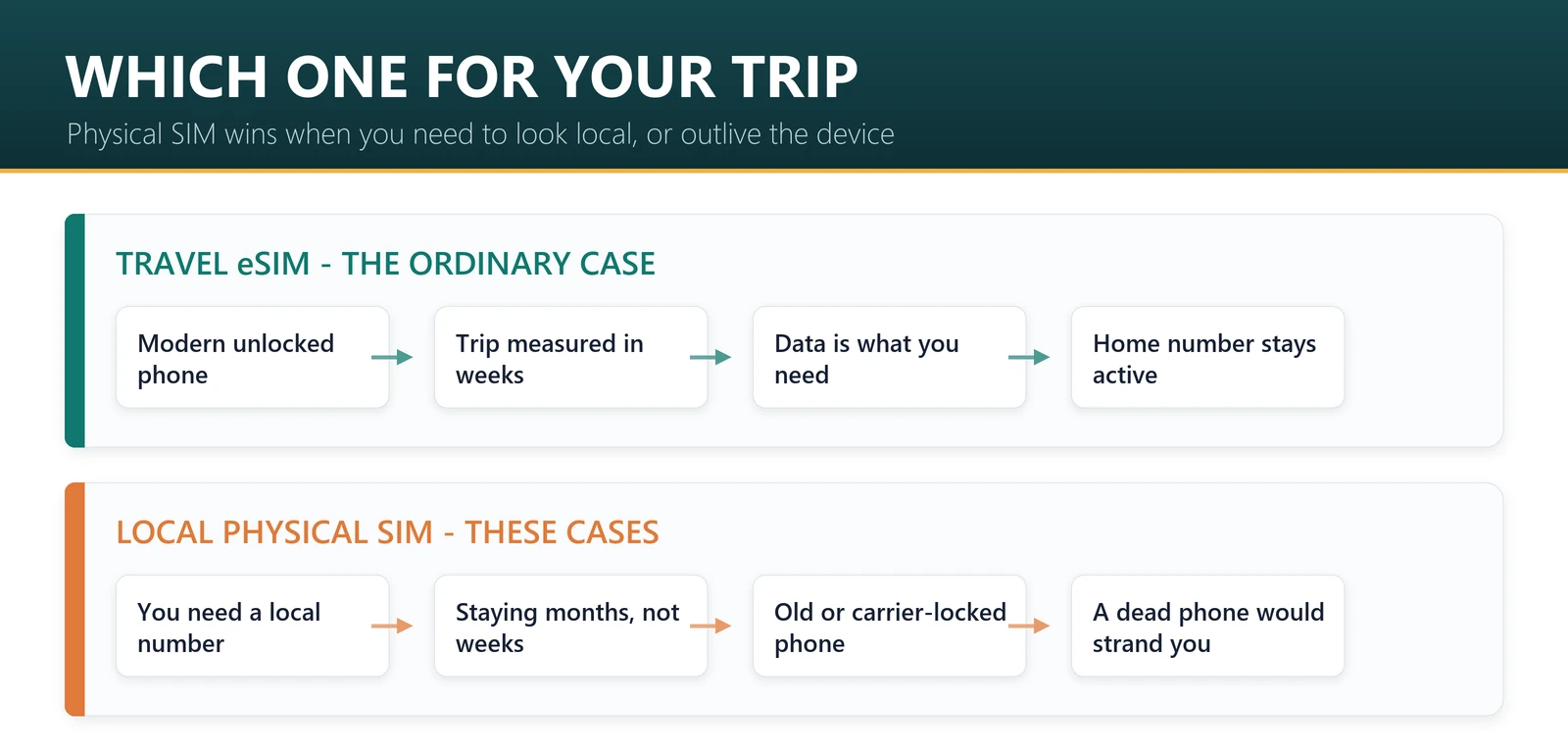
We would tell you to buy a local physical SIM, or to buy one in addition, if any of these apply:
- You need a local number for apps, deliveries, bookings or a domestic service that sends codes by SMS.
- You are staying for months rather than weeks, where the economics and the number both favour becoming a local subscriber.
- Your phone is old, budget or carrier-locked, in which case the choice has already been made for you.
- You are travelling alone somewhere remote and a dead handset would leave you genuinely stranded — plastic survives a device swap; a profile normally does not.
- You are a heavy user in a market with very cheap local prepaid data, where a local bundle can undercut any roaming-based product.
The pattern across those five is that physical SIMs win when you need to be treated as a resident, or when you need the connection to outlive the device. Everything else favours the eSIM.
Method, and what this comparison cannot tell you
The figures above come from our own live catalogue on 18 August 2026: 827 plans on sale, excluding top-up packages and out-of-stock items. Voice, SMS, top-up support and IP routing location are fields published on each product page, supplied by the network provider behind the plan. Counts move as the catalogue syncs daily.
Three things we deliberately do not claim. We do not sell physical SIMs, so we have no price data for local prepaid and have not compared costs country by country — where we say local can be cheaper for heavy users, treat that as a direction, not a figure. SIM registration rules are set by each country and change; check official guidance for your destination rather than any retailer’s summary, ours included. And whether a specific provider will reissue an eSIM profile after a device failure is a provider-by-provider question we cannot answer generally.
Frequently asked questions
Is an eSIM better than a physical SIM for travel?
For most trips, yes. An eSIM installs before you fly, needs no identity documents and lets you keep your home number active on the other line. A local physical SIM is better when you need a local phone number, when your phone does not support eSIM or is carrier-locked, or when you need the connection to survive a handset failure.
Does a travel eSIM give you a phone number?
Almost never. Of the 827 plans on sale in our catalogue on 18 August 2026, 12 include voice and 6 include SMS — about 1.5% of the range. Travel eSIMs are sold as data products; if you need a local number, a local physical SIM is the reliable way to get one.
Can I move an eSIM to another phone?
Usually not. A travel eSIM profile is provisioned to the device it was installed on, and the QR code can normally only be installed once. Some providers will reissue a profile on request, but you should not plan around it. A physical SIM moves between handsets in seconds, which is its clearest remaining advantage.
Do I need ID to buy an eSIM?
Not for a travel eSIM. Buying takes a name, an email address and a payment. Local prepaid SIMs are generally registered against a passport or national ID at the point of sale, because that line makes you a subscriber of a local operator.
Will a travel eSIM give me a local IP address?
Usually not. Travel eSIMs are typically home-routed, so traffic reaches the internet in the issuing operator’s country. In our range, only 22 of 529 single-country plans exit in the country they are sold for. A local physical SIM does give you a local IP.
Can I use an eSIM and a physical SIM at the same time?
Yes, on any dual-SIM phone, and it is the setup we recommend: keep your home physical SIM in the phone for calls and verification texts with its data roaming switched off, and let the travel eSIM carry the data.
Which phones cannot use an eSIM?
Older handsets, most budget models, some regional variants, and any phone still locked to a home carrier. Flagship phones from roughly 2020 onward generally support eSIM, and several recent US models have no SIM tray at all. Check before buying either kind of plan.
Is a local SIM cheaper than a travel eSIM?
It can be, particularly for heavy use over a long stay in markets with very cheap domestic data. For a one or two week trip the difference is usually small enough that setup convenience decides it. We do not sell physical SIMs and do not publish local prepaid prices, so treat this as a direction rather than a benchmark.
Bottom line
Buy the travel eSIM for the ordinary case: a modern unlocked phone, a trip measured in weeks, and data as the thing you actually need. It gets you online before you land, asks for nothing but an email address, and leaves your home number working. Buy the local physical SIM when you need to be treated as a local — a number that receives domestic SMS, an IP address in the country you are standing in — or when you need the connection to survive losing the phone it lives on. Those are the two things a plastic card still does better, and no amount of convenience elsewhere makes them go away.
If the eSIM side is the right call for your trip, start with your destination: all 191 destinations, or Japan, Europe, Thailand and USA. Before you buy, check whether your phone supports eSIM, then read how to keep your home number and when the plan starts counting.
Last reviewed 18 August 2026 by the Code eSIM team. Catalogue figures were counted from the 827 plans on sale that day, excluding top-up packages and out-of-stock items, using the voice, SMS, top-up and IP routing fields published on each product page. Plan terms are set by the network providers behind them and change over time. SIM registration and device rules are set by each country — confirm current official guidance for your destination before you travel.