
You land in Tokyo, connect your travel eSIM, and open a website that greets you in English and quotes prices in pounds. Your phone knows exactly where you are. The internet thinks you are in the United Kingdom. Nothing is broken — that is how travel eSIMs normally route traffic, and almost nobody explains it before you buy.
Short answer: yes, a travel eSIM usually changes the country your IP address appears to be in — and it is usually not the country you are standing in. Counted across our own catalogue in August 2026:
- Of 525 single-country plans, only 22 exit in that same country. For the other 503, your IP appears somewhere else entirely.
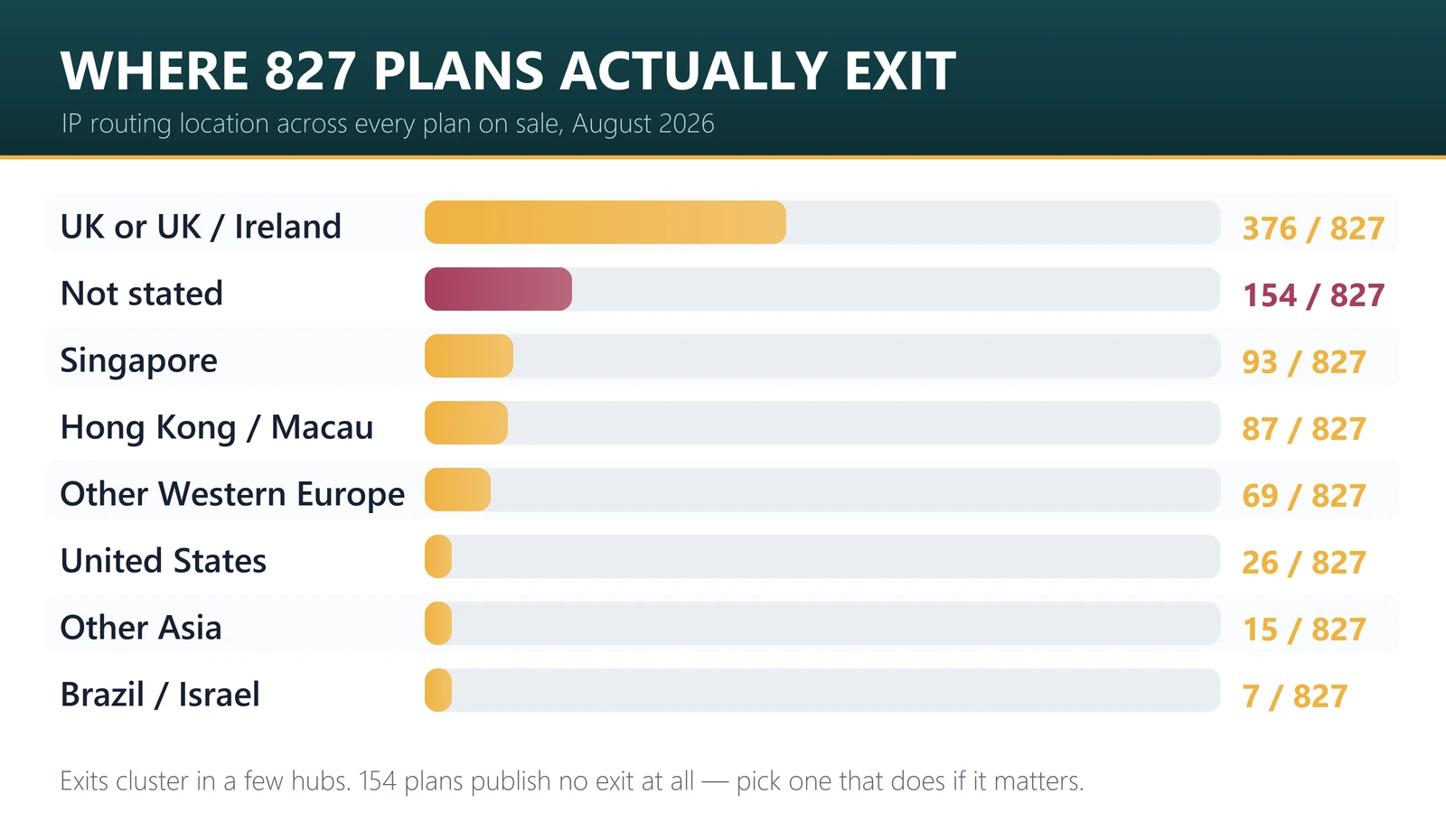
- 376 of 827 plans exit in the UK or UK/Ireland — by far the most common exit point, whatever the destination.
- The next most common exits are Singapore (93), Hong Kong and Macau (87), other Western Europe (69) and the USA (26).
- 154 plans do not state an exit location at all. If this matters to your trip, that is a reason to pick a plan that does.
What “IP routing location” actually means
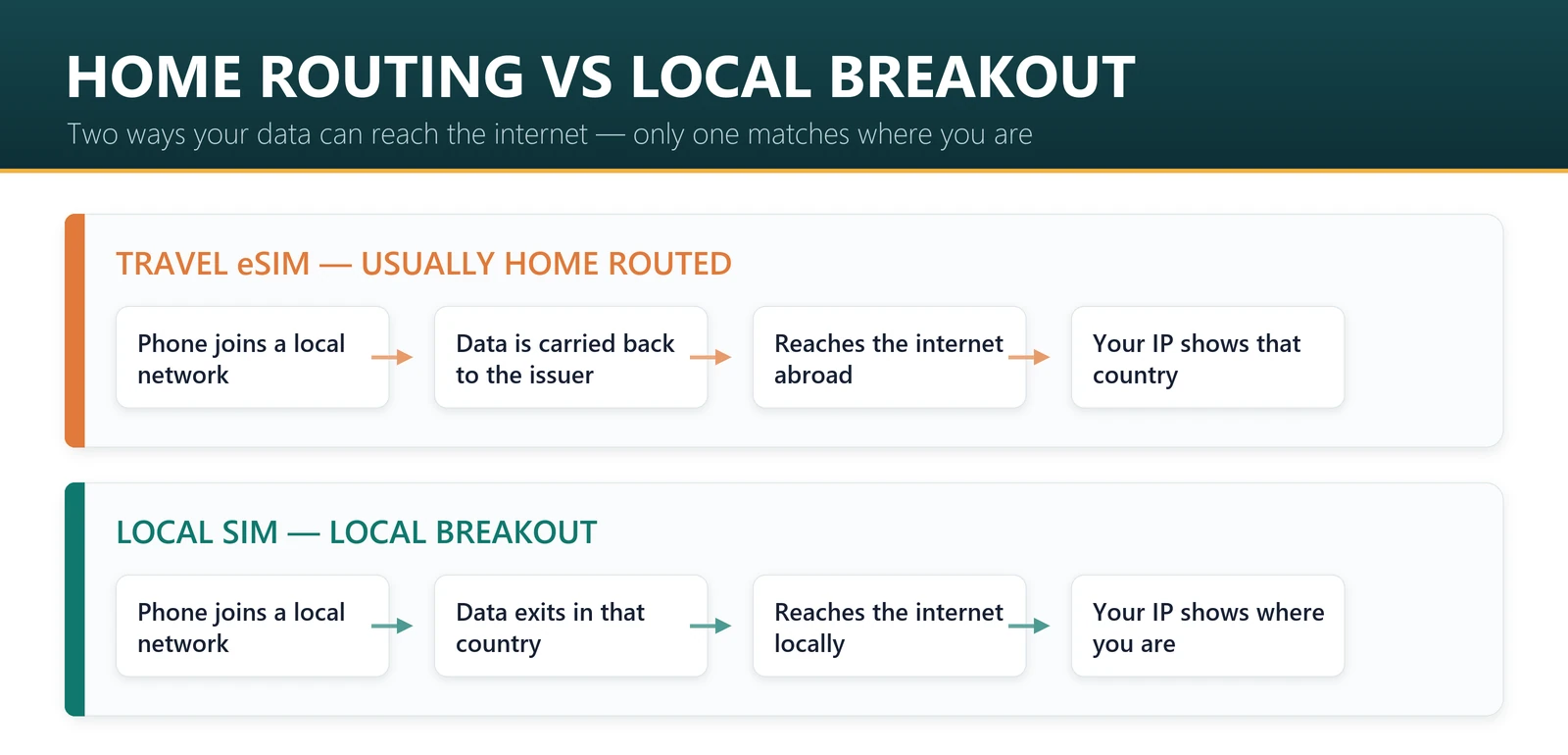
When you roam, your data can reach the internet in one of two places. This is ordinary mobile network architecture, not something invented for eSIMs:
- Local breakout — your traffic exits in the country you are visiting. This is what a local SIM does, and what your IP address then reflects.
- Home routing — your traffic is carried back to the network that issued your profile and reaches the internet there. Your IP address reflects that country, not the one you are in.
Travel eSIMs are typically home-routed. The profile belongs to an operator somewhere else, you connect as a visiting roamer, and your traffic surfaces on that operator’s gateway. That is why a plan sold for Japan can hand you a British IP address, and why the destination on the label tells you nothing about the exit.
Every plan we sell that has this information lists it on the product page as IP routing location. It is not a hidden setting or something you can choose — it is a property of the plan, decided by the provider behind it.
Where our plans actually exit
This is the full distribution across all 827 plans on sale, grouped by exit region:
| Exit location | Plans | Share |
|---|---|---|
| United Kingdom, or UK / Ireland | 376 | 45% |
| Not stated on the product page | 154 | 19% |
| Singapore | 93 | 11% |
| Hong Kong and Macau | 87 | 11% |
| Other Western Europe (incl. Belgium, France) | 69 | 8% |
| United States | 26 | 3% |
| Other Asia (Japan, Vietnam, Malaysia) | 15 | 2% |
| Brazil and Israel | 7 | 1% |
Two things stand out. First, the exit is concentrated in a handful of hubs — mostly the UK and Singapore — regardless of where the plan is sold for. Second, and we would rather say it than hide it, nearly one plan in five does not publish an exit location. Where the field is blank the information was not supplied to us, and we would rather leave it empty than invent it. If your trip depends on knowing the exit, choose from the 673 plans that state one.
The number that surprises people: 22 out of 525
Take only the single-country plans, where you might reasonably expect the exit to match the destination. It almost never does:
| Single-country plans | Count |
|---|---|
| Total single-country plans on sale | 525 |
| Exit in the same country as the destination | 22 |
| Exit somewhere else | 503 |
Real examples from our current range: Australia plans that exit in Singapore. Saudi Arabia plans that exit in the UK, Ireland or Western Europe. UAE plans that exit in the UK. In each case the phone is on a local network — the coverage is genuinely local — but the traffic surfaces thousands of kilometres away.
This is not a defect and it is not specific to us. It follows from home routing, which is how most travel eSIM products are built.
What this changes in practice
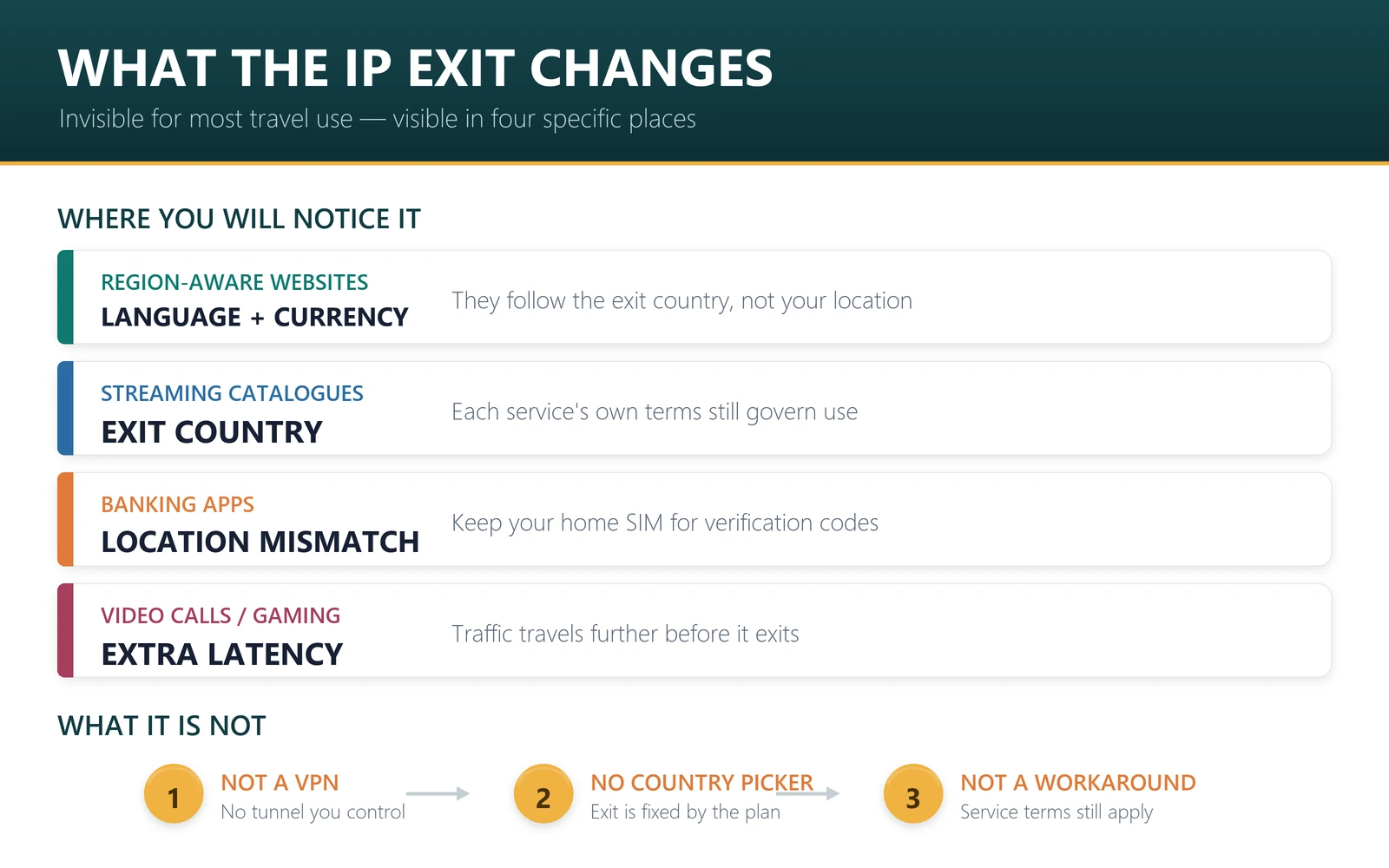
For most travel — maps, messaging, ride-hailing, email, social, booking sites — it changes nothing you would notice. Where it does show up:
| Situation | What actually happens |
|---|---|
| Websites guessing your location | Language, currency and regional redirects follow the exit country, not where you are standing |
| Streaming and other licensed content | Catalogues are determined by the exit country. You may see neither the local catalogue nor your home one — and each service’s own terms govern what is permitted |
| Banking and payment apps | Some flag a location that does not match your card or your travel. Keep your home SIM in the phone for verification codes |
| Local services at your destination | Sites that expect visitors from inside the country may behave oddly, since your traffic arrives from abroad |
| Speed | Traffic travelling further can add latency. It rarely matters for browsing; it can matter for video calls and gaming |
Whether the exit works for you or against you depends entirely on what you are doing. Someone who wants their usual home services to keep behaving normally may prefer a European exit; someone who needs to look local at their destination will not get that from a travel eSIM at all.
What a travel eSIM is not
It is worth being blunt, because this topic attracts a lot of overselling:
- It is not a VPN. There is no encrypted tunnel you control, no server list, no country picker. The exit is a fixed property of the plan you bought.
- You cannot choose the exit country. You can only choose a plan whose stated exit happens to suit you.
- It is not a tool for getting around geo-restrictions. Streaming and other licensed services set their own terms, and those terms apply to you regardless of how your traffic is routed. We describe the behaviour here so you are not surprised by it — not as a workaround.
- It does not hide anything. Your traffic is ordinary roaming traffic. The exit country changes; nothing becomes private that was not private before.
If a seller pitches an eSIM as a way to unlock content or mask your location, that is a reason to distrust the rest of their claims. The honest framing is narrower: the exit country is a spec, it is knowable in advance, and you should check it if it matters to you.
How to check before you buy
- Open the plan page and find “IP routing location”. If it is listed, that is your exit country. If the field is blank, the provider did not supply it.
- Decide whether it matters for this trip. For navigation, messaging and general browsing it usually does not. For anything tied to your home country’s services, or anything where latency counts, it does.
- If it matters, choose a plan that states an exit you can live with rather than assuming the destination country. 673 of our 827 plans publish one.
- Keep your home SIM in the phone with data roaming off, so bank verification codes still arrive on your own number regardless of where the data exits.
Frequently asked questions
Does a travel eSIM change your IP address?
Yes. A travel eSIM gives you an IP address from the network that issued the plan, which is usually not the country you are visiting. Across our 525 single-country plans, only 22 exit in the same country as the destination — for the other 503, your IP appears elsewhere, most often the UK or Singapore.
Will my IP show the country I am travelling in?
Usually not. Travel eSIMs are typically home-routed, meaning traffic is carried back to the issuing operator and reaches the internet there. Local SIM cards use local breakout and do show the local country. The exit is listed as “IP routing location” on each plan page where the provider supplied it.
Can I choose which country my eSIM IP is in?
No. The exit country is fixed by the plan and cannot be changed on your phone. You can only compare plans and pick one whose stated exit suits you. There is no country picker, because a travel eSIM is not a VPN.
Is a travel eSIM a VPN?
No. There is no encrypted tunnel you control and no choice of server. Your traffic is ordinary roaming traffic that happens to reach the internet in the operator’s country. Nothing becomes private that was not private before.
Will streaming services work on a travel eSIM?
They will connect, but the catalogue you see follows the exit country rather than your location, and each service’s own terms govern what is permitted on their platform. If a specific service matters on your trip, check its terms and consider using hotel Wi-Fi or your home carrier’s roaming instead.
Why does my banking app behave differently on an eSIM?
Because the app may see a connection from the exit country rather than from where you are. Keep your home SIM active in the phone with its data roaming switched off so verification texts still reach your own number, and use your bank’s official app rather than a browser where possible.
Does the IP exit affect my speed?
It can add latency, because traffic travels further before reaching the internet. For browsing, maps and messaging this is rarely noticeable. For video calls, live gaming or anything latency-sensitive, an exit on the other side of the world is worth knowing about in advance.
Why do some plans not list an IP routing location?
Because the provider behind that plan did not supply the information. 154 of our 827 plans have the field blank, and we leave it blank rather than guessing. If the exit country matters to you, choose one of the 673 plans that publishes it.
Bottom line
A travel eSIM almost always changes the country your IP appears to be in, and almost never to the country you are visiting — 503 of our 525 single-country plans exit somewhere else, most often the UK or Singapore. For ordinary travel use this is invisible. It becomes visible with streaming, banking apps, region-aware websites and latency-sensitive calls. The exit country is a published spec on most plans, so the fix is simply to read it before you pay rather than discovering it after you land. And treat any seller who frames this as unlocking content or hiding your location as unreliable on everything else too.
Check the IP routing line on any plan: all 191 destinations, or start with Japan, Europe, USA, Saudi Arabia or Asia regional. Related reading: what is an eSIM and how it works, whether one eSIM works in multiple countries, when an eSIM starts counting and how to keep your home number while travelling.
Last reviewed August 12, 2026. Exit-location counts were taken from the 827 plans on sale at Code eSIM on that date, excluding top-up add-ons and out-of-stock items, and reflect the IP routing location supplied by each provider. Routing arrangements are set by the network providers and can change, so the product page is always the authoritative version. Third-party services set their own terms of use, which apply independently of how your traffic is routed.