
You buy a 30-day eSIM two weeks before a trip, install it the same evening while you still remember, and land with 16 days left instead of 30. Nothing went wrong technically. You just bought one of the plans that starts counting the moment it is installed, rather than the moment you use it.
Short answer: most travel eSIMs do not start when you install them — they start when you first use data or first connect to a network abroad, so installing early is free. But a minority start at installation, and they are not distributed the way you would expect. Here is the full picture from our own catalogue in August 2026:
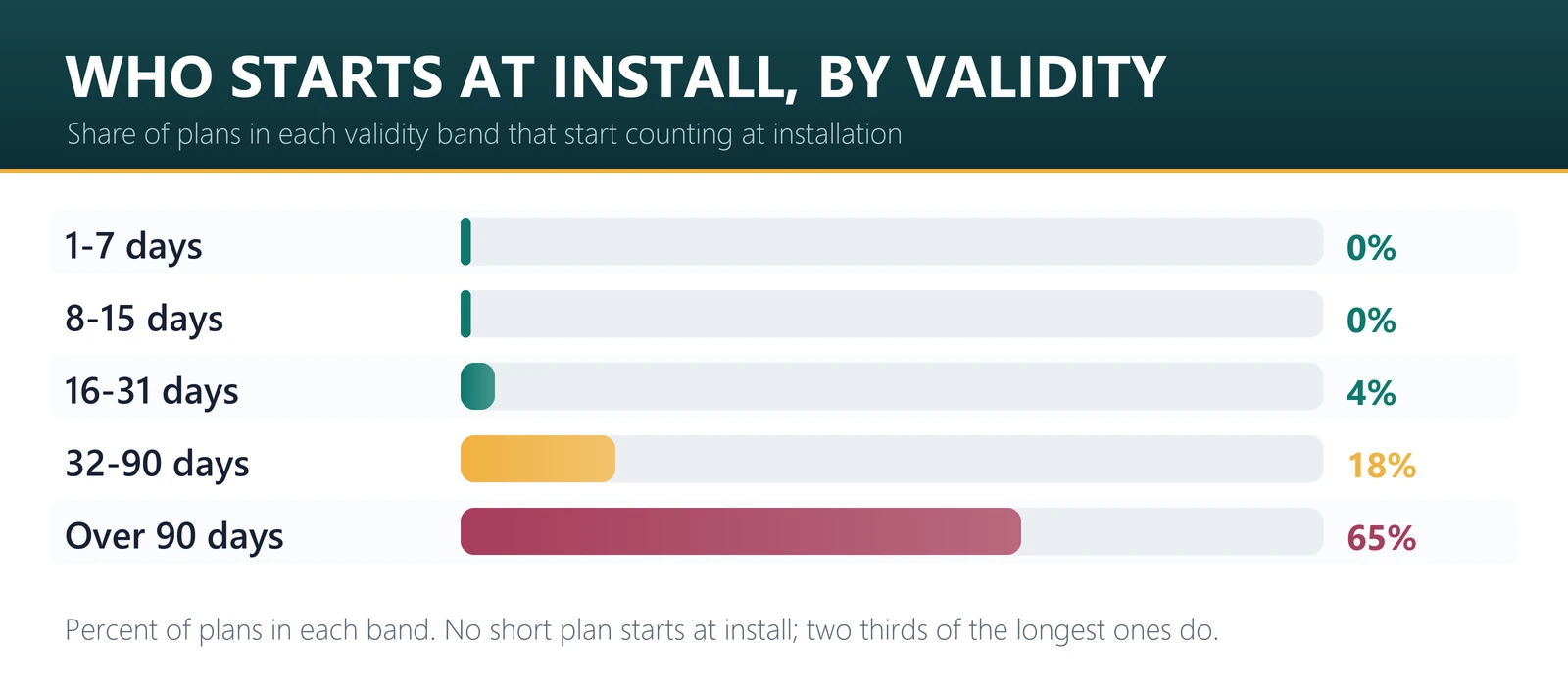
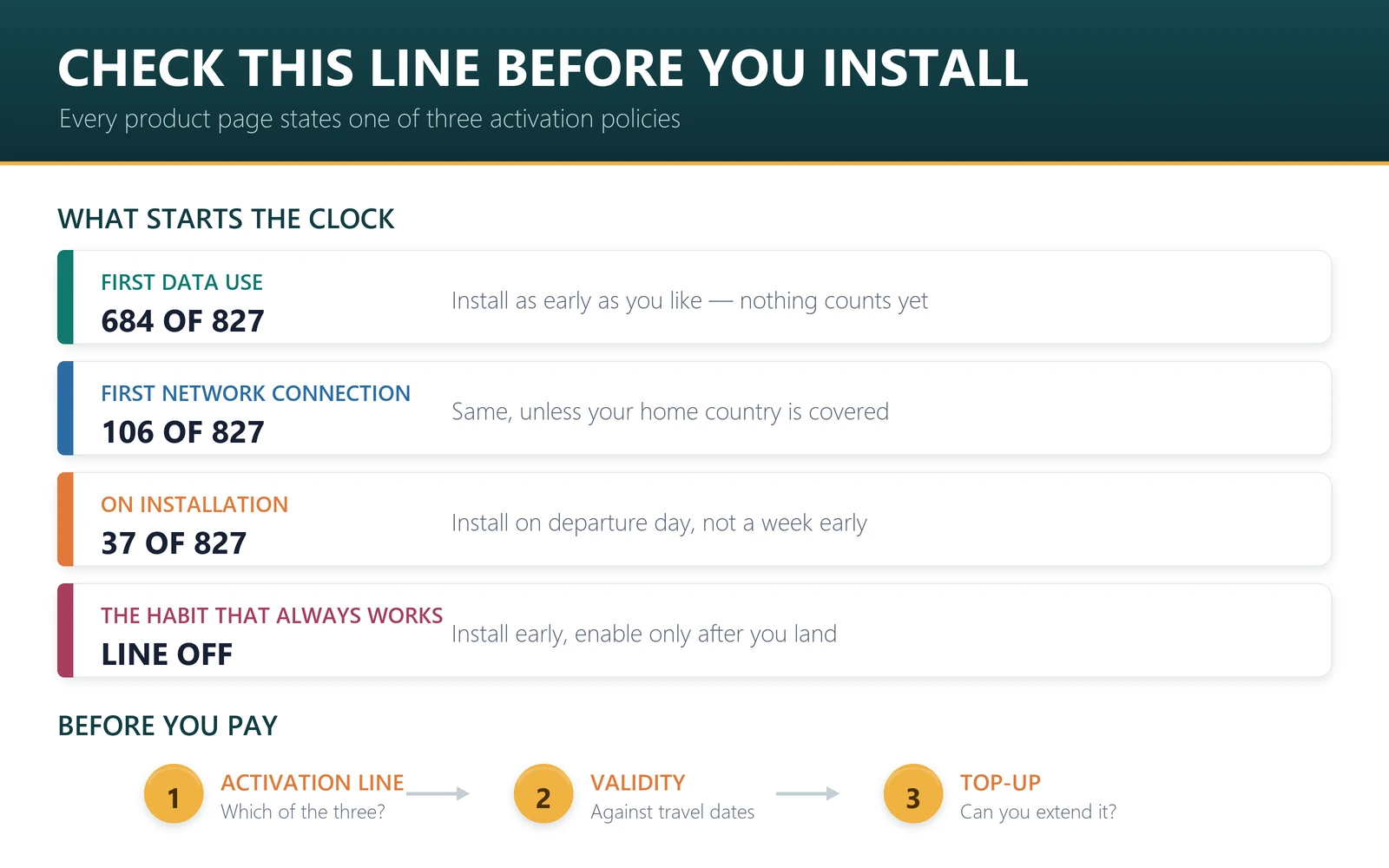
- Of 827 plans on sale, 684 start on first data use and 106 start on first network connection — for both, installing early costs nothing.
- 37 plans (about 1 in 22) start the moment the eSIM is installed.
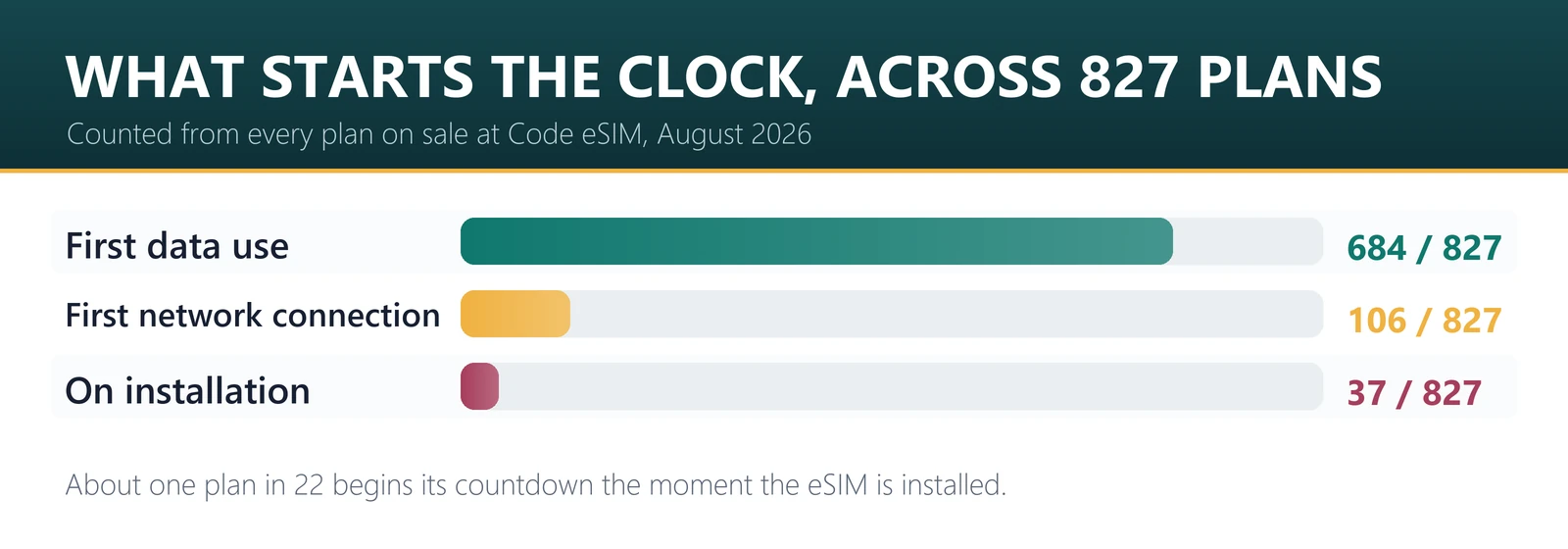
- Not one short plan does. Across all 247 plans valid 15 days or less, zero start at installation.
- The long ones are the opposite: 11 of the 17 plans valid over 90 days start at install — roughly two in three.
That last pair is the part worth remembering. The plans you are most likely to buy months in advance are the plans most likely to start counting the day you install them.
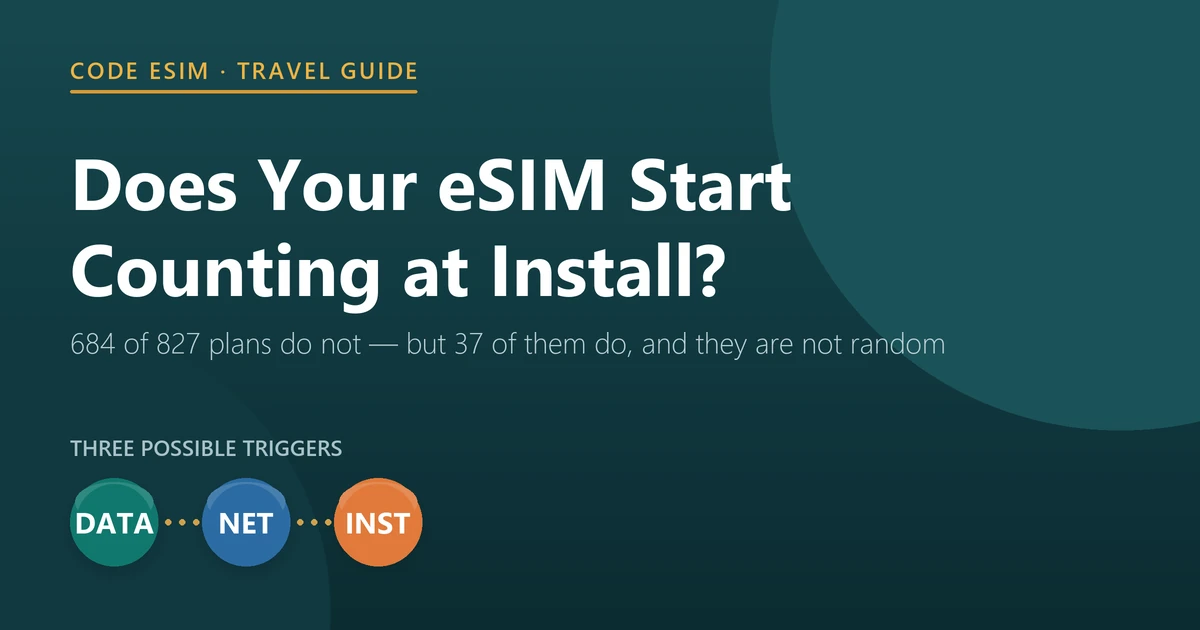
The three activation policies
Every plan we sell states one of three activation policies on its product page. They are not marketing variations; they behave differently:
| Policy | Plans | What starts the clock | Can you install early? |
|---|---|---|---|
| Activates on first data use | 684 of 827 | The first byte of data you actually use | Yes — freely |
| Activates on first network connection | 106 of 827 | When the profile registers on a covered network | Yes, with one caveat (below) |
| Activates when the eSIM is installed | 37 of 827 | Installation itself | No — install on departure day |
The first two cover 96% of the catalogue, which is why “always install before you fly” is decent general advice. It is just not universal advice, and the exceptions are not random.
The pattern nobody tells you: short plans are safe, long plans are not
Sort the catalogue by validity and the exceptions stop looking random:
| Validity | Plans | Start at installation | Share |
|---|---|---|---|
| 1–7 days | 106 | 0 | None |
| 8–15 days | 141 | 0 | None |
| 16–31 days | 546 | 23 | 4% |
| 32–90 days | 17 | 3 | 18% |
| Over 90 days | 17 | 11 | 65% |
Read that bottom row again. Two thirds of the long-validity plans — the yearly and half-yearly ones, the plans a frequent traveller buys in advance precisely so it is ready whenever the next trip comes — begin their countdown at installation.
The damage is easy to underestimate because the numbers look small against a long validity. They are not:
- A 30-day plan installed a week early loses about 23% of what you paid for.
- A 365-day plan bought in January for a March trip, installed on the day of purchase, expires the following January rather than the following March. You paid for twelve months and can use ten.
Neither is a defect. Both are avoidable in about five seconds if you read one line on the product page before installing.
Which plans are affected
The 37 install-activated plans are 25 multi-country and 12 single-country, and they cluster noticeably around Asia and around large, long bundles. Families that include install-activated plans in our current range:
- Single-country: Japan, South Korea, Taiwan, Indonesia and Israel plans in the larger sizes
- Regional combinations: China + Hong Kong + Macau, Korea + Japan, Singapore + Malaysia + Thailand, Saudi Arabia + UAE, USA + UK
- Wide multi-country: the APAC, Half Global and Global bundles, especially the yearly ones
This list is a snapshot, not a rule — our catalogue syncs daily and suppliers change plan terms. Treat it as “these are the shelves where the exception lives”, then check the actual product page for the plan you are buying. If you are shopping in one of those families, our Indonesia guide works through the same check for a single destination.
The subtle one: “first network connection” and your home country
The 106 plans that activate on first network connection are usually equivalent to first data use in practice — the profile has nothing to register on until you land somewhere covered.
There is one situation where that is not true: if your home country is on the plan’s coverage list. A Europe regional plan bought by someone living in Europe, or a wide global bundle bought anywhere, may find a covered partner network the moment you enable the line at home. The clock can then start before you have left.
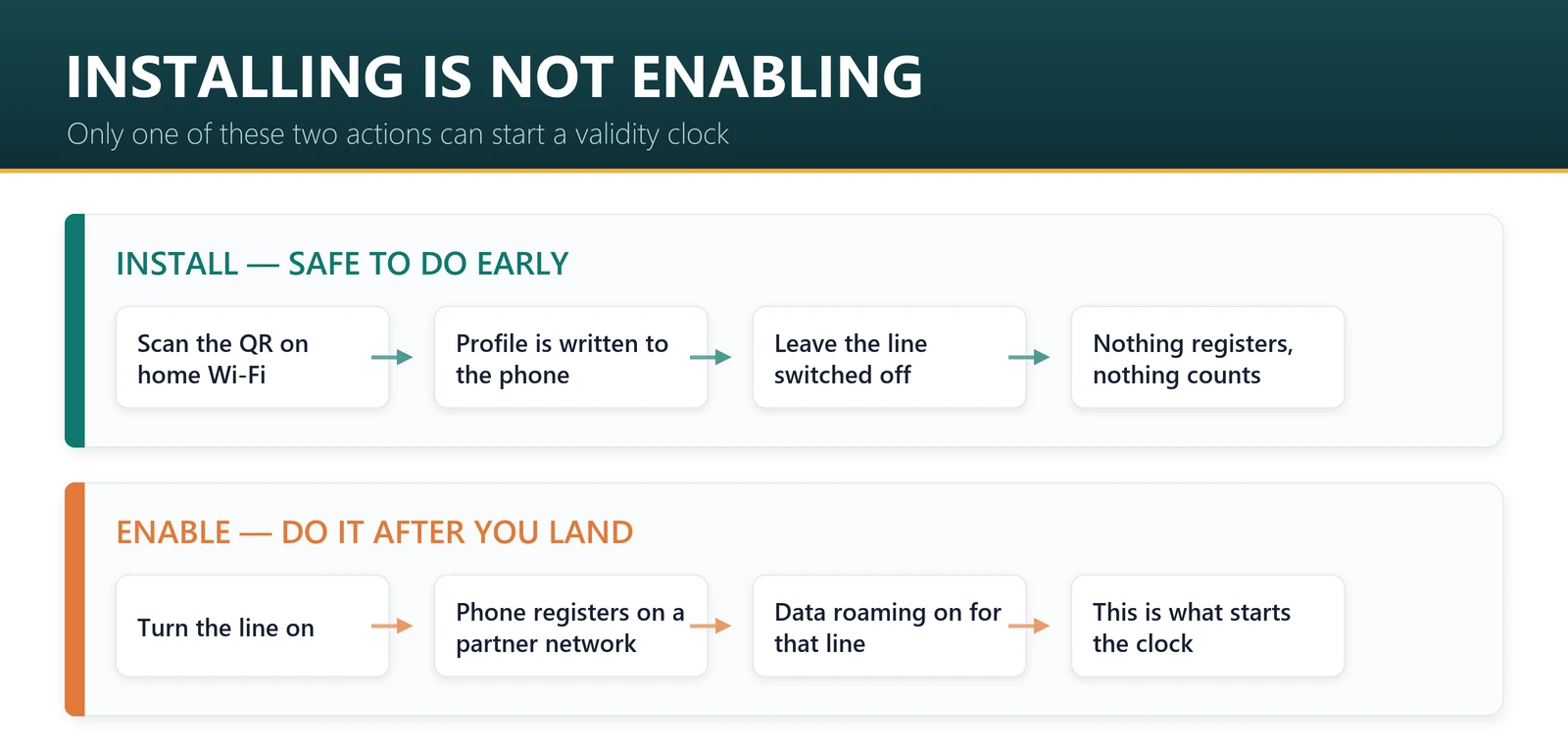
The fix is a distinction most people never make: installing an eSIM and enabling the line are two different actions.
- Installing writes the profile onto your phone. This is the part that needs Wi-Fi and that you want to do calmly at home.
- Enabling turns that line on so it can register on a network. This is the part that can start a clock.
On iPhone, after adding the eSIM you can leave the line switched off under Settings → Cellular until you land. On Android, the added SIM can be left disabled under Settings → Network & Internet → SIMs. Install early, enable on arrival, and every activation policy behaves the way you want.
How to check before you install
- Find the activation line on the product page before you pay. Every plan we sell states it: first data use, first network connection, or on installation.
- If it says “on installation”, plan the install for departure day — on your home Wi-Fi, before you leave for the airport. You still avoid the airport queue; you just do not do it a week early.
- If it says anything else, install whenever you like, but leave the line switched off until you land. This habit is correct for all three policies, so you never have to remember which one you bought.
- Check validity against your actual trip dates, not against the day you buy. For long plans this is where the money is.
If the plan does not connect once you enable it on arrival, work through the eSIM troubleshooting checklist — activation policy is almost never the cause of a connection failure, and the fix is usually one toggle.
Frequently asked questions
Does an eSIM start counting when you install it?
Usually not. Of the 827 plans we sell, 684 start on first data use and 106 on first network connection, so installing early costs nothing. 37 plans — about one in 22 — do start at installation, and those should be installed on your departure day rather than a week ahead. Every product page states which policy applies.
Can I install my eSIM weeks before I travel?
For most plans, yes, and it is the recommended approach: install on home Wi-Fi, then enable the line after you land. The exception is a plan whose activation policy says it activates on installation. The safe habit that works either way is to install early but leave the line switched off until arrival.
What is the difference between installing an eSIM and activating it?
Installing writes the eSIM profile onto your phone and requires an internet connection, usually Wi-Fi. Activation is what starts the plan’s validity period, and it is triggered by data use, network registration or installation depending on the plan. Installing is not automatically activating.
Which eSIM plans start counting at installation?
In our current range they are mostly larger and longer plans: no plan valid 15 days or less starts at installation, while 11 of the 17 plans valid over 90 days do. They cluster around Japan, South Korea, Taiwan, Indonesia and Israel, several Asian regional combinations, and the APAC, Half Global and Global bundles. Always confirm on the product page, since terms change.
If I install an eSIM at home, will it connect to a network before I travel?
It can, if your home country is on that plan’s coverage list — a regional or global plan may find a covered partner network where you live. For a plan that activates on first network connection, that can start the clock early. Leaving the line switched off until you land avoids this entirely.
Does deleting and reinstalling an eSIM reset the clock?
No. Validity is tracked on the plan, not on the copy of the profile on your handset, and most QR codes can only be installed once. Deleting an eSIM mid-trip usually means losing access to the remaining data rather than resetting anything.
Why do some plans activate at installation at all?
Activation rules are set by the network provider behind each plan, not by the retailer. Providers that issue long-validity or large-bundle products often start validity at installation because the profile is provisioned and reserved on their network from that point. It is a supplier term, which is why it is printed per plan rather than applied site-wide.
How do I check the activation policy before buying?
It is listed in the plan details on every product page, alongside network, hotspot, speed and top-up support. Read it before you pay, and again before you install — those are the two moments where the information changes what you do.
Bottom line
Installing early is free for 96% of the plans we sell, and it is still the right habit: you land connected instead of hunting for airport Wi-Fi. But 37 plans start counting the moment they are installed, and they are concentrated exactly where the cost is highest — no short plan behaves this way, while two thirds of the plans valid over 90 days do. The habit that makes the question moot: install on Wi-Fi whenever you like, leave the line switched off, and enable it after you land. Read the activation line before you pay, and check validity against your travel dates rather than your purchase date.
Browse plans with the activation policy shown on every page: all 191 destinations, or start with Japan, South Korea, Indonesia, Europe or Asia regional. New to eSIMs? Start with what is an eSIM and how it works, then see whether one eSIM works in multiple countries and how to keep your home number while travelling.
Last reviewed August 12, 2026. Plan counts and activation policies were counted from the 827 plans on sale at Code eSIM on that date, excluding top-up add-ons and out-of-stock items. Activation terms are set by the network providers behind each plan and change over time, so the activation line on the product page is always the authoritative version. Device menu paths vary by handset and operating system version.