
Which eSIM is best for a USA trip in 2026? The short answer: a prepaid travel eSIM that runs on one of the three nationwide 5G networks — AT&T, T-Mobile or Verizon — costs a fraction of what daily roaming passes charge, and activates before you board. This guide covers what US coverage really looks like outside the big cities, how much data a US trip needs, what plans cost, and the 10-minute setup that gets you online the moment you land at JFK, LAX or SFO.
Key numbers at a glance:
- Carrier roaming passes for the US typically cost $10–16 per day; a 30-day 10 GB travel eSIM usually costs less than two days of roaming.
- The US has three nationwide networks — AT&T, T-Mobile and Verizon; travel eSIMs ride on one of these, most commonly AT&T or T-Mobile.
- 5G covers the vast majority of Americans, but rural interstates and national parks can drop to 4G or no signal on any carrier.
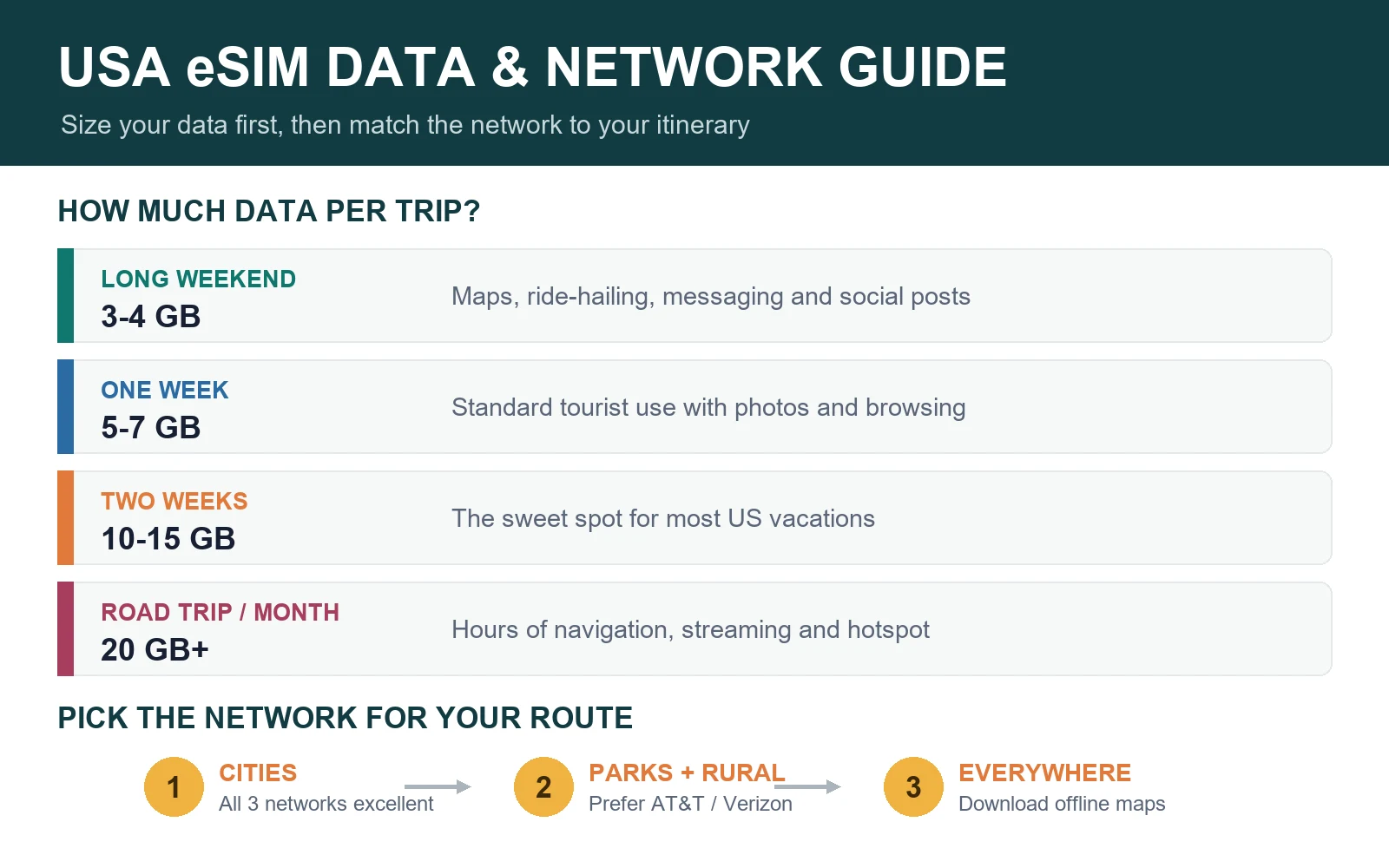
- A standard tourist uses 500 MB – 1 GB per day; two weeks in the US fits comfortably in 10–15 GB.
- US phone numbers are not included with data-only eSIMs — WhatsApp, iMessage and FaceTime handle calls over data, and your home SIM stays active for SMS codes.
Why use a travel eSIM in the USA?
The US is one of the most expensive countries to roam in on a home-carrier plan. Typical daily roaming passes run $10–16 per day — on a two-week trip that is $140–220 just for data you could buy outright for under $20. Airport SIM counters in the US are rare compared with Asia, and retail store prepaid SIMs usually require a US ID or take 30+ minutes of in-store setup. A travel eSIM skips all of it: you buy online, scan a QR code on hotel or home WiFi before departure, and data starts working when the plane door opens. For the full cost comparison across carriers, see our international roaming charges guide.
US networks: what coverage really looks like
Every travel eSIM for the USA runs on one of the three nationwide networks. The practical differences for a tourist:
| Network | Strengths | Worth knowing |
|---|---|---|
| AT&T | Broad nationwide coverage, strong in cities and suburbs, wide 5G footprint | The most common network behind travel eSIMs |
| T-Mobile | Fastest average 5G speeds in cities, dense urban coverage | Weaker than AT&T/Verizon in some rural areas |
| Verizon | Historically the strongest rural coverage | Fewer travel eSIM products use it; often slightly pricier |
For a city-focused trip — New York, Los Angeles, San Francisco, Chicago, Las Vegas, Miami — any of the three networks is excellent, so choose on price. If your itinerary is heavy on national parks and long rural drives (Yellowstone, the Utah parks, Route 66), expect dead zones on every carrier and download offline maps before you leave the city; an AT&T or Verizon-based plan has the edge outside metro areas.
How much data for a US trip?
US travel is navigation-heavy — driving directions, ride-hailing, restaurant lookups — but those are cheap in data terms. Our app-by-app data usage guide has the full numbers; the short version for the US:
| Trip | Light user | Standard tourist | Heavy user (video/hotspot) |
|---|---|---|---|
| Long weekend (4 days) | 1–2 GB | 3–4 GB | 8–12 GB |
| One week | 2–3 GB | 5–7 GB | 15–20 GB |
| Two weeks | 4–5 GB | 10–15 GB | 30–40 GB |
| One month (road trip) | 8–10 GB | 20–30 GB | 50 GB+ or unlimited |
Two US-specific notes: free WiFi is widespread (hotels, Starbucks, malls, many intercity buses), which pulls real usage down — but road trips flip that, because in-car navigation, Spotify streaming and passengers tethering laptops all run on cellular for hours at a time.
Types of USA eSIM plans
- USA-only plans — the best value per GB for a US-only trip; typical range runs from a few dollars for 1 GB to roughly $20–30 for 20 GB over 30 days.
- USA + Canada / North America plans — worth it if your route crosses into Canada or Mexico; one eSIM covers the whole loop with no border swap.
- Americas regional plans — cover a dozen or more countries; only pay the regional premium if you actually visit multiple countries.
- Unlimited plans — sensible for heavy hotspot users and long road trips; check the fair-use policy, as many throttle speed after a daily high-speed allowance.
Browse current USA eSIM plans to compare data sizes, validity and prices side by side, or check all destinations if the US is one stop on a longer trip.
Before you buy: 4 checks
- Phone compatibility. Your phone must be unlocked and eSIM-capable — iPhone XS or newer, most recent Pixels and Galaxys qualify. Two minutes with our eSIM compatibility check settles it.
- Network bands. Phones sold in Europe and Asia generally work fine on US networks in 2026, but very old or regional models can miss US 5G bands — they will fall back to 4G, which is fine for travel use.
- Hotspot support. If you plan to tether a laptop or share with family, confirm the plan allows hotspot — most do, some unlimited plans restrict it.
- Validity window. Confirm when the clock starts (at install vs. at first connection) and that it covers arrival and departure days.
Setup: 10 minutes before you fly
- Buy your USA eSIM online; the QR code arrives by email within minutes.
- On home or hotel WiFi, scan the QR code (iPhone: Settings → Cellular → Add eSIM; Android: Settings → Network → SIMs). Full walkthrough in the eSIM installation guide.
- Label it “USA travel”, enable Data Roaming for the eSIM line only, and keep your home SIM active for calls/SMS but with its data roaming off.
- On landing, the eSIM picks up the network automatically — no counter, no paperwork.
USA eSIM FAQ
Do travel eSIMs work in all 50 states?
Yes — plans are nationwide, not state-based. Coverage quality follows the underlying network (AT&T, T-Mobile or Verizon), so cities are uniformly strong while remote rural areas vary by carrier. Alaska and Hawaii are included on nationwide plans, though remote parts of Alaska have limited coverage on every carrier.
Does a USA eSIM come with an American phone number?
Most travel eSIMs are data-only with no US number. Calls and messages run over data via WhatsApp, iMessage, FaceTime or Telegram, and your home SIM stays in the phone for receiving SMS verification codes. If you specifically need a US number for local services, look for the minority of plans that include one.
Is hotel and public WiFi enough — do I even need data in the US?
WiFi is common but gaps appear exactly when you need data most: navigation while driving or walking, ride-hailing pickups, mobile boarding passes and two-factor codes on the move. A small eSIM plan as a baseline plus WiFi for heavy tasks is the setup that works.
Which network should my USA eSIM use?
For city trips, whichever is cheapest — all three are excellent in metro areas. For national parks and rural driving, prefer AT&T or Verizon-based plans and always carry offline maps; remote areas have dead zones on every network.
Can I top up if I run out of data?
Most plans support top-ups purchased online in minutes, without changing the eSIM. Buying a size up front is usually cheaper per GB than topping up mid-trip, so round up if you are between sizes.
Bottom line
For 2026 the math is simple: daily roaming passes cost $10–16 per day while a travel eSIM covers an entire two-week US trip for the price of one or two roaming days. Pick a USA-only plan sized to your trip (10–15 GB for two standard-tourist weeks), prefer AT&T-network plans if you’ll leave the cities, install on WiFi before departure, and land online. Compare current USA eSIM plans here.
Last reviewed July 16, 2026. Coverage characteristics and typical prices reflect publicly available carrier information as of mid-2026; check individual plan pages for current terms. Reference reading: Apple Support: Use eSIM while traveling internationally.