
Every travel eSIM listing tells you the destination, the gigabytes and the price. Almost none of them tell you the thing that actually determines whether you have signal in a valley in Hokkaido or on a road two hours outside Riyadh: which local mobile network the plan roams onto.
That is not a detail you get to choose. It is fixed by whoever built the plan, it varies from one plan to the next inside the same country, and it is the single biggest predictor of real-world coverage once you leave the cities. So we mapped it — every partner network named across the 829 plans on sale in our catalogue on 18 August 2026 — and published what we found, including the parts that do not flatter us.
The headline finding is not that coverage is bad. It is that plan availability does not track network quality. In several countries, the operator with the best rural reach is the one you are least likely to get.
Why the carrier matters more than the brand on the box
A travel eSIM does not build a network. It buys wholesale access to networks that already exist, and when you land, your phone registers on one of them as a roaming visitor. Everything you experience — bars of signal, whether 5G appears, how far out of town you can drive before things get patchy — is a property of that host network, not of the company that sold you the plan.
This has a consequence worth sitting with. Two eSIMs sold for the same country, at a similar price, by the same retailer, can behave very differently in the same village, because one rides on the incumbent operator with 30 years of tower building behind it and the other rides on a challenger that concentrated its spend on cities. The label on the product will not tell you that. The partner network line will.
It also explains why the honest answer to “is this eSIM good in rural Australia” is never a yes or a no. It depends entirely on which of the three Australian networks that particular plan uses, and the answer is printed on the product page.
How we built this map
We took every plan on sale in our catalogue on 18 August 2026 — 829 after excluding top-up packages and out-of-stock items — and read the partner network field that each network provider supplies for its own plans. All 829 carry that data, and 508 of them name more than one carrier in at least one country, which is why a single plan can fall back between networks.
The raw data needed cleaning before it could be counted, and the cleaning is worth describing because it is where this kind of table usually goes wrong. Different suppliers write the same operator differently: KDDI and au (KDDI), SKTelecom and SK Telecom and SKT, Du and du, AIS and AIS/AWN. Counted naively, South Korea appears to have five operators and Croatia seven. It does not.
So we merged writing variants of the same entity — case, spacing, parenthetical notes, local legal names — and deliberately did not merge corporate relationships. HKT and csl are kept separate even though one owns the other; VNPT and Vinaphone likewise. Merging those would mean making a judgement on the reader’s behalf about whether two brands are one network, and that is a judgement we would rather leave visible than bury in a total.
After normalisation: 190 countries and territories with at least one named partner network, and 533 distinct operator entries across them.
The map: partner networks across 20 destinations
Read this as “how many of our plans name this operator”, not as a market share table. A high number means you are likely to land on that network; a low one means it exists in the range but you have to look for it.
| Destination | Partner networks, by number of plans naming them |
|---|---|
| Japan | NTT docomo (39) · KDDI (37) · SoftBank (33) · Rakuten (15) |
| South Korea | SK Telecom (75) · LG U+ (33) |
| China | China Unicom (39) · China Telecom (30) · China Mobile (29) |
| Taiwan | Chunghwa (47) · Taiwan Mobile (17) · FarEasTone (4) |
| Hong Kong | 3 (35) · SmarTone (20) · csl / 1010 (16) · HKT (4) · CMCC HK (4) |
| Thailand | AIS (56) · TrueMove (32) · dtac (23) |
| Vietnam | Vinaphone (44) · MobiFone (18) · Vietnamobile (12) · Viettel (11) |
| Singapore | SingTel (41) · StarHub (38) · SIMBA (18) |
| Malaysia | Maxis (46) · DiGi (38) · U Mobile (37) · Celcom (32) |
| Indonesia | Telkomsel (71) · XL (59) · Smartfren (25) · Indosat Ooredoo (18) · 3 (14) · AXIS (4) |
| USA | Verizon (72) · AT&T (63) · T-Mobile (39) |
| United Kingdom | Vodafone (64) · O2 (57) · EE (51) · 3 (34) |
| France | Orange (73) · Free Mobile (73) · Bouygues (65) · SFR (7) |
| Germany | Vodafone (66) · O2 (58) · Deutsche Telekom (40) |
| Italy | Iliad (53) · Vodafone (51) · WINDTRE (32) · TIM (14) |
| Spain | Orange (66) · Vodafone (59) · Movistar (58) · Yoigo (13) |
| Turkey | Türk Telekom (81) · Turkcell (62) · Vodafone (51) |
| UAE | du (44) · e& / Etisalat (9) |
| Saudi Arabia | Zain (23) · Mobily (12) · STC / Al Jawal (8) |
| Australia | Optus (50) · Telstra (11) · Vodafone (11) |
Three things the data shows
Most markets are fully represented
In the large majority of the destinations above, every national operator appears somewhere in the range. The United States gives you all three of Verizon, AT&T and T-Mobile; the UK all four; Spain, France and Malaysia all four; China, Germany, Turkey, Thailand and Taiwan all three. If you are travelling to a major market and you care which network you use, you can almost always find a plan that names it.
South Korea is the one visible gap
Korea has three national operators. Our range names two: SK Telecom, on 75 plans, and LG U+ on 33. KT does not appear at all. We would rather write that down than let the table imply otherwise. In practice Korean urban coverage is excellent on all three, so this matters less than it would in a country with big rural gaps — but if you specifically need KT, we do not currently have it, and no amount of plan comparison on our site will change that.
Availability does not track coverage quality
This is the finding with the most practical consequence, and it repeats across several countries:
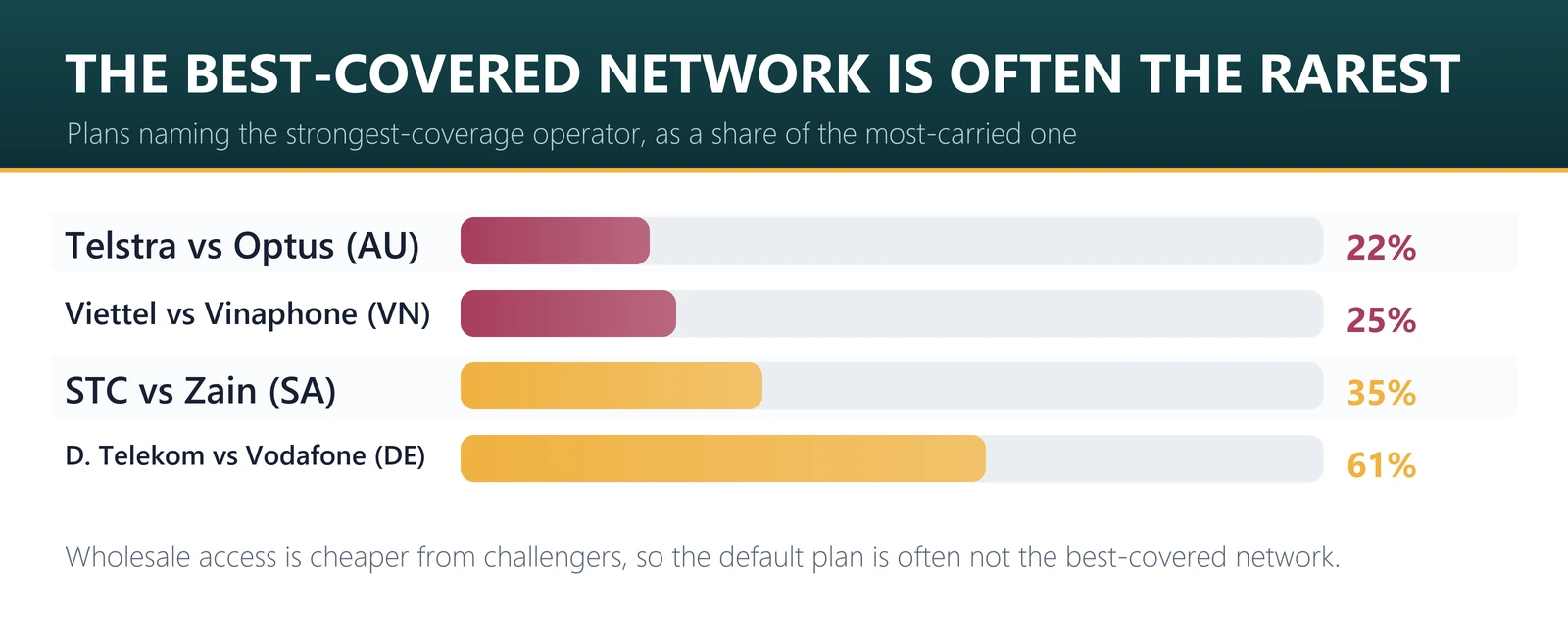
- Australia: Optus appears on 50 plans; Telstra on 11. Telstra is widely regarded as the network to have once you leave the coast and the capitals. The plan you are most likely to buy is not the one with the best outback reach.
- Saudi Arabia: Zain leads with 23 plans; STC, the incumbent with the longest-built footprint, appears on 8.
- Vietnam: Vinaphone appears on 44 plans; Viettel — the country’s largest operator by subscribers and the one with the deepest rural build — on 11.
- Germany: Vodafone on 66 and O2 on 58, against 40 for Deutsche Telekom, which has historically led German coverage benchmarks.
None of this is a conspiracy. Wholesale access is negotiated network by network, and challengers are usually more willing to sell capacity cheaply than incumbents with a coverage advantage to protect. But the effect on you is real: the default choice in a country is often the cheaper wholesale network rather than the best-covered one, and if your trip is urban that is a fine trade, while if you are driving into the Northern Territory it is not.
Multi-network plans, and why they are usually the safer buy
508 of the 829 plans name more than one carrier somewhere in their coverage. That matters because a phone on a multi-network profile can register on whichever partner is usable where you happen to be standing, rather than being tied to one operator’s tower map.
Indonesia is the clearest example. It is roughly 17,000 islands, coverage genuinely varies between them, and our Indonesian plans bundle Telkomsel with XL as standard — plus Smartfren, Indosat, 3 or AXIS on some. If one is weak on a particular beach, the phone has somewhere else to go. A single-network plan in that geography is a narrower bet.
The caveat is that “multi-network” on a product page means the profile is permitted on several partners, not that your phone will constantly hop between them looking for the best one. Handsets are conservative about re-selection; if you are getting nothing usable, forcing a manual network choice in your phone’s settings is often what actually fixes it.
How to use this before you buy
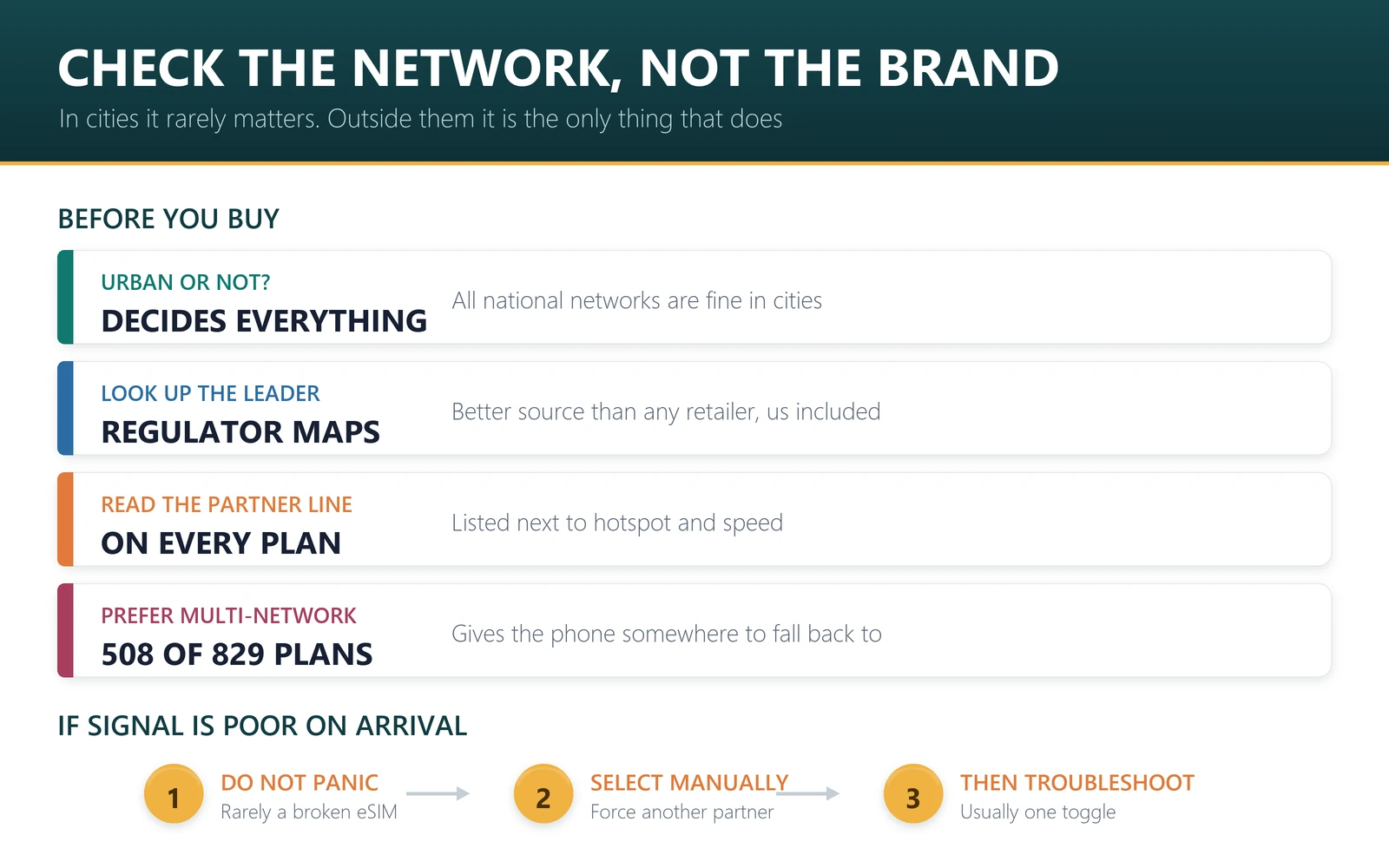
- Decide whether your trip is urban or not. In cities, all national networks in these markets are fine and this whole question is academic. The moment your itinerary includes mountains, islands, deserts or long drives, the carrier becomes the most important spec on the page.
- Look up which operator leads coverage at your destination — national regulators and independent measurement firms publish this, and it is a better source than any retailer, us included.
- Then read the partner network line on the plan, not the brand name of the plan. It is listed on every product page we sell, next to hotspot and speed.
- Prefer a plan naming more than one network where the geography is difficult, so your phone has a fallback.
- If signal is poor on arrival, try selecting the network manually before assuming the eSIM is broken. Our troubleshooting checklist covers the sequence.
What this data cannot tell you
Being specific about the limits is the point of publishing a table like this rather than a marketing claim.
These counts describe which networks our plans are permitted to use, not how well those networks perform. We are not a measurement company; we have not drive-tested anything, and the coverage judgements above — Telstra in regional Australia, Viettel’s rural build, Deutsche Telekom’s benchmark record — reflect the general industry consensus rather than our own testing. Treat them as reasons to check a regulator’s coverage map, not as findings of ours.
The figures are also a snapshot. Our catalogue syncs daily, wholesale agreements change, and a network that appears on 40 plans today may appear on 20 next quarter. The product page is always more current than this article. And where a provider did not supply a partner network at all, that plan contributes nothing here — in this dataset that case did not arise, since all 829 carry the field, but it can.
Finally, one operator being on more plans than another says nothing about which is better. It reflects wholesale economics, and as the Australian and Saudi rows show, it often points the opposite way.
Frequently asked questions
Which network does a travel eSIM use?
A local one, chosen by the plan rather than by you. Your phone registers on a partner operator in the country you are visiting as a roaming visitor. Across the 829 plans on sale in our catalogue on 18 August 2026, every plan names its partner network or networks on the product page, and 508 name more than one.
Can I choose which carrier my eSIM connects to?
Not directly — you choose it by choosing the plan. If a plan names several partners, your phone will normally select among them automatically, and you can force a specific one through your handset’s manual network selection if the automatic choice is performing badly.
Which network is best in Japan for a travel eSIM?
All four Japanese operators appear in our range: NTT docomo on 39 plans, KDDI on 37, SoftBank on 33 and Rakuten on 15. docomo and KDDI have the longest-established rural footprints, which matters if you are travelling outside the main corridors; in Tokyo, Osaka and Kyoto the practical difference is small.
Do travel eSIMs work on Telstra in Australia?
Some do. Optus appears on 50 of our Australian plans and Telstra on 11, so Telstra plans exist but are the minority. If your route goes well beyond the coastal cities, it is worth filtering for the Telstra plans specifically rather than taking the default.
Why do two eSIMs for the same country perform differently?
Because they are almost certainly riding on different host networks. Coverage, 5G availability and rural reach are properties of the partner operator, not of the retailer. Two plans at a similar price for the same destination can sit on an incumbent and a challenger respectively, and behave very differently once you leave the cities.
Is a multi-network eSIM better than a single-network one?
In difficult geography, usually yes, because the profile is permitted on more than one operator and your phone has somewhere to fall back to. In a compact, well-covered country the advantage is smaller. 508 of our 829 plans name more than one carrier.
Does your range include KT in South Korea?
No. Our Korean plans name SK Telecom (75 plans) and LG U+ (33). KT does not currently appear in the range. Urban coverage in Korea is strong on all three networks, but if you specifically need KT, we do not have it.
Can I cite this data?
Yes. Please attribute it as Code eSIM’s partner network map, 18 August 2026, covering 829 travel eSIM plans, and link to this page so readers can see the method and the limits alongside the numbers. If you need the underlying per-country breakdown for more than the 20 destinations shown here, get in touch.
Bottom line
The network your travel eSIM lands on is a specification, not a preference, and in most listings it is the specification least likely to be shown to you. In cities it rarely matters. Outside them it is the only thing that matters, and the operator with the best reach is frequently the one carried by the fewest plans — Telstra in Australia, STC in Saudi Arabia, Viettel in Vietnam. Look up which network covers your actual route, then read the partner network line on the plan before you look at the price.
Every product page we sell lists its partner networks: browse all 191 destinations, or go straight to Japan, Australia, Indonesia, Saudi Arabia or USA. Related reading: whether one eSIM covers multiple countries, where your traffic actually exits and eSIM versus a local physical SIM.
Last reviewed 18 August 2026 by the Code eSIM team. Partner network counts were derived from the 829 plans on sale that day, excluding top-up packages and out-of-stock items, using the partner network field published on each product page and supplied by the network provider behind each plan. Writing variants of the same operator were merged; distinct corporate brands were not. Counts describe which networks a plan may use, not measured performance. Wholesale agreements change and the catalogue syncs daily, so the product page is always the authoritative version.