
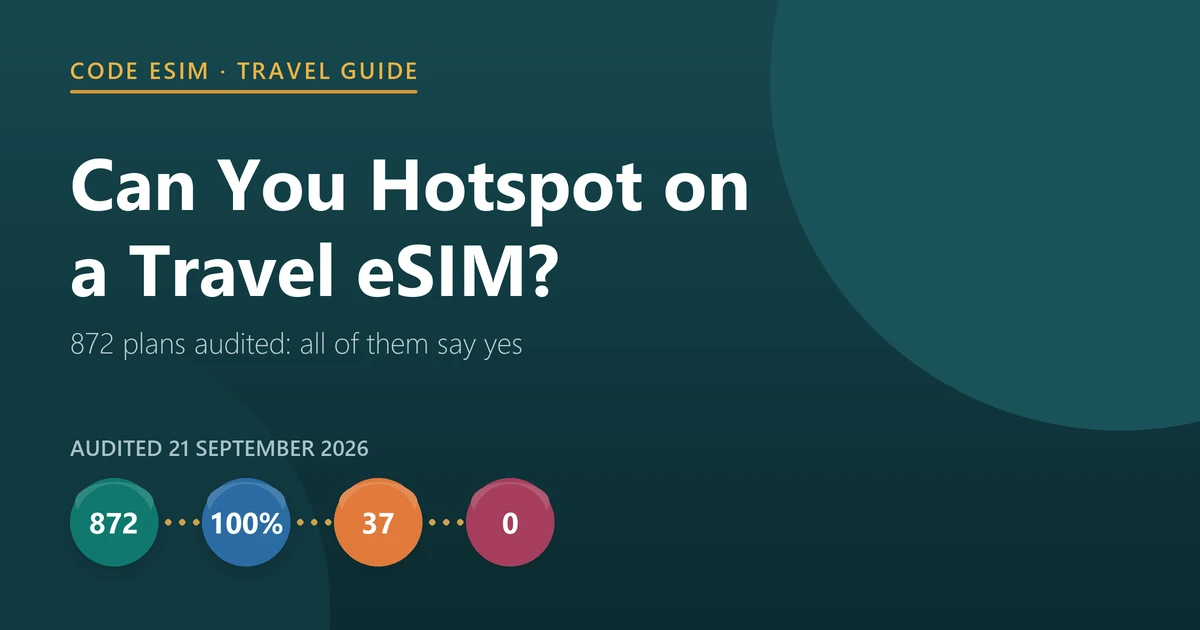
Yes: all 872 travel eSIM plans on sale in our catalogue on 21 September 2026 list Personal Hotspot as supported. Not most of them — all of them. The question that actually decides whether tethering works for you is not permission but capacity, and there the catalogue says something more interesting: 835 of 872 plans carry no speed cap at all, and every single plan that does carry one is an “unlimited” plan.
Hotspot support is one of the most-asked questions about travel data, and almost every answer online is either a single provider describing its own plans or a guess. This is an audit: one field, every plan, one date, with the denominator attached.
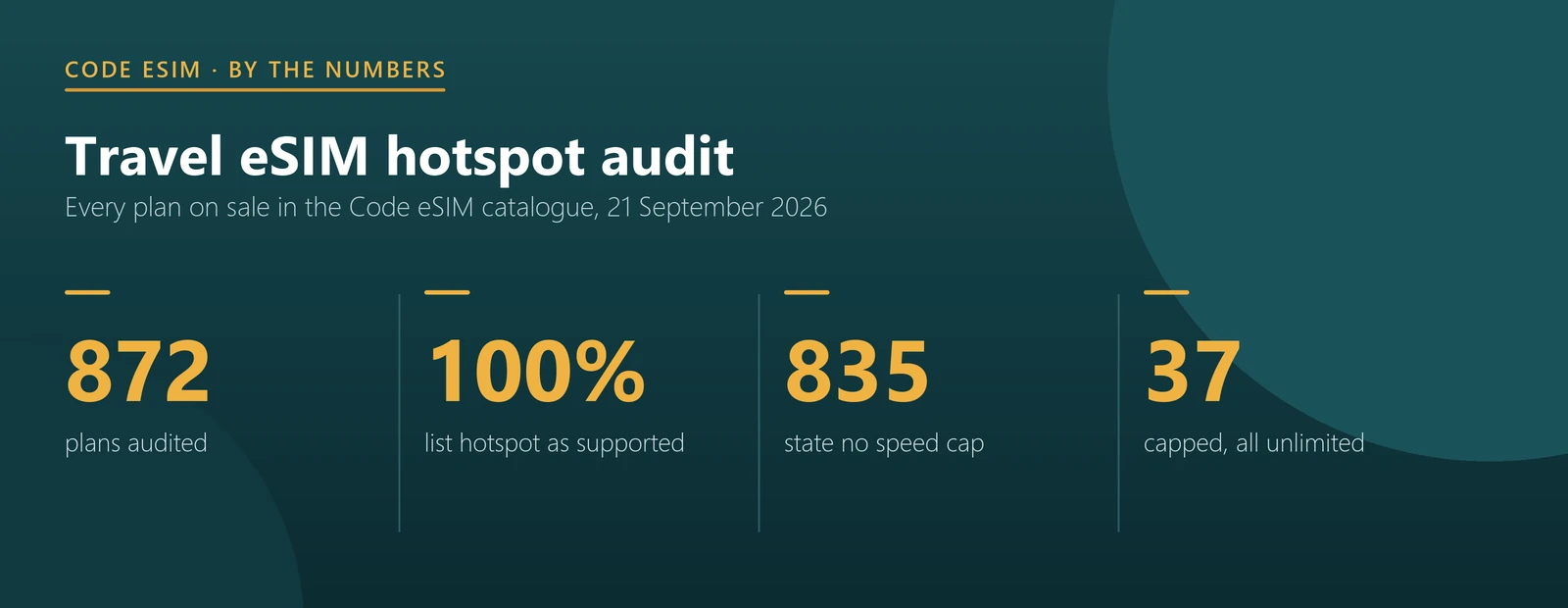
- Hotspot supported: 872 of 872 plans (100%).
- No speed cap: 835 of 872 plans (95.8%).
- Speed-capped: 37 plans (4.2%) — the same 37 plans that describe themselves as unlimited.
- Fixed-data plans with a cap: zero.
- What actually limits you: your allowance, not a tethering switch.
What the audit found
We read four fields on every published plan: hotspot, speed limit, data allowance and validity. Here is the result, with denominators.
| Finding | Plans | Share of 872 |
|---|---|---|
| Hotspot listed as supported | 872 | 100% |
| Hotspot listed as not supported | 0 | 0% |
| Described as “No speed cap” | 835 | 95.8% |
| Carries a stated speed cap | 37 | 4.2% |
| Unlimited-data plans | 37 | 4.2% |
| Unlimited plans that are capped | 37 of 37 | 100% |
| Fixed-data plans that are capped | 0 of 835 | 0% |
The last three rows are the finding worth carrying away. In this catalogue, “unlimited” and “speed cap” are the same set of plans: every plan that markets itself as unlimited also states a cap in its own description, and no fixed-allowance plan states one. Typical wording on those 37 plans is “3GB/day at 20Mbps, 1Mbps afterwards” or “Total 30 GB at full speed, 2Mbps speed cap afterwards”.
Why tethering is rarely blocked, and what bites instead
A travel eSIM is a prepaid data profile roaming on a local network. There is no contract term to police, no subsidised handset to protect, and the plan has already been paid for. Blocking tethering would cost the seller support tickets and gain nothing, which is why the field reads the way it does across the whole catalogue.
What bites is arithmetic. A phone on maps and messaging uses 500 MB to 1 GB a day. A laptop tethered to that phone behaves like a laptop: cloud sync, software updates, video calls with the camera on, a browser with thirty tabs restoring at once. It is entirely normal for a tethered laptop to use more data in an afternoon than the phone uses all week.
| What you tether | Realistic daily use on top of phone data | Plan size to consider for a week |
|---|---|---|
| Laptop, email and documents | 1–2 GB | 15–20 GB |
| Laptop, video calls a few hours a day | 3–5 GB | 30 GB or more |
| Tablet for streaming in the evening | 3–7 GB | 30 GB or more |
| A second phone for a travel companion | 0.5–1 GB | Two plans, not one |
These are planning figures, not measurements from your device: actual use depends on video quality, sync settings and how much the operating system decides to download while you are not looking. Our data usage guide explains the sizing method, and what happens when an eSIM runs out covers the moment it goes wrong.
The unlimited trap, in the catalogue’s own words
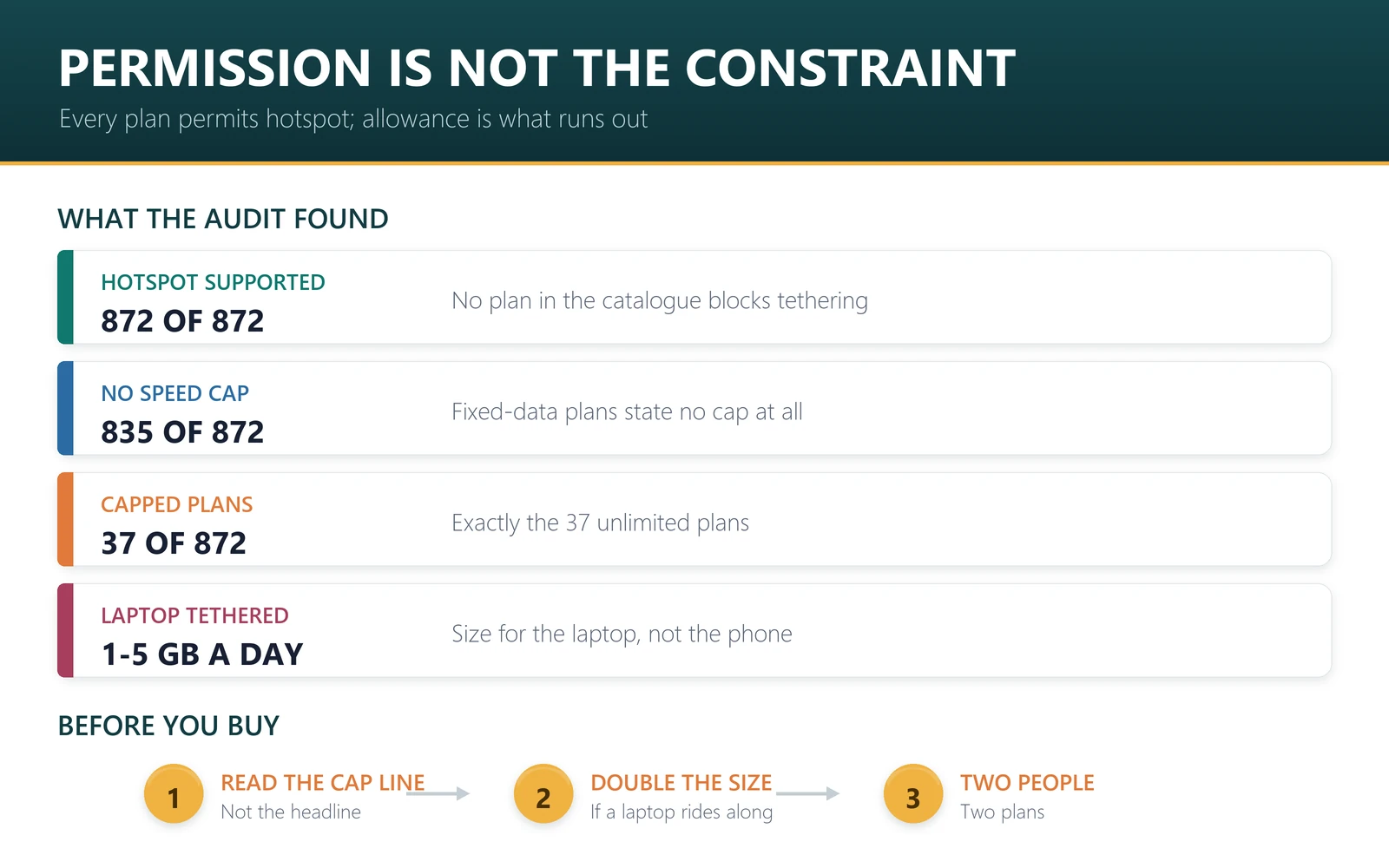
If you are buying specifically to tether, the 37 unlimited plans look like the obvious choice and are often the wrong one. Their own descriptions state the cap: a daily high-speed allowance, then a reduced speed for the rest of the day. At 1 Mbps a laptop still loads email and messaging, but video calls and large uploads become painful.
A fixed-data plan behaves differently. It gives you a number, does not throttle you along the way in this catalogue, and stops when the number is gone. For tethering, most people are better served by a large fixed allowance than by an unlimited plan with a daily ceiling — unless the daily ceiling is comfortably above what you need every day. Our guide on whether unlimited eSIM data is really unlimited goes through the wording in detail.
How to check before you buy
- Read the speed limit line, not the headline. “Unlimited” with “3GB/day at 20Mbps” is a 3 GB-a-day plan with a slow tail.
- Size for the laptop, not the phone. If a tethered laptop is part of the trip, double what you would buy for yourself.
- Check the hotspot line anyway. It is on every product page. Our catalogue is unanimous today; other sellers and future stock may not be.
- Two travellers, two plans. Sharing one hotspot drains one battery and one allowance, and splits up the moment you do.
- Remember the battery. Hotspot is one of the heaviest things a phone does; plan a power bank for long travel days.
Need a plan that can carry a laptop? Filter by size on any destination page: Japan, Europe, the US, Turkey, or all 190+ destinations. Every plan page states hotspot, speed limit and validity before you pay.
Method, and what this audit does not prove
We read the hotspot, speed limit, data and validity fields on every product published in our own catalogue on 21 September 2026, excluding items hidden from the catalogue, and counted the values. The population is 872 plans from 14 suppliers covering single-country, regional and global coverage. Figures are a snapshot: stock changes daily, so the numbers will drift.
What this does not prove: it describes the plans we sell, not the whole travel eSIM market, and it reports what each plan states rather than what a network does on the day. We have not measured tethering speeds in any country, and a plan permitting hotspot cannot promise the local network will be fast where you are standing.
Citing this: you are welcome to quote or reproduce these figures in articles, comparisons or videos, with credit to Code eSIM and a link to this page. Suggested citation: Code eSIM, Travel eSIM Hotspot Audit, 21 September 2026, 872 plans. For per-country pricing, our travel eSIM price index covers cost per GB across 69 countries.
Frequently asked questions
Can you use a hotspot with a travel eSIM?
Yes. In our audit of 872 travel eSIM plans on 21 September 2026, every plan listed Personal Hotspot as supported. Tethering is rarely restricted on prepaid travel data; what limits you is the size of your allowance, not permission.
Do travel eSIMs block tethering?
None of the 872 plans we audited listed hotspot as unsupported. Prepaid travel data has no contract to protect, so blocking tethering would create support work without benefit. Always check the hotspot line on the plan page, since stock and sellers vary.
How much data does tethering a laptop use?
Plan for 1–2 GB a day for email and documents, and 3–5 GB a day if you are on video calls. A tethered laptop often uses more in an afternoon than a phone uses in a week, because of cloud sync, updates and browser tabs.
Are unlimited travel eSIMs good for hotspot use?
Often not. All 37 unlimited plans in our catalogue state a speed cap, typically a few GB per day at full speed and about 1 Mbps afterwards. For tethering, a large fixed-data plan without a cap is usually the better buy.
Do travel eSIM plans have speed caps?
Mostly no: 835 of 872 plans we audited describe themselves as having no speed cap. The 37 that do are exactly the 37 unlimited plans. No fixed-allowance plan in the catalogue states a cap.
Can two people share one travel eSIM hotspot?
Technically yes, and practically it is usually a false economy. One phone carries the battery drain and the whole allowance, and the connection disappears when the group splits up. Two plans cost little more and remove the dependency.
Does hotspot drain the battery faster?
Yes. Sharing a connection keeps the modem and Wi-Fi radio working continuously, which is heavier than ordinary phone use. On long travel days, plan for a power bank if the hotspot will be running for hours.
Where do I check hotspot support before buying?
On the plan page itself. Every product page in our catalogue lists hotspot support, the speed limit wording, data allowance and validity before checkout, so you can confirm rather than assume.
Bottom line
Tethering is not the problem it is made out to be: every one of the 872 plans we audited permits it. The real decisions are size and fine print. Buy for the laptop rather than the phone, read the speed limit line rather than the headline, and be sceptical of unlimited plans if hotspot is the point — in this catalogue they are the only plans with caps at all.
Audited 21 September 2026 across 872 plans on sale in the Code eSIM catalogue, excluding items hidden from the catalogue. Figures describe the plans we sell on that date, not the whole market, and stock changes daily. Data-use figures are planning estimates, not measurements. Illustrations are our own.