
For a traveller, the one hard difference between iPhone Duo and Galaxy Z Fold8 is the SIM tray. Samsung lists the Fold8’s SIM slot type as “SIM 1 + eSIM / Dual eSIM”, with a nano-SIM and an embedded SIM. Apple describes iPhone Duo as an “eSIM-only design worldwide”. If you still buy local SIM cards on trips, only one of these phones will take them.
Most other differences are about taste and ecosystem, not travel. Both unfold to a 7.6-inch inner screen and have a 5.4-inch outer one. Samsung’s is lighter and thinner by its own figures, 201 g against Apple’s 254 g. Apple quotes longer video playback, but the two companies test differently. The bigger practical question for most people is whether they are switching platform, because moving from iPhone to Android or the other way is a larger change than the fold.
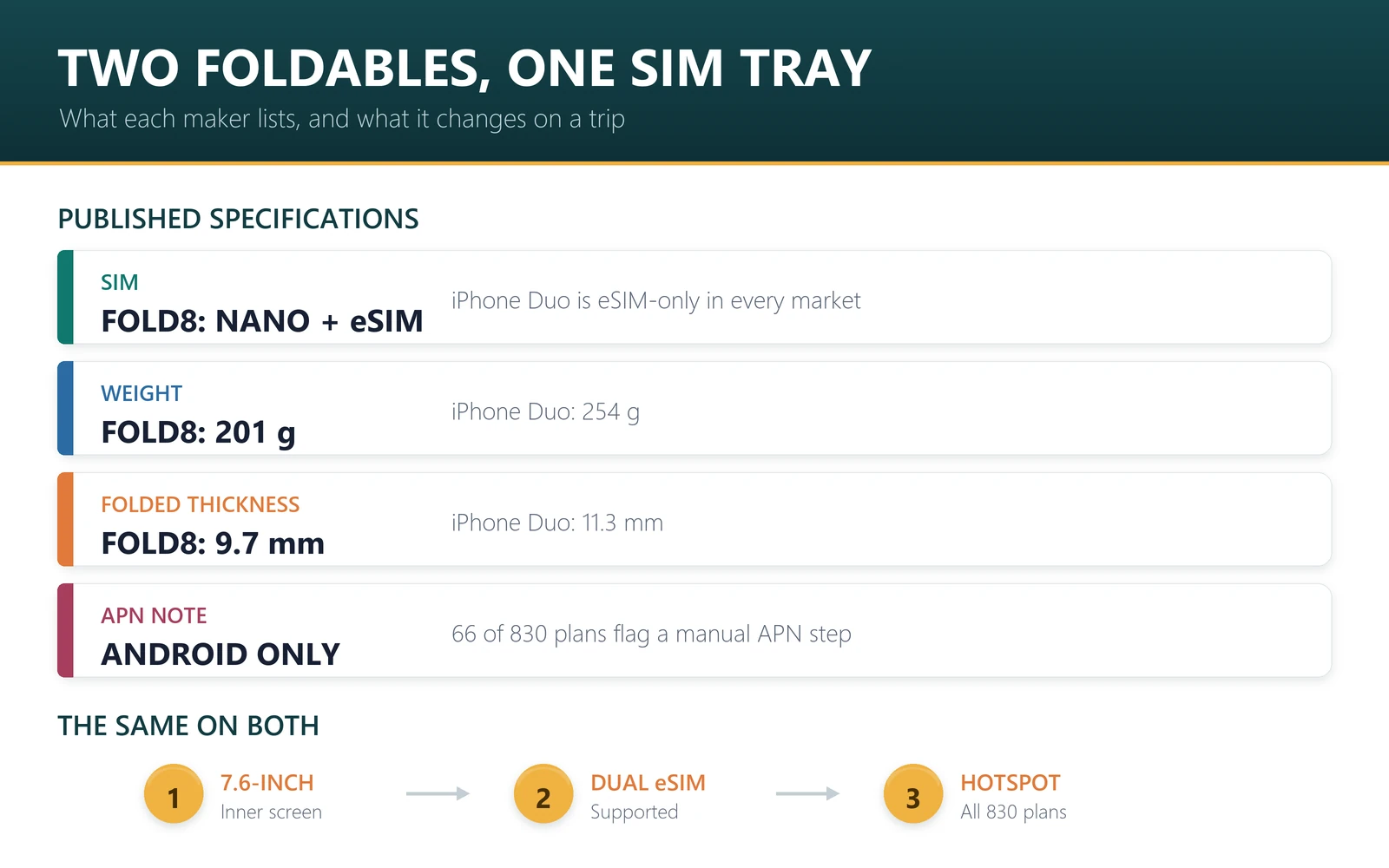
- SIM: Galaxy Z Fold8 lists nano-SIM plus eSIM, or dual eSIM; Samsung notes configuration may vary by market. iPhone Duo is eSIM-only everywhere.
- Weight and thickness: Fold8 201 g, 9.7 mm folded. Duo 254 g, 11.3 mm folded.
- Screens: both 7.6-inch inside and 5.4-inch outside, measured with rounded corners.
- Travel eSIM setup: 66 of the 830 plans we sell carry a note that Android users must set the APN manually.
- Availability: Galaxy Z Fold8 is on sale now; iPhone Duo arrives on 23 October 2026.
What each maker lists
Samsung figures are from its UK Galaxy Z Fold8 specifications and the specification FAQ on its Singapore store. Apple figures are from the iPhone Duo technical specifications. All were read on 13 September 2026.
| Specification | iPhone Duo | Galaxy Z Fold8 |
|---|---|---|
| SIM | Dual eSIM only; not compatible with physical SIM cards | Nano-SIM and embedded SIM; slot type “SIM 1 + eSIM / Dual eSIM” |
| Inner screen | 7.6-inch, 1878 x 2670 | 7.6-inch, 1848 x 2448 |
| Outer screen | 5.4-inch | 5.4-inch with rounded corners (5.5-inch as a full rectangle) |
| Weight | 254 g | 201 g |
| Thickness | 5.2 mm open, 11.3 mm closed | 4.5 mm open, 9.7 mm closed |
| Battery | Dual batteries; up to 24 hours typical use | 4,800 mAh |
| Video playback | Up to 31 hours on the inner display, 44 on the outer | Up to 26 hours |
| Chip | Apple A20 Pro | Snapdragon 8 Elite Gen 5 for Galaxy |
| Unlock | Touch ID in the side button | Fingerprint sensor |
| Storage | 256 GB to 2 TB | 256 GB to 1 TB |
| Software support | iOS 27.1 at launch | Samsung lists up to seven years of security updates and seven Android upgrades |
Treat the battery rows with care. Apple and Samsung each test their own way, so 31 hours against 26 is not a like-for-like result. Samsung also sells a larger Galaxy Z Fold8 Ultra with a 5,000 mAh battery; this comparison uses the standard Fold8.
The SIM tray: when it still matters on a trip
A physical SIM slot is no longer essential for most travellers, because a travel eSIM covers data on both phones. It still matters in four situations:
- Long stays with a local number. A prepaid SIM card from a kiosk is still the simplest route in many countries. With an eSIM-only phone you depend on a local carrier selling eSIMs to visitors.
- A home carrier without eSIM. If your plan only comes on a physical card, an eSIM-only phone cannot carry your home number at all.
- Swapping phones. A SIM card moves between handsets in seconds. A travel eSIM usually cannot move; most QR codes install only once.
- A failed install abroad. With a tray, a local SIM card is the fallback. Without one, you troubleshoot on Wi-Fi.
Samsung’s own wording carries a caveat: “Configuration availability may vary by market, network operator and device variant.” Check the listing for the exact Fold8 you are buying, especially from a carrier. Our eSIM vs physical SIM comparison goes deeper on the trade-offs, and what the Duo’s eSIM-only design means for travel covers the Apple side.
Taking a foldable abroad? Both phones run a travel eSIM for data. Browse plans by destination, or start with Japan, Europe or Thailand, and check the setup notes on the plan page.
Travel eSIMs on each phone
Both install a travel eSIM from a QR code, and both can keep a home line active beside it. There is one practical difference in our catalogue. Of the 830 plans on sale at codeesim.com on 13 September 2026, 66 carry a note that Android users must manually adjust APN settings. The APN, or access point name, is the setting that tells the phone how to reach the partner network’s internet gateway. On those plans, a Fold8 owner has one extra step after installing, and the plan page says so before you buy.
Everything else is the same on both phones. All 830 plans support hotspot, so either foldable can share its connection with a laptop. Plans start on the rule shown on the product page: 683 start on first data use, 106 on first network connection and 41 as soon as they are installed. When an eSIM starts counting explains the difference, and the installation guide covers iPhone and Android screens.
Switching platform is the bigger decision
For many buyers, choosing between these two is really choosing between iPhone and Android. That affects travel in ways that have nothing to do with the hinge.
- Your devices. An Apple Watch needs an iPhone; Apple says watchOS 27 requires iPhone 11 or later. If you wear one, moving to Android means leaving it behind. Watch cellular abroad has its own limits, which we cover in Apple Watch and travel eSIMs.
- Moving your number. Apple says that from iOS 26, some carriers and phone makers support transferring an eSIM from Android to iPhone and the reverse. Where they do not, your carrier issues a new eSIM.
- Travel eSIMs you already have. A profile installed on your current phone usually stays there. Finish the plan before switching, or keep the old phone for that trip.
When each one is the better travel phone
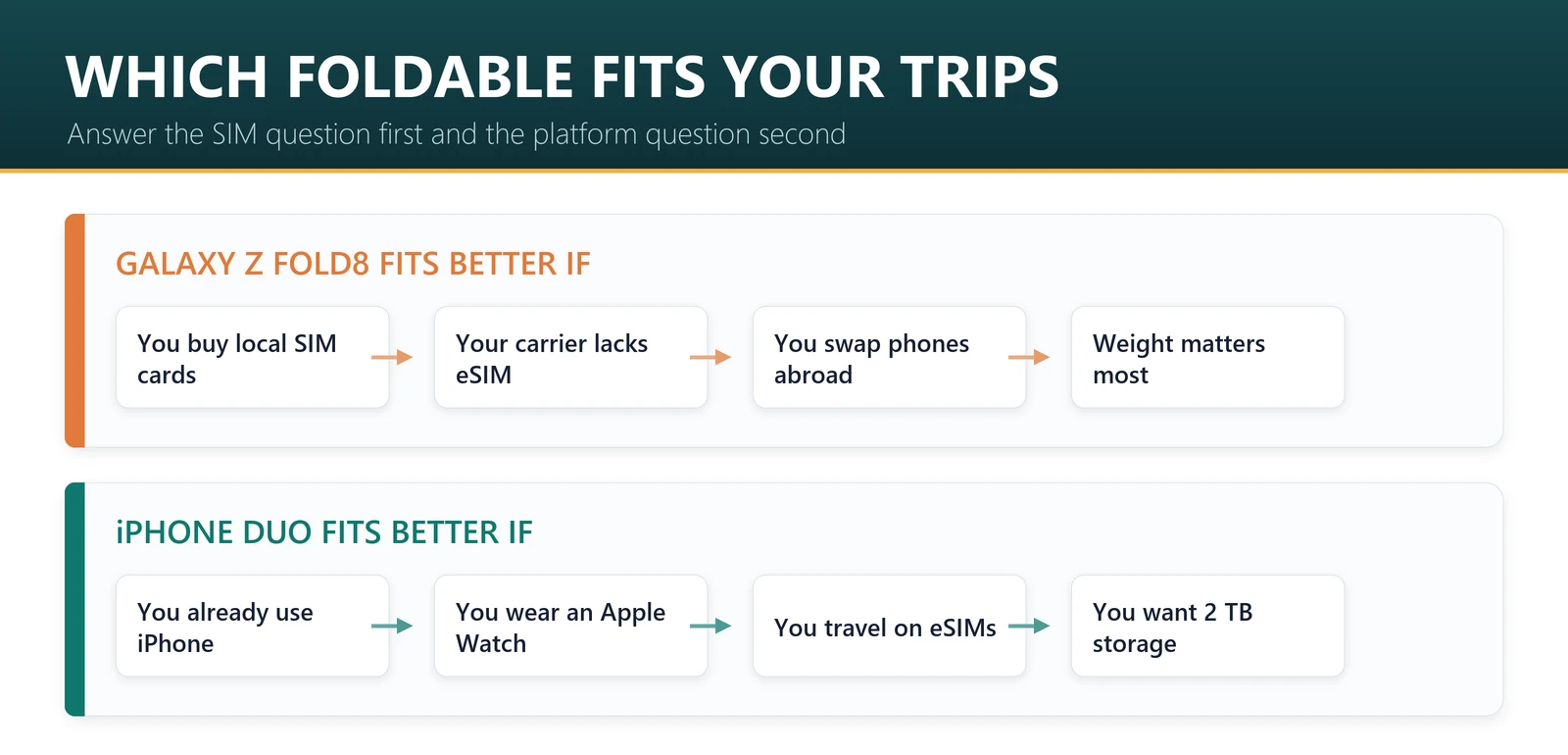
| If this describes you | Better choice | Why |
|---|---|---|
| You buy local SIM cards on long trips | Galaxy Z Fold8 | Nano-SIM slot where that configuration is sold |
| Your home carrier or plan has no eSIM | Galaxy Z Fold8 | iPhone Duo cannot take your number otherwise |
| Weight in a day bag matters most | Galaxy Z Fold8 | 201 g against 254 g |
| You travel on eSIMs already | Either | Both hold two active eSIMs |
| You use an Apple Watch or a Mac | iPhone Duo | Staying in one ecosystem avoids a platform switch mid-life |
| You shoot and store a lot of video | iPhone Duo | Storage up to 2 TB against 1 TB |
| Travelling before 23 October 2026 | Galaxy Z Fold8 | iPhone Duo is not on sale yet |
Sources, and what this cannot tell you
Galaxy Z Fold8 details are from Samsung’s UK specification page and Singapore specification FAQ, and its US product page for the chip and storage options. iPhone Duo details are from Apple’s technical specifications and announcement of 9 September 2026. All were read on 13 September 2026. Catalogue figures are our counts of the 830 plans on sale at codeesim.com on that date.
We have not used either phone, and we have not compared prices, which vary by market, carrier and promotion. SIM configurations can differ by country and by carrier variant, particularly for Samsung, so read the exact listing before buying. We make no claim about hinge durability or crease visibility.
Frequently asked questions
Does Galaxy Z Fold8 have a SIM card slot?
Samsung’s specifications list a nano-SIM and an embedded SIM, with the slot type “SIM 1 + eSIM / Dual eSIM”. Samsung adds that configuration availability may vary by market, network operator and device variant, so check the listing for the model you buy, especially a carrier version.
Can iPhone Duo use a physical SIM card?
No. Apple describes iPhone Duo as an eSIM-only design worldwide and says it is not compatible with physical SIM cards. It supports two active eSIMs and stores eight or more, so a home line and a travel data plan can run at the same time.
Is Galaxy Z Fold8 lighter than iPhone Duo?
Yes, by the makers’ figures. Samsung lists Galaxy Z Fold8 at 201 g and 9.7 mm thick when folded. Apple lists iPhone Duo at 254 g and 11.3 mm when closed. Both have a 7.6-inch inner screen and a 5.4-inch outer screen.
Which foldable has better battery life?
They are hard to compare directly. Apple quotes up to 31 hours of video on the Duo’s inner display and 44 on the outer one; Samsung quotes up to 26 hours of video for the Fold8 and a 4,800 mAh battery. The companies use different tests, so treat the numbers as indicative.
Do travel eSIMs work on Galaxy Z Fold8?
Yes, on an unlocked Fold8 with eSIM support. Some plans need one extra step on Android: 66 of the 830 plans we sell note that Android users must set the APN manually after installing. The note appears on the plan page before you buy.
Which foldable is better for travelling with local SIM cards?
Galaxy Z Fold8, where it is sold with a nano-SIM slot. iPhone Duo cannot take a physical SIM anywhere, so on a Duo a local number depends on a local carrier selling eSIMs to visitors, which can involve showing a passport.
Can I move my eSIM from iPhone to Galaxy Z Fold8?
Sometimes directly. Apple says that from iOS 26, some carriers and select phone makers support transferring an eSIM between Android and iPhone in both directions. Otherwise your carrier issues a new eSIM. A travel eSIM usually cannot be moved and should be used up first.
When is iPhone Duo available compared with Galaxy Z Fold8?
Galaxy Z Fold8 is already on sale. iPhone Duo pre-orders open on 16 October 2026, with availability from 23 October in more than 70 countries and from 30 October in 28 more, according to Apple.
Bottom line
If local SIM cards, a carrier without eSIM or a lighter bag matter to how you travel, the Galaxy Z Fold8’s SIM slot is a real advantage and the iPhone Duo cannot match it. If you already travel on eSIMs and live inside Apple’s ecosystem, the Duo’s lack of a tray costs you very little. Decide the SIM question first, the platform question second, and leave battery claims from two different test labs for last.
Last reviewed 13 September 2026. Specifications are from Samsung’s and Apple’s official product pages, read on that date and subject to change; configurations vary by market. Galaxy and Galaxy Z Fold are trademarks of Samsung Electronics; Apple, iPhone and iPhone Duo are trademarks of Apple Inc. This article is independent editorial commentary and is not affiliated with, sponsored by or endorsed by either company. Illustrations are our own.