
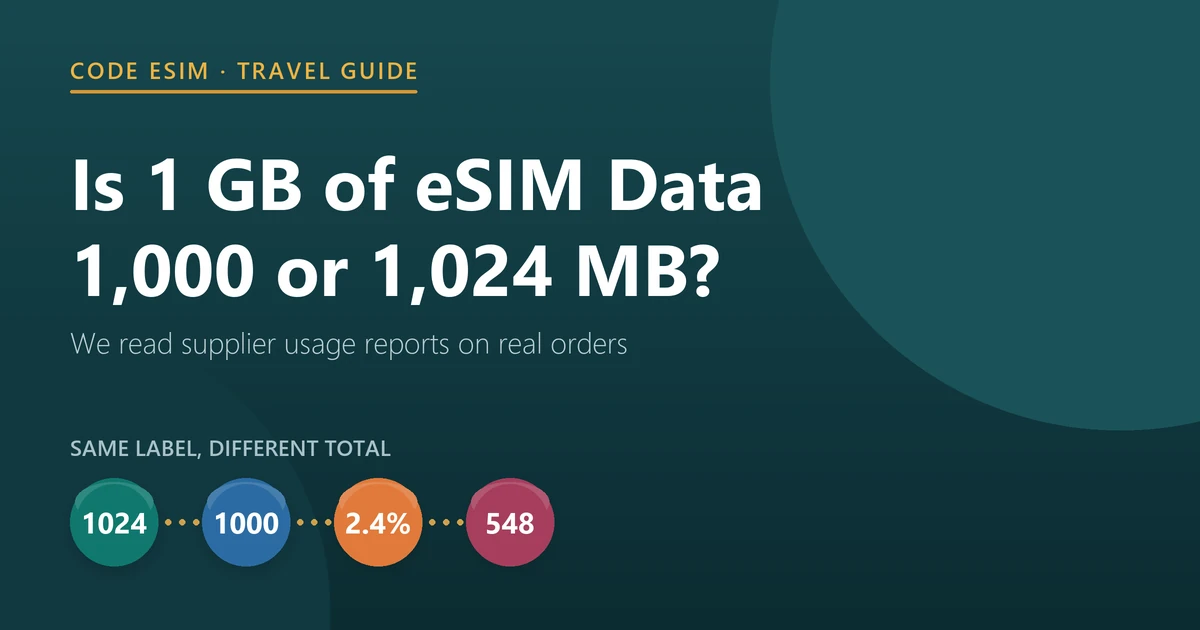
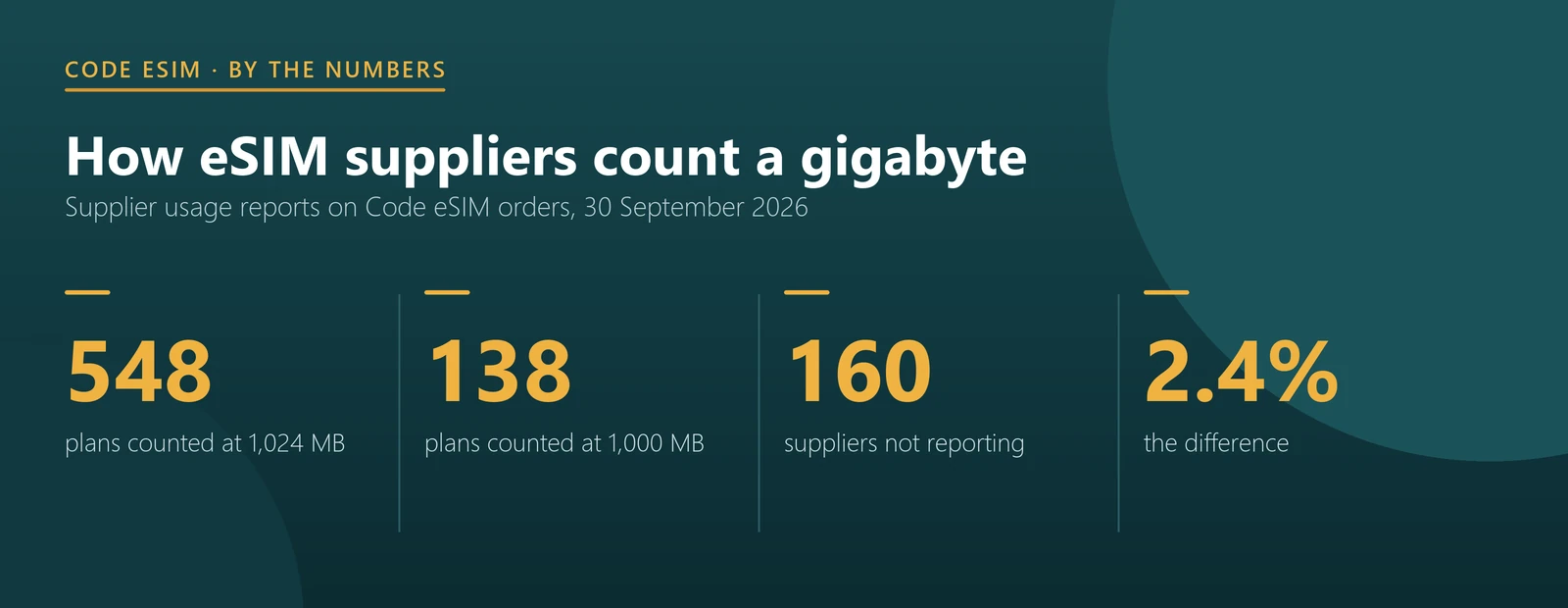
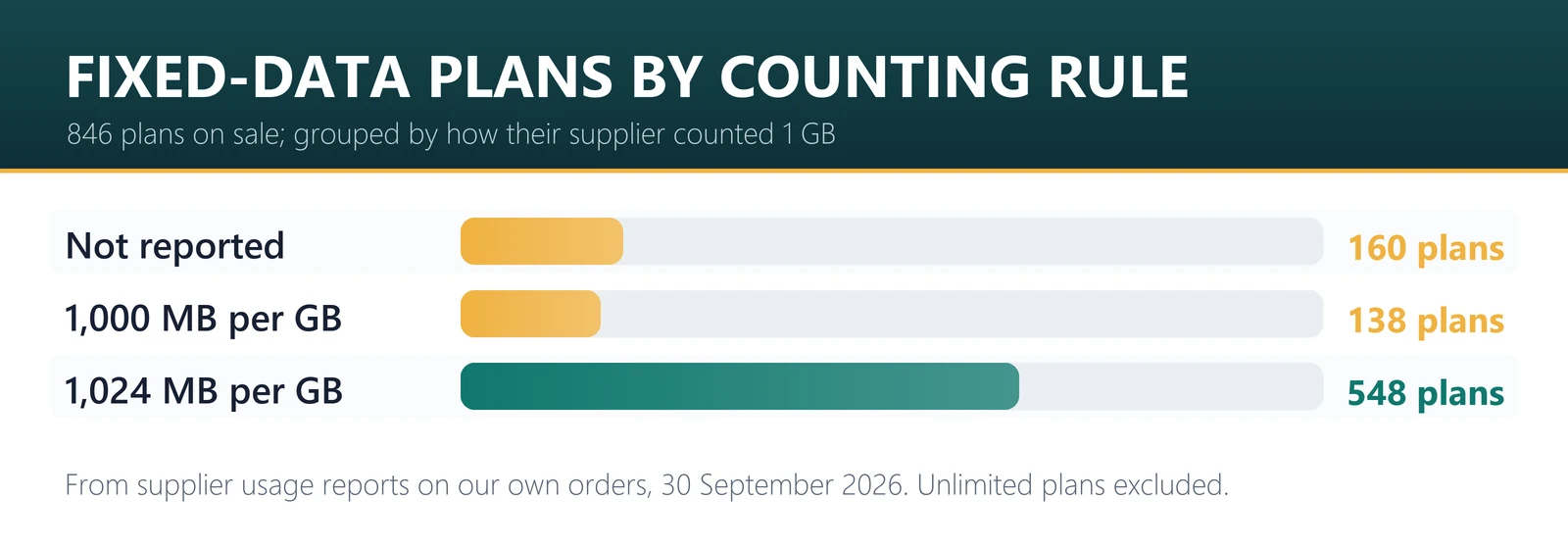
It depends on who supplies the eSIM: some count 1 GB as 1,024 MB, others as 1,000 MB. We checked the supplier usage reports on our own customers’ orders on 30 September 2026. A 10 GB plan from Sparks reported its allowance as “out of 10240” MB; a 30 GB plan from eSIMGo reported “out of 30000”. Across our catalogue, 548 of 846 fixed-data plans come from suppliers whose reports counted 1,024 MB per GB, 138 from a supplier that counted 1,000, and 160 from suppliers that do not report a total we could check.
That 24 MB per gigabyte sounds trivial, and on a 1 GB plan it is. On a 50 GB plan it is 1,200 MB — more than a whole small plan. Here is where the two numbers come from, what we found on real orders, and how to check any eSIM before you buy it.
- Two conventions: decimal (1 GB = 1,000 MB) and binary (1 GB counted as 1,024 MB).
- Counted as 1,024 on our orders: Sparks, NextLink, Airalo and RoamVault.
- Counted as 1,000 on our orders: eSIMGo.
- Share of our fixed-data plans: 548 of 846 (64.8%) from 1,024-counting suppliers.
- The difference: 2.4% more data — 240 MB on a 10 GB plan, 1,200 MB on 50 GB.
Why “1 GB” has two meanings
The prefix “giga” comes from the metric system, where it means a billion: the US National Institute of Standards and Technology lists giga as (103)3. Computers, however, count in powers of two, and for decades “kilo”, “mega” and “giga” were also used to mean 1,024, 1,024² and 1,024³. In 1998 the International Electrotechnical Commission adopted separate binary prefixes to end the ambiguity — kibi, mebi, gibi — so that a gibibyte (GiB) is (210)3 bytes. NIST documents both on its binary prefixes page.
Mobile data sits in the middle of that history. Plans are sold as “GB”, but the systems that meter them are free to count either way, and the plan name will not tell you which. The only reliable evidence is the provider’s own usage counter: when it says “used 4,185 MB out of 10,240”, the denominator is the answer.
What we found on real orders
We called the supplier usage report for eSIMs delivered on our recent orders and read the total each supplier stated. Where a supplier reported a total, it did so consistently.
| Supplier | Orders with a readable total | How 1 GB was counted | Example from a report | Fixed-data plans in our catalogue |
|---|---|---|---|---|
| Sparks | 7 of 7 | 1,024 MB | 10 GB plan: “out of 10240” | 252 |
| Airalo | 1 of 1 | 1,024 MB | 20 GB plan: “out of 20480” | 142 |
| NextLink | 2 of 2 | 1,024 MB | 25 GB plan: “out of 25600” | 89 |
| RoamVault | 1 of 1 | 1,024 MB | 20 GB plan: “out of 20480” | 65 |
| eSIMGo | 2 of 2 | 1,000 MB | 30 GB plan: “out of 30000” | 138 |
| Other suppliers | None readable | Not reported | Usage-only or no total in the report | 160 |
Two honest caveats. First, the sample is small for some suppliers — one order each for Airalo and RoamVault — so read those rows as “every report we could read”, not as a guarantee for every plan they will ever sell. Second, the reports state totals in MB, and they do not say whether each of those MB is 1,000,000 or 1,048,576 bytes. What we can compare is the number of MB each supplier allows per GB, which is what the counter on your usage page will show.
How much difference does it make?
Counting 1,024 MB per GB instead of 1,000 gives you 2.4% more data. Here is what that is in megabytes at common plan sizes.
| Plan size | Counted at 1,000 MB per GB | Counted at 1,024 MB per GB | Extra data | Roughly enough for |
|---|---|---|---|---|
| 1 GB | 1,000 MB | 1,024 MB | 24 MB | A few hours of maps |
| 5 GB | 5,000 MB | 5,120 MB | 120 MB | A day of light use |
| 10 GB | 10,000 MB | 10,240 MB | 240 MB | A travel day of maps and messaging |
| 20 GB | 20,000 MB | 20,480 MB | 480 MB | Half a day of normal use |
| 50 GB | 50,000 MB | 51,200 MB | 1,200 MB | More than a whole 1 GB plan |
The “roughly enough for” column uses our usual planning figure of 500 MB to 1 GB a day for a normal tourist, from our data usage guide. It is a planning estimate, not a measurement.
When a 1,000 MB plan is still the better buy
We would rather you buy the right plan than the one that wins this particular argument, so here is the other side.
- Price per GB matters more than the counting rule. A 1,000-counted plan that is 10% cheaper beats a 1,024-counted plan that is not. Our travel eSIM price index compares cost per GB across 71 countries.
- Features can outweigh 2.4%. Our UK plans with a phone number come from eSIMGo, a 1,000-counting supplier, and include a UK number and calling minutes that no data-only plan has.
- Network and coverage come first. A plan on the network that actually covers your route is worth more than 24 MB per gigabyte on one that does not.
- Size with margin anyway. The gap between conventions is smaller than the gap between a normal day and a video-heavy one. Buy about 30% above your estimate regardless.
How to check any eSIM, before and after you buy
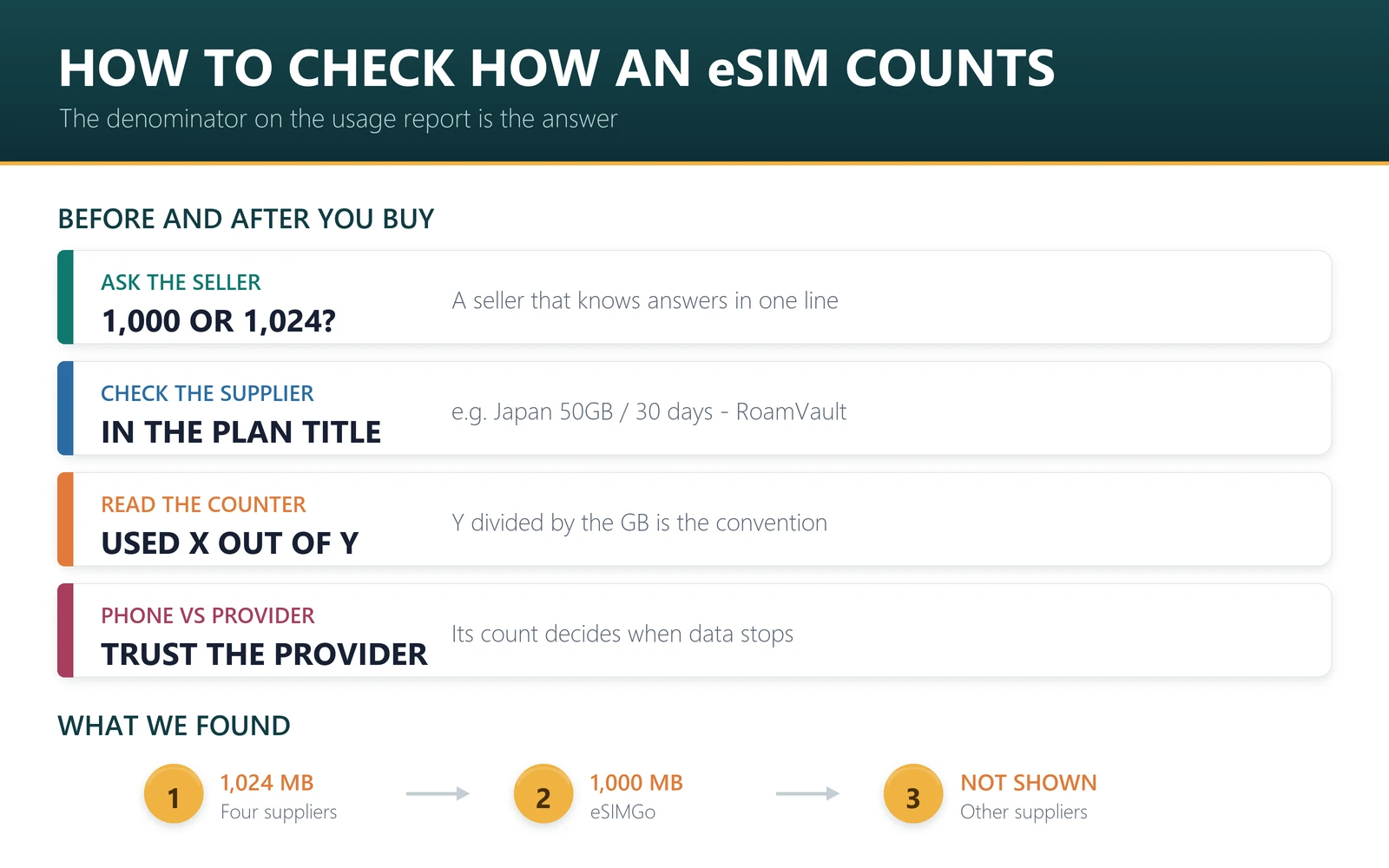
- Before buying, ask the seller how they count a gigabyte. A seller that knows will answer in one line.
- On our site, look at the supplier in the plan title — for example “Japan eSIM 50GB / 30 days · RoamVault 5G” — and match it to the table above.
- After installing, read the usage counter. Divide the total it shows by the plan size: 1,024 or 1,000 per GB tells you the convention.
- Trust the provider’s counter over your phone’s. Phone settings count their own way and reset on their own schedule, so the two numbers rarely match exactly.
- Top up before the last few hundred MB. Whatever the convention, the plan stops when the provider’s count reaches zero; our top-up audit shows which plans can be recharged.
Looking for a plan? Every plan title on Code eSIM names its supplier, so you can see how it counts before paying. Browse 190+ destinations, or start with Japan, Europe or the US.
Method, and what this does not prove
We read the supplier usage report for eSIMs delivered on our recent completed orders on 30 September 2026. Where the report stated a total allowance — in the form “used X MB out of Y” — we divided Y by the plan’s nominal size in GB. Of the orders checked, 13 carried a readable total: 11 at 1,024 MB per GB (Sparks, NextLink, Airalo, RoamVault) and 2 at 1,000 (eSIMGo). Other reports either showed usage without a total, showed the plan had not been used yet, or returned no data. Catalogue counts are of fixed-data plans on sale that day, excluding unlimited plans and items hidden from the catalogue, grouped by supplier.
What this does not prove: it describes how each supplier counted on the orders we could read, not a contractual guarantee for every plan, and suppliers can change their systems. It does not establish how many bytes are in each reported MB. And it says nothing about network speed or coverage.
Citing this: you are welcome to quote these figures with credit to Code eSIM and a link to this page. Suggested citation: Code eSIM, How eSIM suppliers count a gigabyte, 30 September 2026. Related audits: what unlimited really means and what happens when data runs out.
Frequently asked questions
Is 1 GB of eSIM data 1,000 MB or 1,024 MB?
It depends on the supplier. In usage reports on our own orders, Sparks, NextLink, Airalo and RoamVault counted 1 GB as 1,024 MB, while eSIMGo counted it as 1,000 MB. The plan name alone does not tell you which convention applies.
How do I know how my eSIM counts a gigabyte?
Read the provider’s usage counter after installing. If it says something like “used 500 MB out of 10240” on a 10 GB plan, it counts 1,024 MB per GB; “out of 10000” means 1,000. Before buying, ask the seller directly.
How much extra data is 1,024 MB per GB?
It is 2.4% more than counting 1,000 MB per GB: 24 MB on a 1 GB plan, 240 MB on 10 GB and 1,200 MB on 50 GB. On small plans it hardly matters; on large plans it adds up to more than a small plan’s worth.
Do most travel eSIMs use 1,024 MB per GB?
In our catalogue on 30 September 2026, 548 of 846 fixed-data plans came from suppliers whose usage reports counted 1,024 MB per GB, 138 from a supplier that counted 1,000, and 160 from suppliers whose reports did not show a total.
What is the difference between a GB and a GiB?
A gigabyte (GB) is decimal: one billion bytes, as NIST defines the giga prefix. A gibibyte (GiB) is binary: 2 to the power of 30 bytes, a prefix adopted by the IEC in 1998. Mobile plans usually say GB whichever way they count.
Why does my phone show different data usage from my eSIM provider?
Phones keep their own counter, which resets on its own schedule and may count differently from the provider. The provider’s counter is the one that decides when your plan runs out, so check usage there rather than relying on the phone’s figure.
Is a plan that counts 1,000 MB per GB a bad deal?
Not necessarily. Price per GB, network coverage and features such as a phone number or top-up matter more than a 2.4% difference. Compare the price for the data you actually get rather than choosing on the counting rule alone.
Can I see which supplier a Code eSIM plan uses?
Yes. Every plan title names its supplier, for example “Japan eSIM 50GB / 30 days · RoamVault 5G”, so you can match it to the counting convention we observed before buying. If the supplier is not in our table, ask us before you pay.
Bottom line
“1 GB” is not a fixed amount on travel eSIMs: on our own orders, four suppliers counted it as 1,024 MB and one as 1,000. Most of the fixed-data plans we sell — 548 of 846 — come from the 1,024-counting suppliers, and every plan title names its supplier so you can tell which is which. The difference is 2.4%: worth knowing on a 50 GB plan, not worth choosing on over price, network or features. When in doubt, read the denominator on the usage report.
Last reviewed 30 September 2026. Counting conventions are as observed in supplier usage reports on our own completed orders on that date and may change; catalogue counts are of plans on sale that day. Prefix definitions are from NIST. Supplier names are shown as they appear in our plan titles. Illustrations are our own.