
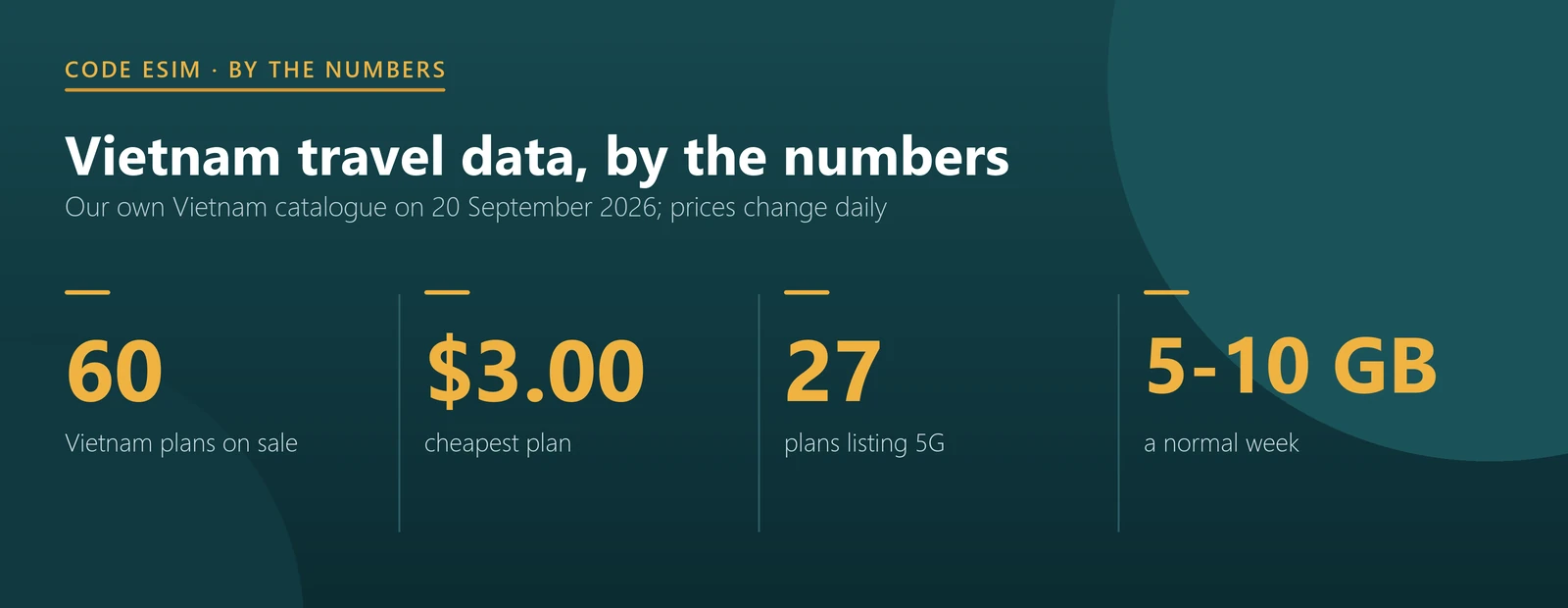
A week in Vietnam runs comfortably on 5–10 GB, and a travel eSIM lands on Vinaphone, MobiFone, Viettel or Vietnamobile — the national networks. Our catalogue has 60 Vietnam plans as of 20 September 2026, from $3.00, and 27 of them list 5G.
Vietnam is a moving trip. Most itineraries string together Hanoi, Ha Long, Hoi An, Da Nang and Ho Chi Minh City with internal flights, sleeper trains and a lot of Grab rides — and almost every one of those steps wants data: booking the car, showing the driver a pin, checking whether the train actually leaves from that station. A single plan that works from the north to the Mekong is worth more here than in a one-city trip.
- A week for most people: 5–10 GB, or 2–3 GB a day if video is part of your routine.
- Networks: Vinaphone, MobiFone, Viettel and Vietnamobile, depending on the plan.
- Prices: from $3.00, with plans up to 60 GB and up to 365 days.
- 5G: 27 of our 60 Vietnam plans list it, where the operator provides it.
- Ride-hailing and QR payments are the reason to have data from the moment you land, not after the hotel.
How much data do you need in Vietnam?
Size from behaviour, not anxiety. A normal tourist uses 500 MB to 1 GB a day: maps, messaging, translation, ride-hailing, photo uploads. Video and tethering push that to 2–3 GB. Add about 30% margin — you will use more than you think on travel days and less on beach days.
| Trip length | Light: city Wi-Fi, occasional maps | Normal tourist | Heavy: video, hotspot, working |
|---|---|---|---|
| 5 days | 3 GB | 5 GB | 15 GB |
| 7 days | 3–5 GB | 5–10 GB | 20 GB |
| 10 days | 5 GB | 10 GB | 30 GB |
| 14 days, north to south | 10 GB | 15–20 GB | 40 GB or more |
The Vietnam-specific adjustment is the transit time. A two-week north-to-south trip has more hours in vehicles than a two-week beach holiday, and vehicles are where maps run and people catch up on messages. If your itinerary looks like a list of cities rather than a base, budget toward the higher end. Our data usage guide has the full method.
Which networks a Vietnam eSIM lands on
A travel eSIM roams on a local operator. Vietnam has several national networks, and our catalogue is weighted toward Vinaphone.
| Network | Technology listed | Plans in our catalogue |
|---|---|---|
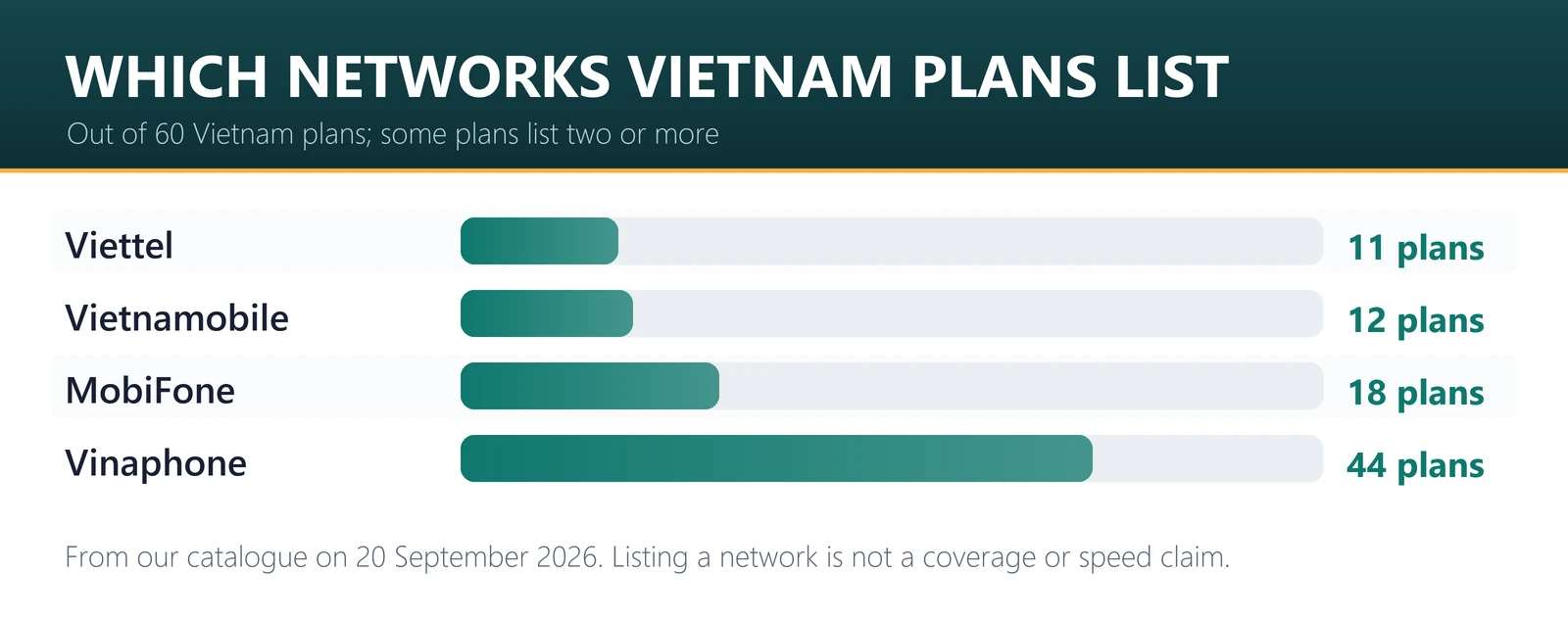
| Vinaphone | 5G | 44 of 60 |
| MobiFone | 5G and 4G LTE | 18 of 60 |
| Vietnamobile | 4G LTE | 12 of 60 |
| Viettel | 5G | 11 of 60 |
Counts overlap where a plan lists more than one network, and Viettel appears under two spellings in supplier data, which we have merged here. The practical read: most of our Vietnam plans put you on Vinaphone, and about half the catalogue permits 5G. What that means on a given street in Hanoi or a beach in Phu Quoc is the operator’s business — we have not run speed tests in Vietnam, and a plan listing 5G is a permission, not a promise.
Roaming, local SIM or travel eSIM?
Vietnam sells cheap local SIMs, so the comparison here is less about price than about the first two hours after you land.
| Home SIM roaming | Vietnamese local SIM | Travel eSIM | |
|---|---|---|---|
| Setup | Nothing to do | Airport or shop counter, passport needed | Install before you fly |
| Cost control | Your operator’s Asia roaming rate | Local prices in dong | Fixed price, prepaid |
| Keeps your number | Yes | No, unless you dual-SIM | Yes, as a second line |
| Vietnamese number | No | Yes | No, data only |
| Working when you land | Yes | After the counter, with registration | Yes, switch it on |
Two things decide it. If you want a Vietnamese number — some local apps and deliveries ask for one — buy a local SIM; registration is done with your passport at the counter. If you mainly want data that works the second the plane doors open, so you can order a Grab instead of negotiating at the taxi rank, a travel eSIM installed at home does that without giving up your own number.
For travellers from Europe, note that Vietnam is far outside the EU roam-like-at-home area, which the Commission limits to the EU plus Iceland, Liechtenstein, Norway, Moldova and Ukraine; it warns that roaming beyond it can be expensive. Check your own tariff before defaulting to your home SIM.
Which plan for which Vietnam trip
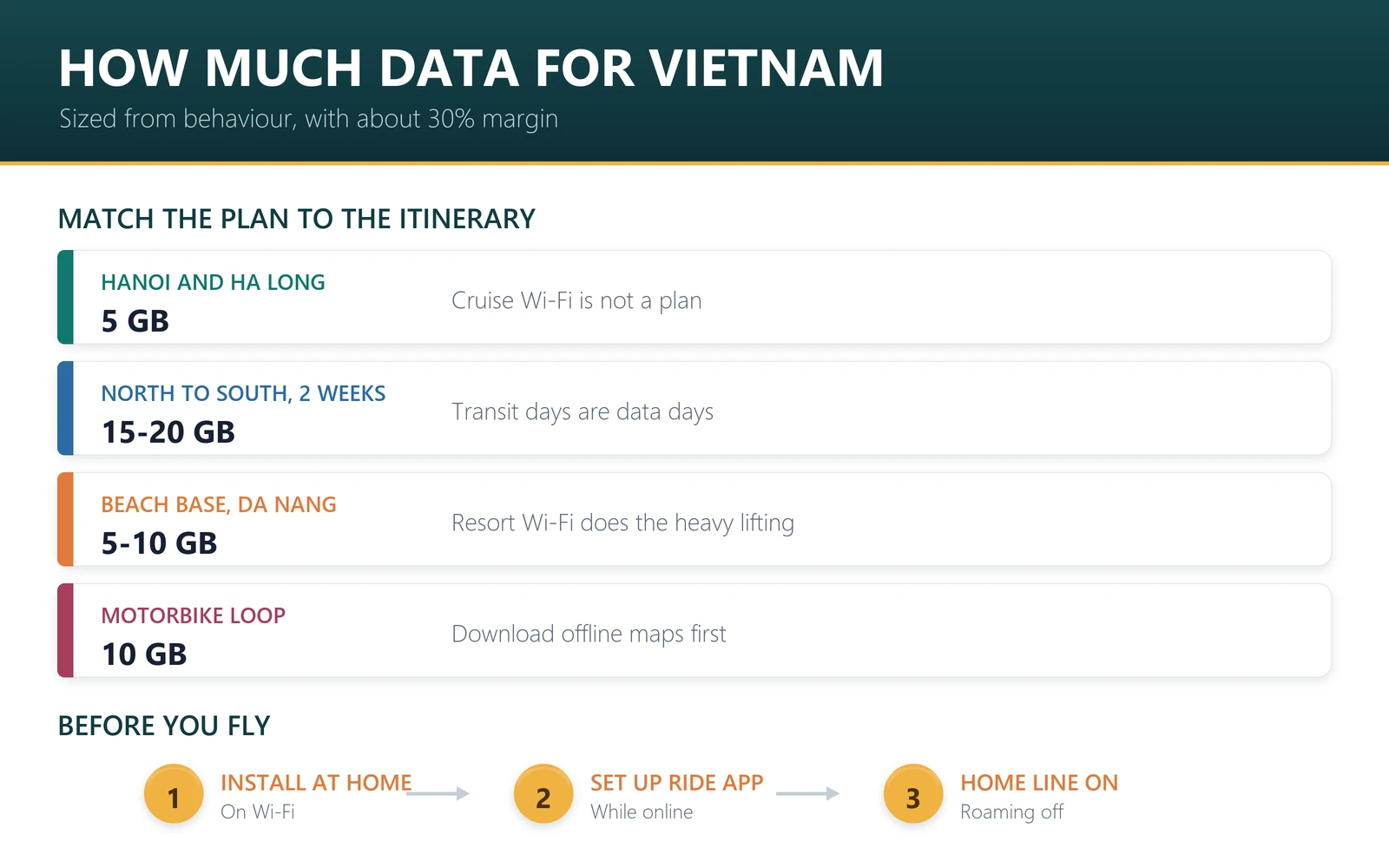
- Hanoi and Ha Long, 5 days: 5 GB. Cruise Wi-Fi is not something to count on.
- Classic north-to-south, two weeks: 15–20 GB, because transit days are data days.
- Beach base in Da Nang or Phu Quoc: 5–10 GB, since resort Wi-Fi does the heavy lifting.
- Motorbike loop, Ha Giang or Hai Van: 10 GB and offline maps downloaded first; mountain coverage is the operator’s and it varies.
- Remote work for a month: our Vietnam catalogue runs to 60 GB and up to 365 days.
Sorting the trip out? Compare Vietnam eSIM plans — 60 of them, from $3.00 — or look at Asia regional plans if Vietnam is one stop among several, and all 190+ destinations for everything else.
Installing before you fly
- Buy and install at home, on Wi-Fi. Installation needs an internet connection, and Noi Bai or Tan Son Nhat arrivals is the wrong place to find that out.
- Check the start rule. Some plans start at installation, others on first network connection; when an eSIM starts counting explains which is which.
- Set up your ride-hailing app before departure, while you still have a connection you trust.
- On arrival, switch on the travel line, set it as the data line, keep your home line enabled for verification codes with data roaming off.
- Do not delete the profile mid-trip: many eSIM QR codes install only once.
Our dual SIM guide covers keeping your own number live, and what to check if data does not come up covers the first ten minutes on the ground.
Calls, apps and what a data plan is not
Vietnam travel eSIMs are data-only. No Vietnamese number, no local minutes: calls go through apps, and your own number stays reachable for bank codes if you leave that line switched on. If a local number is required for a specific service, that is a local SIM alongside your data plan rather than instead of it.
We also will not promise that any particular app or service behaves the same way on every network. Availability depends on the service, your account and how traffic is routed; our guide on whether a travel eSIM changes your IP address explains the routing part honestly.
Sources, and what this cannot tell you
Plan counts, prices, data sizes, durations and network names come from our own Vietnam catalogue, read on 20 September 2026; prices move daily, so the Vietnam plans page is the live version. EU roaming scope is quoted from the European Commission’s Your Europe roaming page.
What we cannot tell you: speeds, coverage on a particular mountain pass, or whether 5G is live where you will be. Those belong to the operators. We can tell you exactly which networks our plans list and how many of them permit 5G.
Frequently asked questions
How much data do I need for a week in Vietnam?
Most travellers are comfortable on 5–10 GB for seven days, covering maps, ride-hailing, messaging and photo uploads. If you stream video daily or tether a laptop, plan 2–3 GB per day, so about 20 GB for the week, plus roughly 30% margin.
Which network does a Vietnam travel eSIM use?
Depending on the plan, Vinaphone, MobiFone, Viettel or Vietnamobile. In our catalogue 44 of 60 plans list Vinaphone, 18 list MobiFone, 12 list Vietnamobile and 11 list Viettel. Each plan page shows its networks before you buy.
Is 5G available on Vietnam travel eSIMs?
On some plans: 27 of our 60 Vietnam plans list 5G, and the others are 4G LTE. Whether you actually connect at 5G depends on the operator’s coverage where you are standing, which is their information rather than ours.
How much does a Vietnam eSIM cost?
Our Vietnam plans start at $3.00 and run to about $67 for the largest packages, with data from 1 GB to 60 GB and durations from 5 days to a full year. Prices change daily, so the plans page carries the current figures.
Can I use Grab with a travel eSIM in Vietnam?
Ride-hailing apps need working mobile data and a signed-in account, which a travel eSIM provides as your data line. Set the app up before you travel while you have a connection you trust. We do not guarantee any specific third-party app or service.
Do I get a Vietnamese phone number with an eSIM?
No. Travel eSIMs for Vietnam are data-only, so calls and messages run over apps. Keep your home line active for verification codes, or buy a local SIM with your passport at the airport if a Vietnamese number is required.
Will one eSIM work from Hanoi to Ho Chi Minh City?
Yes. A Vietnam plan covers the country, so the same profile works in the north, the centre and the south without changing anything. That is the main advantage over buying local SIMs as you move between regions.
When should I install a Vietnam eSIM?
Before you fly, on home Wi-Fi, because installation needs an internet connection. Check whether your plan starts at installation or on first connection, then turn the line on when you land so you can order a car before leaving the terminal.
Bottom line
Vietnam rewards having data from the moment you land: ride-hailing, maps and QR codes are woven into the trip. Our 60 Vietnam plans start at $3.00, mostly on Vinaphone, with 27 permitting 5G. Size a normal week at 5–10 GB and a two-week north-to-south run at 15–20 GB, install before you fly, and keep your own number switched on for the codes that always arrive at the worst moment.
Last reviewed 20 September 2026. Plan counts, prices and network names are from our own catalogue on that date and change daily; the Vietnam plans page is authoritative. Coverage, speeds and 5G availability are the operators’. EU roaming rules are quoted from the European Commission’s Your Europe portal. Vinaphone, MobiFone, Viettel and Vietnamobile are trademarks of their owners; this guide is independent and not affiliated with them.