
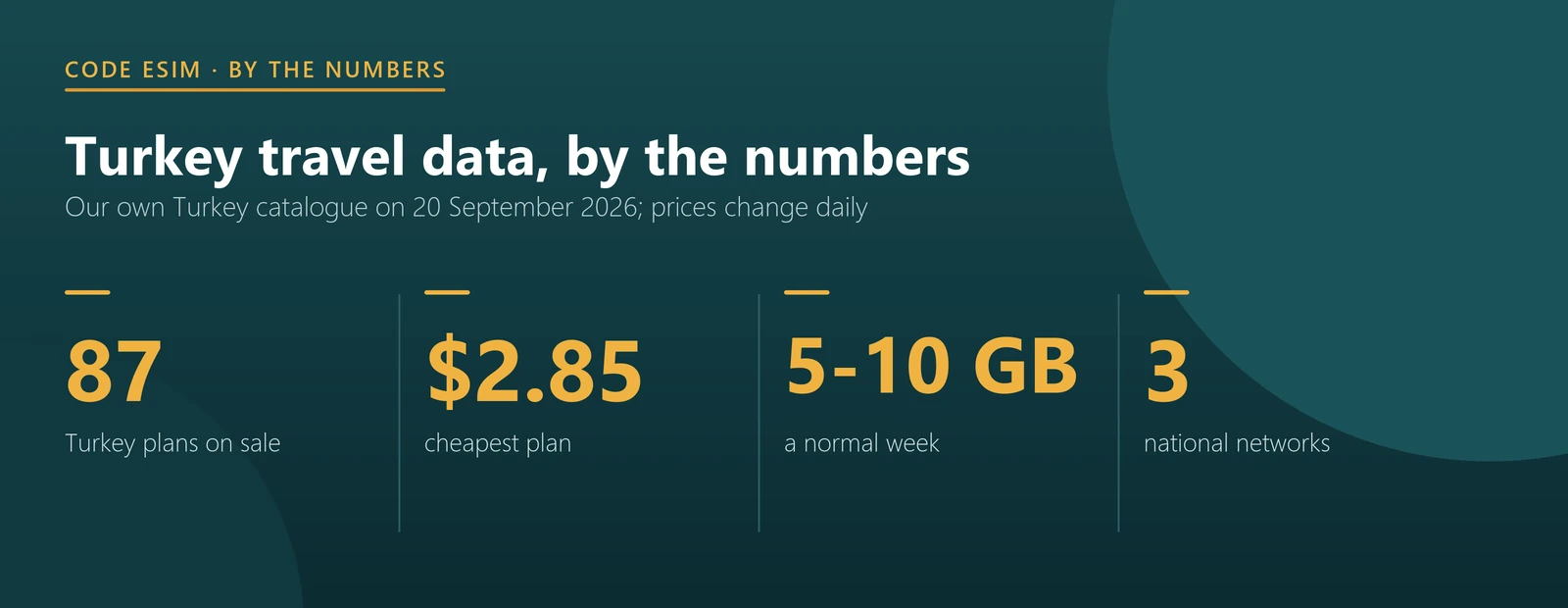
For a week in Turkey, most travellers need 5–10 GB, and a travel eSIM lands on Turkcell, Türk Telekom or Vodafone — the same three networks a local SIM uses. Our catalogue has 87 Turkey plans as of 20 September 2026, starting at $2.85, with 51 of them offering 5G where the network provides it.
Turkey is one of the trips where the connectivity maths actually matters. It sits outside the EU roaming area, so a European SIM roams at out-of-bundle rates unless your operator says otherwise. Distances are long: Istanbul to Cappadocia is a flight or an overnight bus, and the coast road eats hours. And most of what you need data for — maps, translation, ride-hailing, museum tickets, checking ferry times — happens while you are moving.
- A week for most people: 5–10 GB, or 2–3 GB a day if video is part of your routine.
- Networks: Turkcell, Türk Telekom and Vodafone, depending on the plan.
- Prices: from $2.85, with plans up to 120 GB and up to 365 days.
- 5G: 51 of our 87 Turkey plans include it where available.
- EU travellers: Turkey is not in the roam-like-at-home area. Check your operator’s out-of-EU rate before relying on your home SIM.
How much data do you need in Turkey?
We size plans from behaviour, not fear. A normal tourist uses 500 MB to 1 GB a day: maps, messaging, translation, a few uploads. Video changes everything, and hotspot use changes it again. Add about 30% margin so a slow hotel Wi-Fi night does not leave you rationing.
| Trip length | Light: maps, chat, hotel Wi-Fi at night | Normal tourist | Heavy: video, hotspot, working |
|---|---|---|---|
| 5 days | 3 GB | 5 GB | 15 GB |
| 7 days | 3–5 GB | 5–10 GB | 20 GB |
| 10 days | 5 GB | 10 GB | 30 GB |
| 14 days | 10 GB | 15 GB | 40 GB or more |
Two Turkey-specific adjustments. If your itinerary includes long ground transfers, budget more: maps running for a six-hour coastal drive is the most reliable way to drain a plan. And if you are travelling with someone who will tether, count them as a second traveller rather than hoping one plan stretches. Our data usage guide has the full method. If you are weighing it against your own operator’s rates, our roaming charges guide covers what those usually look like.
Which networks a Turkey eSIM lands on
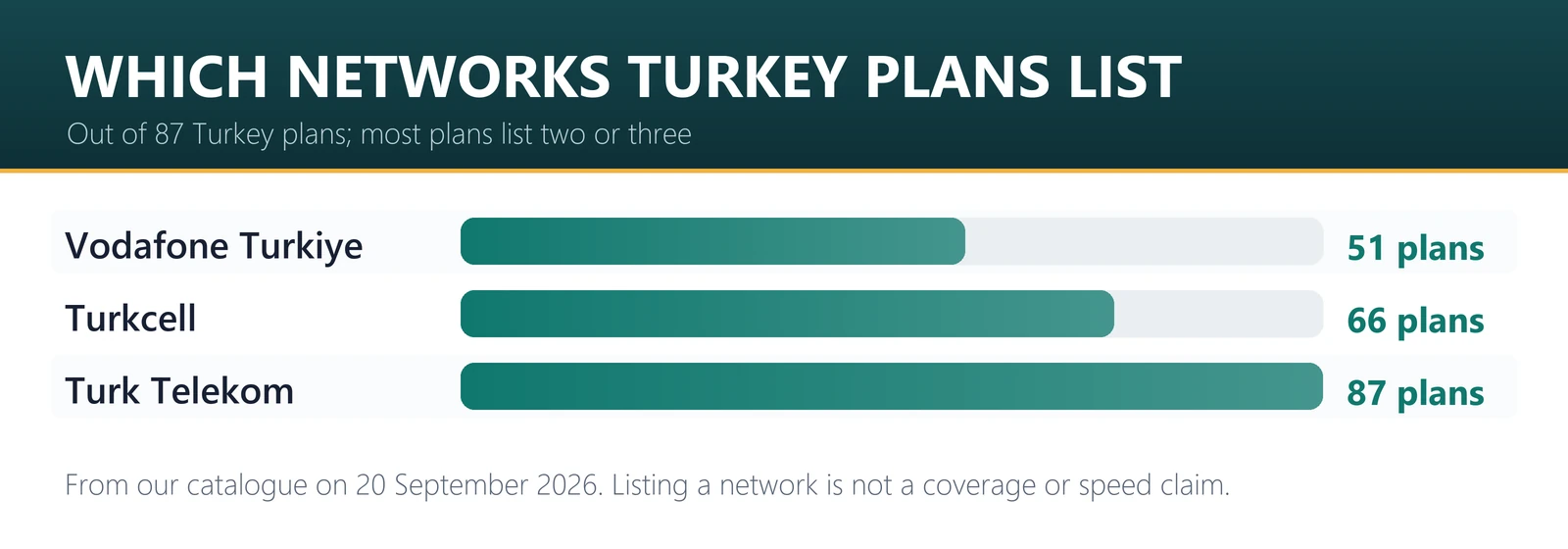
A travel eSIM is a roaming profile: it connects to a local network under a roaming agreement. For Turkey, our catalogue splits across the three national operators, and you can see which one a plan uses on its product page before buying.
| Network | Technology listed | Plans in our catalogue |
|---|---|---|
| Türk Telekom | 5G | 87 of 87 |
| Turkcell | 5G | 66 of 87 |
| Vodafone Türkiye | 5G | 51 of 87 |
The counts add up to more than 87 because most plans list two or three networks: every Turkey plan in our catalogue lists Türk Telekom, three quarters also list Turkcell, and well over half add Vodafone. What matters on the ground is that all three are national operators with their own coverage, so in Istanbul, Ankara, İzmir, Antalya and the main tourist corridors you are on infrastructure that locals use. 5G on a plan means the plan permits it, not that a given street has it: coverage and speed are the operator’s business, not ours, and we have not run speed tests in Turkey.
Roaming, local SIM or travel eSIM?
Three ways to get online in Turkey, and the right answer depends on where you are from and how long you are staying.
| Home SIM roaming | Turkish local SIM | Travel eSIM | |
|---|---|---|---|
| Setup | Nothing to do | Shop visit with passport | Install before you fly |
| Cost control | Depends on your operator’s out-of-EU rate | Local prices, paid in lira | Fixed price, prepaid |
| Keeps your number | Yes | No, unless you dual-SIM | Yes, as a second line |
| Turkish phone number | No | Yes | No, data only |
| Works on arrival | Yes | After the shop opens | Yes, switch it on |
For EU travellers this is the deciding table. The EU’s own guidance is explicit that roam-like-at-home covers the EU plus Iceland, Liechtenstein, Norway, Moldova and Ukraine, and that roaming outside that area “can be expensive”. Turkey is outside it. Some operators extend home rates to Turkey voluntarily, so check yours rather than assuming either way.
The local SIM column has a wrinkle worth flagging: Turkey operates a registration scheme for phones brought in from abroad and used with a Turkish operator’s SIM, run by the regulator BTK. We could not verify the current rules or fees from an official English-language source while writing this, so treat it as a question to ask before you count on a local SIM. A roaming travel eSIM does not put a Turkish operator subscription on your handset.
Which plan for which Turkey trip
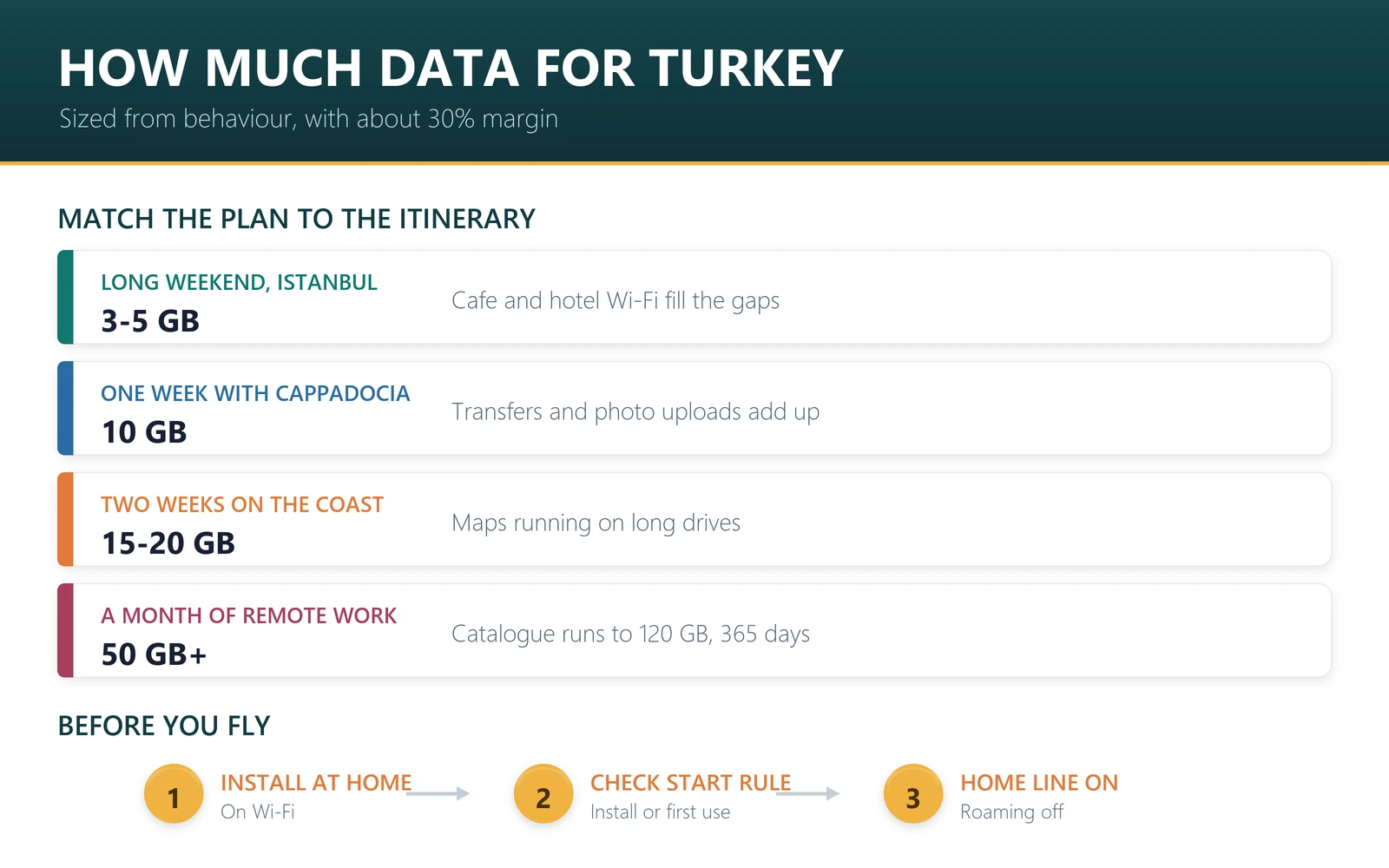
- Long weekend in Istanbul: a 3–5 GB plan over 5–7 days. You will be on hotel and café Wi-Fi more than you expect.
- Istanbul plus Cappadocia, one week: 10 GB. Transfers and balloon-morning photo uploads are what push it above 5.
- Two weeks on the coast: 15–20 GB, especially if you are the one navigating a rental car.
- Working remotely for a month: look at the 50 GB and larger plans; our catalogue runs to 120 GB and up to 365 days.
- Family or group: one plan per phone beats one hotspot. Everyone keeps maps when the group splits up at the Grand Bazaar.
Ready to sort it out? Compare Turkey eSIM plans — 87 of them, from $2.85 — or see Europe if you are combining Turkey with a European leg, and all 190+ destinations for the rest of the itinerary.
Installing before you fly
- Buy and install at home, on Wi-Fi. Installing needs an internet connection, which is exactly what you do not have at İstanbul Airport before you are connected.
- Leave it switched off until you land, if your plan starts on first network connection. Start rules vary by plan; when an eSIM starts counting explains the difference.
- On arrival, turn on the travel line, set it as your data line, and leave your home line on for calls and verification codes with data roaming off.
- Check the status bar before leaving the terminal. If the phone has not registered on a network, a quick airplane-mode toggle usually does it.
- Keep the installation email. Many eSIM QR codes install once, so do not delete the profile mid-trip.
Our dual SIM guide covers keeping your own number reachable, and what to check if data does not come up covers the rest.
Calls, messages and what a data plan is not
Travel eSIMs in Turkey, like almost everywhere in our catalogue, are data-only. You will not get a Turkish number with them, and they are not meant to replace your own line for calls. In practice that matters less than it sounds: WhatsApp, FaceTime and Telegram calls run over data, and your home number stays reachable for bank codes as long as you leave that line enabled.
If a Turkish number is genuinely required — some local services ask for one — that is the case for a local SIM, bought in a shop with your passport, alongside a data eSIM. Our eSIM versus physical SIM comparison goes through when each makes sense.
Sources, and what this cannot tell you
Plan counts, prices, data sizes, durations and network names come from our own Turkey catalogue, read on 20 September 2026. Prices move daily with supplier pricing, so the figures here are a snapshot and the Turkey plans page is the live version. Roaming rules for EU travellers are from the European Commission’s Your Europe roaming page.
What we cannot tell you: real-world speeds, coverage on a specific street, or whether 5G is live where you will be standing. Those are the operators’ to publish, and we have not tested them. Nor can we confirm the current rules for registering a foreign handset with a Turkish operator; check BTK or the operator directly if that affects your plans.
Frequently asked questions
How much data do I need for a week in Turkey?
Most tourists are comfortable on 5–10 GB for seven days, which covers maps, messaging, translation and photo uploads. If you stream video daily or tether a laptop, plan 2–3 GB per day, so 20 GB for the week, and add about 30% margin.
Which network does a Turkey travel eSIM use?
Depending on the plan, Turkcell, Türk Telekom or Vodafone Türkiye. All three are national operators. Our catalogue lists the network on each plan page, and 51 of our 87 Turkey plans include 5G where the operator provides it.
Does my EU phone plan work in Turkey at home rates?
Usually not. The EU says roam-like-at-home covers the EU plus Iceland, Liechtenstein, Norway, Moldova and Ukraine, and warns that roaming outside that area can be expensive. Some operators extend home rates to Turkey voluntarily, so check your own tariff.
How much does a Turkey eSIM cost?
Our Turkey plans start at $2.85 and run to about $105 for the largest packages, with data from 1 GB to 120 GB and durations from 5 days to a full year. Prices change daily, so the plans page shows the current figures.
Can I get a Turkish phone number with a travel eSIM?
No. Travel eSIMs for Turkey are data-only, so there is no Turkish number, and calls run over apps instead. Keep your home line active for calls and verification codes, or buy a local SIM in a shop if a Turkish number is required.
Do I need to register my phone in Turkey?
Turkey runs a registration scheme through its regulator for handsets brought from abroad and used with a Turkish operator’s SIM. We could not verify the current rules and fees from an official English source, so check before relying on a local SIM. A roaming eSIM is a different situation.
Will an eSIM work in Cappadocia and on the coast?
Your plan rides on a national operator’s network, so coverage is whatever that operator provides, which in practice means the towns, main roads and tourist areas are served. We have not measured signal in specific valleys or on specific coastal roads.
When should I install a Turkey eSIM?
Before you fly, on home Wi-Fi. Installation needs an internet connection, and the moment you want data most is when you land. Check whether your plan starts at installation or on first connection, and switch the line on after arrival.
Bottom line
Turkey is a straightforward data destination with one catch for Europeans: it is outside the roam-like-at-home area, so your home SIM may be expensive there. A travel eSIM lands on the same three networks locals use, costs from $2.85, and can be installed before you leave. Size it honestly — 5–10 GB for a normal week, more if you are navigating long drives or tethering — and set it up at home rather than at the airport.
Last reviewed 20 September 2026. Plan counts, prices and network names are from our own catalogue on that date and change daily; the Turkey plans page is authoritative. Coverage, speeds and 5G availability are the operators’. EU roaming rules are quoted from the European Commission’s Your Europe portal. Turkcell, Türk Telekom and Vodafone are trademarks of their owners; this guide is independent and not affiliated with them.