
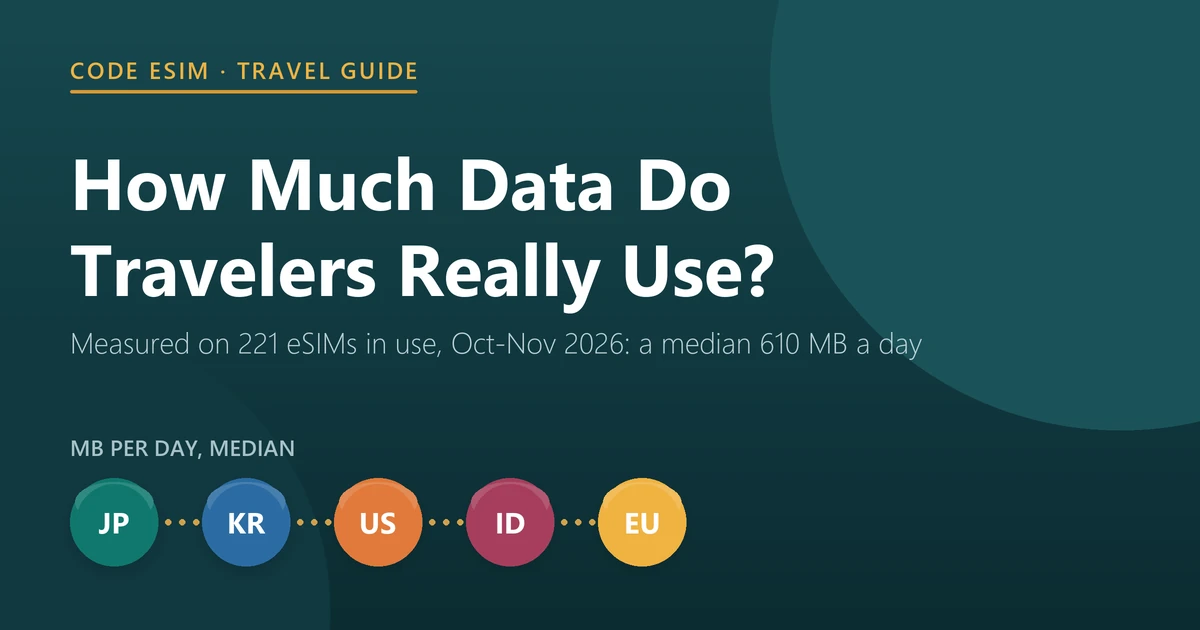
Travelers using a Code eSIM used a median of 610 MB of mobile data a day in late October and early November 2026, measured on 221 eSIMs that were in use on 3 November. A quarter of them used under 260 MB a day and a quarter used over 1 GB. The destination matters more than anything else: in Japan the median was 972 MB a day and on Japan + South Korea plans just over 1 GB, while in the USA it was 483 MB and in Indonesia 460 MB. About half of the eSIMs were on pace to use their whole plan before it expired.
Every data guide we have seen, including our own, works from app-by-app estimates: so many megabytes per hour of maps, so many per hour of video. This article is different. The numbers below come from the data counters that our suppliers report for eSIMs our customers bought, read by the system that sends our low-data emails. They show what people did, not what they planned to do. The sample is small, it covers two weeks, and it is only our customers; each table says how many eSIMs stand behind each number.
How much data travelers use per day
For each eSIM in use with a fixed data amount, we divided the data it had used by the number of days since it was activated, counting only eSIMs active for at least two days. Unlimited plans, day passes and top-ups are left out, because their counters do not mean the same thing.
| All 221 eSIMs in use | Data per day |
|---|---|
| Lightest quarter | under 260 MB |
| Median | 610 MB |
| Heaviest quarter | over 1,014 MB |
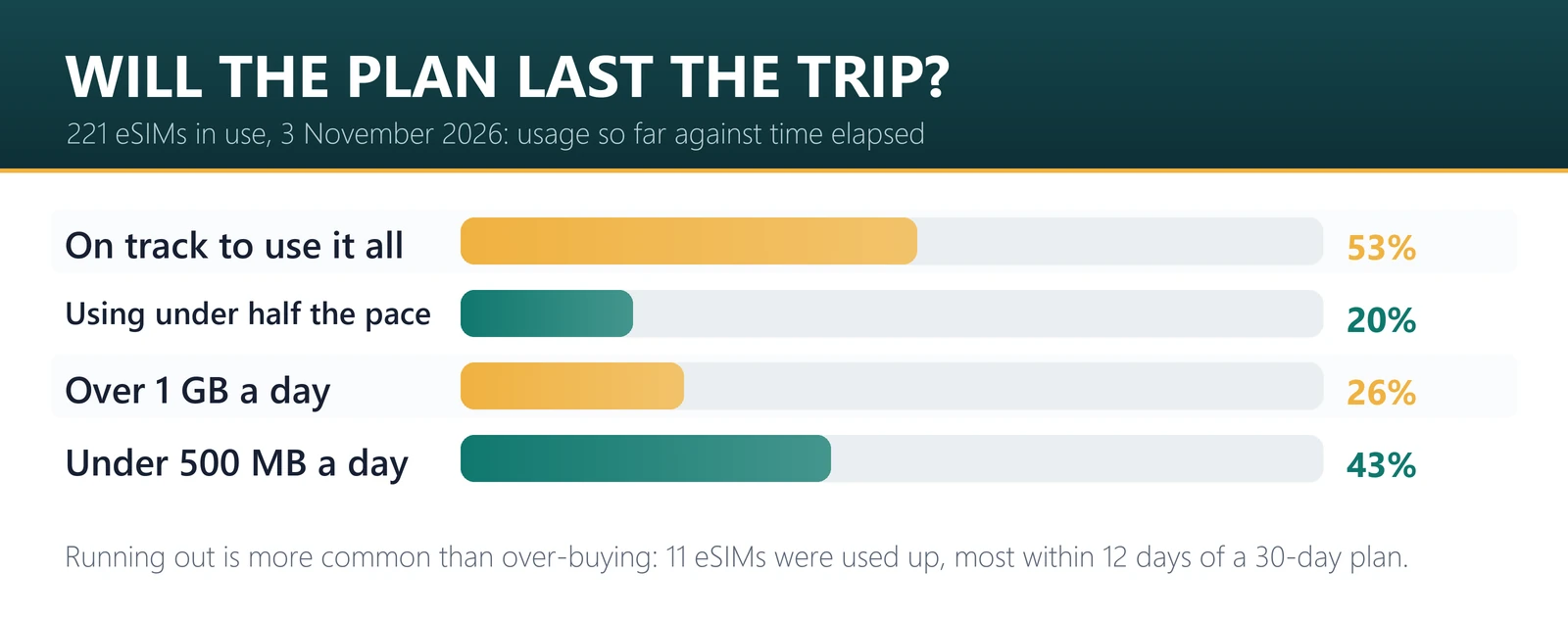
| Share using under 500 MB a day | 43% |
| Share using over 1 GB a day | 26% |
The median, 610 MB, sits inside the 500 MB to 1 GB a day that our data guide calls a standard tourist. The spread is the useful part: four in ten travelers would be fine with 500 MB a day, and one in four needs more than 1 GB. If you do not know which you are, the next section narrows it down by destination.
Data per day by destination
Only destinations with at least five eSIMs in use are listed. The 75th percentile is the amount that three quarters of travelers stayed under, which is a safer number to plan with than the median.
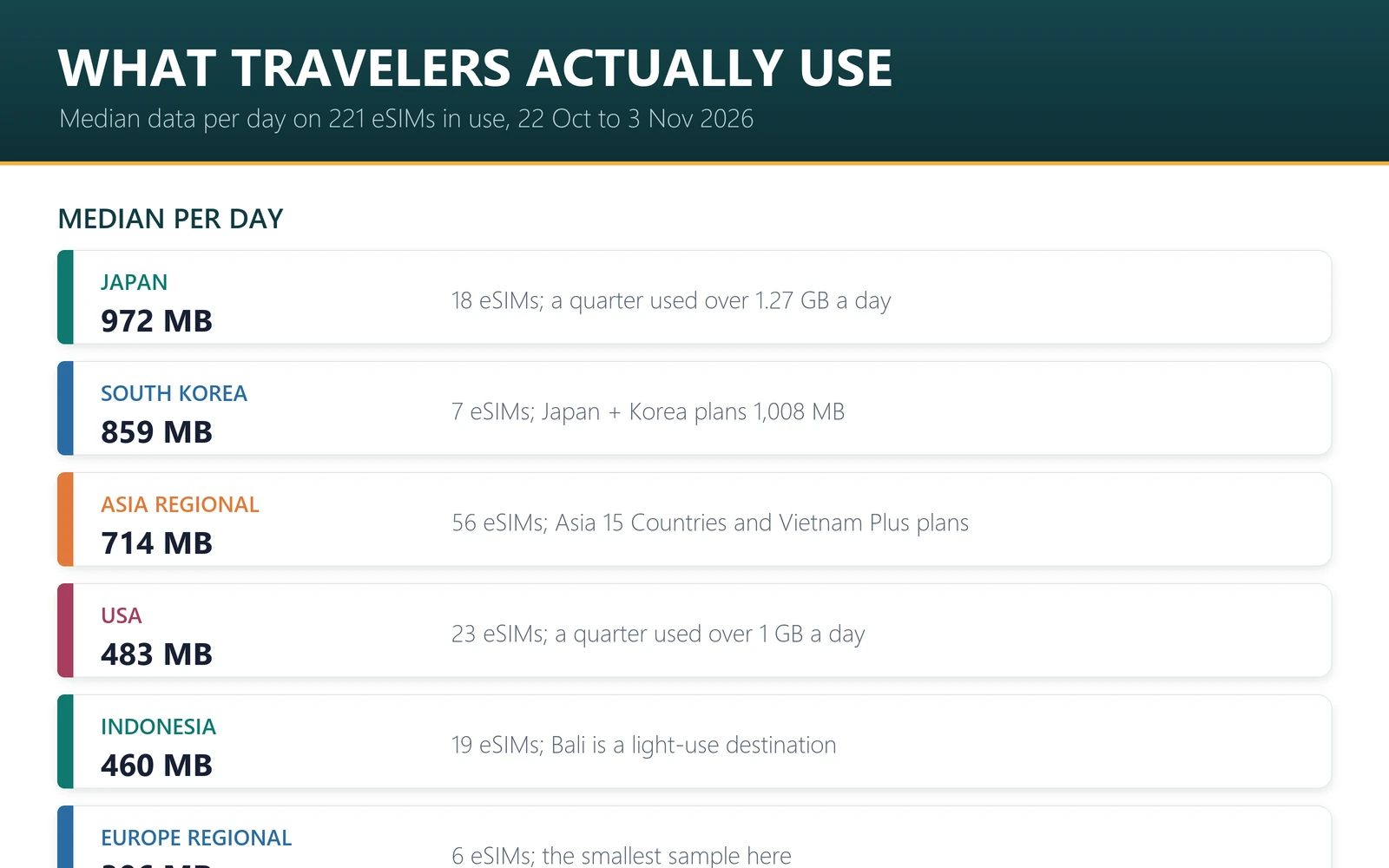
| Destination | eSIMs in use | Median per day | 3 in 4 stayed under |
|---|---|---|---|
| Japan + South Korea (one plan for both) | 12 | 1,008 MB | 1,203 MB |
| Japan | 18 | 972 MB | 1,274 MB |
| South Korea | 7 | 859 MB | 906 MB |
| Albania + Montenegro | 5 | 738 MB | 862 MB |
| Asia regional plans (Asia 15 Countries, Vietnam Plus, Asialink) | 56 | 714 MB | 1,206 MB |
| Americas regional plans (multi-country USA and Latin America plans) | 23 | 501 MB | 990 MB |
| USA | 23 | 483 MB | 1,014 MB |
| Indonesia | 19 | 460 MB | 907 MB |
| Egypt | 8 | 425 MB | 685 MB |
| Europe regional plans | 6 | 306 MB | 626 MB |
| Global plans | 7 | 282 MB | 794 MB |
Japan and South Korea are heavy-use destinations: the typical traveler there used twice as much data a day as the typical traveler in the USA, Indonesia or Egypt. We do not know why from the counters alone, but the pattern fits what those trips look like. Visitors to Japan and Korea rely on their phone for transit apps, translation and navigation in cities with fast 5G networks, and they tend to be on the move all day. A beach week in Bali or a road trip in the USA with hotel Wi-Fi at night uses far less. Europe and global plans had the smallest samples here, so treat those two rows as a hint rather than a finding.
How many GB that means for your trip
Multiply a daily figure by your days and you have a plan size. The median column fits a typical traveler; the second column, built on the 75th percentile of all 221 eSIMs, is the size that three quarters of travelers would not have run through.
| Trip | Typical traveler (610 MB a day) | Safe choice (1 GB a day) | Japan or Korea (1 GB to 1.3 GB a day) |
|---|---|---|---|
| 5 days | 3 GB | 5 GB | 5 to 7 GB |
| 1 week | 4 GB | 7 GB | 7 to 9 GB |
| 10 days | 6 GB | 10 GB | 10 to 13 GB |
| 2 weeks | 8 GB | 14 GB | 14 to 18 GB |
| 1 month | 18 GB | 30 GB | 30 to 40 GB |
In practice the safe column costs little more than the typical one. On 3 November 2026 a Japan plan with 10 GB for 10 days cost $6.39 and 20 GB for 30 days $11.80; a USA plan with 10 GB for 30 days cost $9.00. The trip-length guide lists the cheapest plan at each size in 10 destinations, and the Japan local eSIM page has every Docomo and KDDI plan with a picker by days and daily use.
Half of travelers are on pace to use their whole plan
For every eSIM in use we compared the share of data used with the share of the validity period that had passed. An eSIM that has used 60% of its data with 50% of its days gone is on pace to run out.
| 221 eSIMs in use on 3 November 2026 | Share |
|---|---|
| On pace to use all their data before the plan expires | 53% |
| Using less than half the pace of the plan | 20% |
| Already used up (fixed plans, all customers since 22 October) | 11 eSIMs |
The 11 eSIMs that ran dry tell the clearest story. Most were 30-day plans finished in a fraction of that time: a USA 10 GB plan after 4.8 days and another after 10 days, Japan 15 GB and 20 GB plans after 12 days each, two Japan + South Korea 10 GB plans after 4 and 11 days, and an Albania + Montenegro 10 GB plan after under 3 days. Only a Singapore 10 GB plan lasted past the halfway mark, running out on day 17 of 30. Running out of data was far more common in this period than paying for a plan and using a small part of it; that is why the safe column above is the one to pick when in doubt.
What happens when you run out, and how to avoid it
A prepaid eSIM cannot bill you for extra data. When the plan is used up, data simply stops. If the plan allows top-ups, you can add data to the same eSIM without reinstalling anything; the prepaid eSIM guide counts how many of our plans do. Since 22 October 2026 we also email customers when an eSIM reaches 80% of its data, when it runs out, and 24 hours before it expires, with a link to the usage page and to the top-ups that fit.
Four habits keep most travelers inside the typical column:
- Check your rate on day two. Open the usage page or your phone’s cellular settings. If you have used more than a tenth of the plan in the first two days of a two-week trip, you are on pace to run out.
- Download maps and playlists on Wi-Fi. Offline maps for a city are a one-time download that turns navigation into a near-zero-data activity.
- Turn off background photo backup over cellular. On iPhone it is the Cellular Data switch in the Photos settings. A day of photos can be 1 GB or more on its own.
- Keep hotspot sharing for emergencies. Three devices on one eSIM use data three times as fast; the Japan and Korea medians already assume one phone.
When a smaller plan is the right call
The data argues for buying one size up, but not for everyone. If you are in the lightest quarter, under 260 MB a day, a 3 GB plan covers a 10-day trip with room to spare, and a 1 GB plan covers a long weekend. You are probably in that group if you will have Wi-Fi at your hotel every night, you are not posting video, and you use your phone mainly for maps and messages. The 20% of eSIMs using under half the pace of their plan belonged to travelers like this. For a short, light trip, a day pass with 1 GB a day can also be cheaper than a fixed plan, with the fallback that it keeps working at a reduced speed after the daily allowance.
Four in ten eSIMs bought three weeks ago were never used
One more thing the counters showed. Of 110 eSIMs ordered at least three weeks before 3 November 2026, 47 had never been activated, and 18 had been deleted from the phone before the plan expired. Some of those travelers will have changed plans, and some bought early for a trip that is still ahead, but a share of them most likely forgot the eSIM existed or could not install it on the day. Two things help. Install the eSIM at home on Wi-Fi while you have time to follow the install guide; most of our plans start counting on first data use, not on installation, so nothing is lost by doing it early, and the guide to when an eSIM starts counting explains the exceptions. And if you buy weeks ahead, check the plan page for an activate-by date.
How we measured this
Our low-data email system checks each sold eSIM with the supplier every few hours and records the plan’s total data, the data used and the expiry date. On 3 November 2026 it held records for 381 eSIMs ordered between 17 July and 3 November 2026; the system went live on 22 October, and suppliers do not keep usage for plans that expired before then, so almost all of the records are from the last two weeks. We used the 221 eSIMs with a fixed data amount that were in use and had been active for at least two days. Data per day is data used divided by days since activation, where the activation date is the expiry date minus the plan’s validity. Pace is the share of data used divided by the share of validity elapsed. Nothing about individual customers was used or kept beyond the counters. We will refresh the numbers monthly as the sample grows.
Limitations to keep in mind: these are our customers, who skew toward Asia and the USA; most eSIMs were mid-trip when measured, so the final usage of a plan can end higher or lower than its pace; and several destinations have fewer than ten eSIMs in the sample.
Frequently asked questions
How much mobile data does a traveler use per day?
On 221 travel eSIMs in use in late October and early November 2026, the median was 610 MB a day. A quarter of travelers used under 260 MB a day and a quarter used over 1 GB. The destination made the biggest difference: about 1 GB a day in Japan and South Korea, under 500 MB in the USA and Indonesia.
How much data do I need for a week in Japan?
Plan on 7 to 9 GB. Our customers in Japan used a median of 972 MB a day, and a quarter of them used over 1.27 GB a day. A 10 GB plan covers a week for most people; on 3 November 2026 our Japan 10 GB plan for 10 days cost $6.39.
How much data do I need for two weeks in the USA?
About 7 GB for a typical traveler and 14 GB to be safe. Our customers in the USA used a median of 483 MB a day, but a quarter used over 1 GB a day. A 10 GB or 15 GB plan valid for 30 days covers most two-week trips.
Is 1 GB a day enough for travel?
For three out of four travelers, yes. On our 221 eSIMs in use, 74% used 1 GB a day or less. The exceptions are heavy video users and travelers in Japan and South Korea, where a quarter used more than 1.2 GB a day.
Do most people run out of data on a travel eSIM?
Many come close. On 3 November 2026, 53% of our eSIMs in use were on pace to use all their data before the plan expired, and 11 had already run out, most within 12 days of a 30-day plan. Only 20% were using less than half the pace of their plan.
Is it better to buy a bigger plan or top up later?
Usually a bigger plan. Larger plans cost less per gigabyte, and not every plan can be topped up; the Japan plans in our trip-length guide cannot, for example. If your plan does allow it, a top-up adds data to the same eSIM without reinstalling, and we email you when you reach 80%.
Does the plan start counting when I install the eSIM?
For most of our plans, no: validity starts on first data use at the destination, so you can install at home on Wi-Fi. A few plans start on first network connection or on installation; the plan page states which, and our guide on when an eSIM starts counting lists the exceptions.
Six hundred megabytes a day is a useful number to carry in your head, and one gigabyte a day is the number to buy. If you are heading to Japan or Korea, buy for a gigabyte and a bit. The rest of the time, install early, check your rate on day two, and let the low-data email do the worrying.
First published 3 November 2026. Usage figures come from supplier data counters for 381 Code eSIM orders placed between 17 July and 3 November 2026, read on 3 November; the analysis uses the 221 fixed-data eSIMs in use for at least two days. No individual customer data is published. Prices are from our catalogue on 3 November 2026; product pages are authoritative. Numbers will be refreshed monthly.