
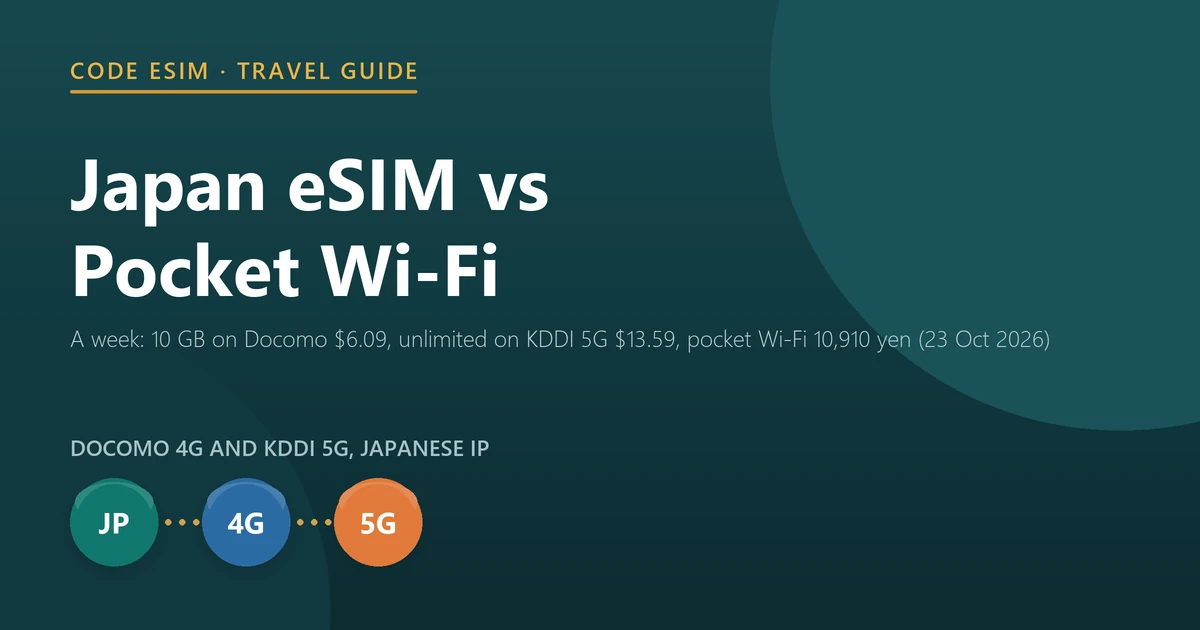
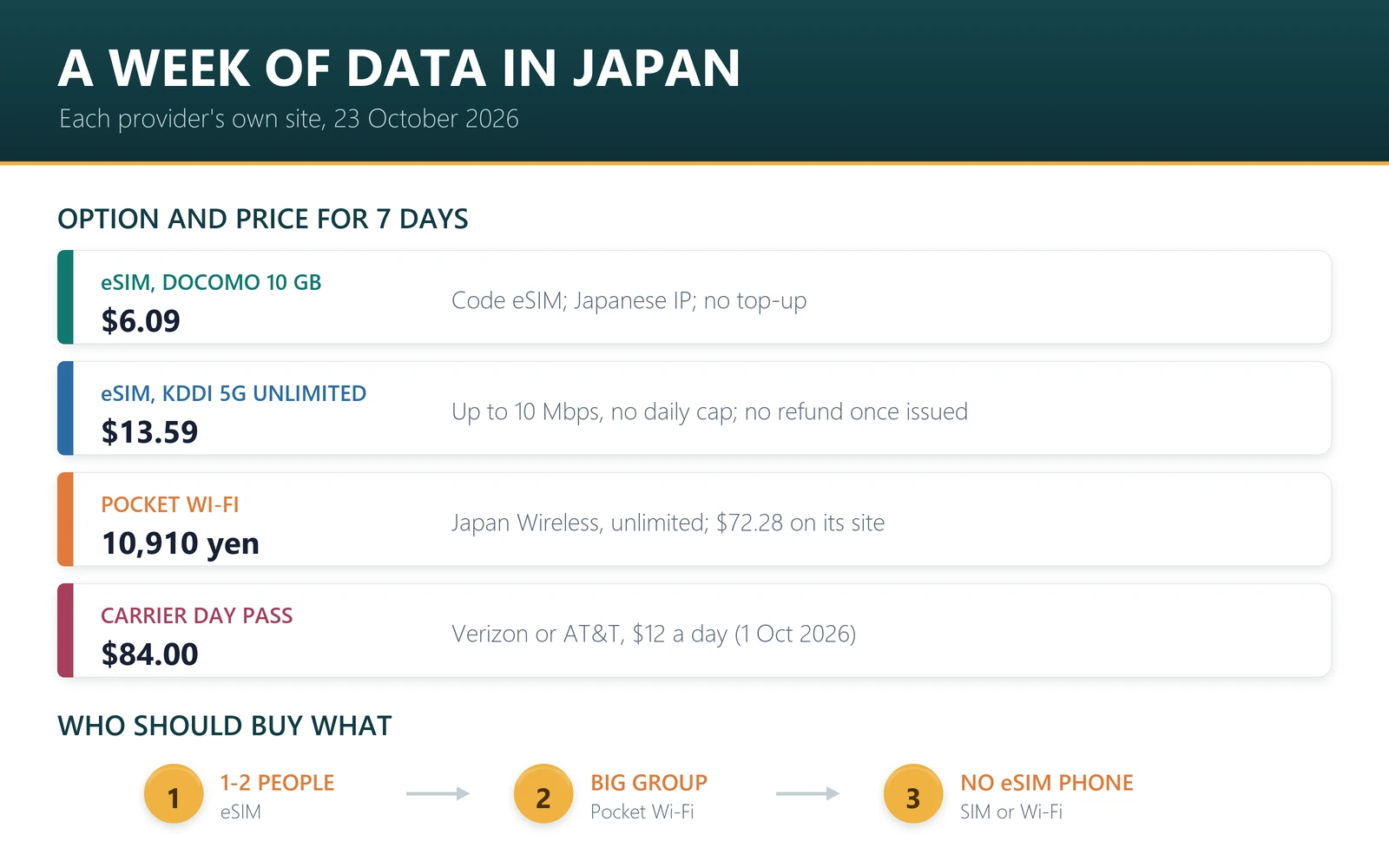
For most travelers whose phone supports eSIM, yes, an eSIM is worth it in Japan: it is the cheapest way to get mobile data, and there is nothing to pick up, charge or return. On 23 October 2026, a week with 10 GB on NTT Docomo cost $6.09 at Code eSIM, and a week of unlimited data cost $13.59 at up to 10 Mbps on KDDI 5G. A week of unlimited pocket Wi-Fi from Japan Wireless cost ¥10,910 ($72.28 on its site), and a US carrier day pass $84.00. Pocket Wi-Fi still makes sense for a group sharing one connection, or a phone that cannot use an eSIM.
Japan’s tourism board, JNTO, still describes pocket Wi-Fi rental as the safest way to stay connected everywhere in the country, and its connectivity page does not mention eSIMs. If your phone takes an eSIM, there is now a much cheaper way. Below is what each option cost for the same week on 23 October 2026, who each one suits, and which plan to buy. Code eSIM publishes this page and sells Japan eSIMs; we have not run speed tests.
- Cheapest for a normal week: an eSIM, from $4.49 for 5 GB or $6.09 for 10 GB at Code eSIM.
- Unlimited data for a week: $13.59 at up to 10 Mbps on KDDI, or $19.00 with no cap on Docomo, at Code eSIM; ¥3,390 with povo; $26.50 at Airalo and $27.50 at Holafly.
- Pocket Wi-Fi: ¥10,910 for 7 days of unlimited data from Japan Wireless, shared by up to 8 devices.
- Roaming: $12 a day with Verizon TravelPass or AT&T International Day Pass, $84.00 for a week.
- Free Wi-Fi: airports, most city hotels and SoftBank’s Free Wi-Fi Passport, which JNTO says gives visitors two weeks of free access.
A week in Japan: what each option costs
Prices from each provider’s own site on 23 October 2026. The pocket Wi-Fi price is Japan Wireless’s quote for a 7-day rental from 2 to 8 November 2026. Carrier prices are from Verizon’s and AT&T’s pages on 1 October 2026.
| Option | Price for 7 days | What you should know |
|---|---|---|
| eSIM, Code eSIM (Docomo) | 10 GB, $6.09 | Full speed until the 10 GB is used up; Japanese IP; no top-up |
| eSIM, Code eSIM (Docomo) | 5 GB, $4.49 | For maps, messages and a few photos |
| eSIM, Code eSIM (KDDI 5G) | Unlimited at up to 10 Mbps, $13.59 | No daily cap; no refund once the QR code is issued |
| eSIM, Code eSIM (Docomo) | Unlimited, $19.00 | No daily high-speed allowance; fair-use rules may apply |
| eSIM, povo 2.0 Japan SIM (au) | 10 GB, ¥1,430 (about $9.50) | Sign up through Ocean Tax Refund; unlimited week ¥3,390 |
| eSIM, Airalo | Unlimited, $26.50 | 10 GB for 30 days costs $18.00 |
| eSIM, Holafly | Unlimited, $27.50 | Unlimited only |
| Pocket Wi-Fi, Japan Wireless | Unlimited, ¥10,910 ($72.28 on its site) | SoftBank 4G, up to 8 devices, power bank included; pick up and return |
| Carrier day pass, Verizon or AT&T | $84.00 | $12 a day on 1 October 2026; keeps your number |
For a solo traveler, the gap is large: a 10 GB eSIM costs less than a tenth of a week of pocket Wi-Fi. It narrows for groups. Split three ways, the pocket Wi-Fi week comes to about ¥3,637 each, still about four times the price of a 10 GB eSIM per person.
When an eSIM is the better choice
- You travel alone or as a couple. Each phone gets its own plan for less than a day of pocket Wi-Fi rental.
- You want data the moment you land. You install the eSIM at home, and the plan starts when it first connects in Japan; there is no counter to queue at.
- You split up during the day. A pocket Wi-Fi only works for the people standing near it.
- You do not want another device. There is no router to charge each night, carry all day or post back before your flight.
- You want a local line. All 175 Japan-only plans in our catalogue run on a Japanese network, NTT Docomo or KDDI, and websites see a Japanese IP address.
When pocket Wi-Fi still makes sense
- Your phone cannot use an eSIM, or it is locked to your home carrier. Check our list of eSIM phones first.
- A group of four or more shares everything. Japan Wireless allows up to 8 devices on one router, so the cost per person falls the more of you there are.
- You need data on a laptop or tablet without a SIM. An eSIM phone can share its connection as a hotspot, and all our Japan plans support it; on the KDDI unlimited plans the hotspot total is 1 GB less than the number of days, for example 6 GB on a 7-day plan.
The trade-offs are practical: Japan Wireless quotes 8 to 10 hours of battery and includes a power bank, the router has to be collected and returned, and a lost or damaged device costs extra unless you buy its protection.
Local options: povo and SIM cards
Since 30 April 2026, KDDI’s povo 2.0 has offered visitors a data-only Japan SIM eSIM, sold through the Ocean Tax Refund service. Its press release lists a free 24-hour unlimited promo code for new sign-ups, then top-ups such as 3 GB for 3 days at ¥600, 10 GB for 7 days at ¥1,430 (about $9.50 at Japan Wireless’s rate of about ¥151 to the dollar) and unlimited data for 7 days at ¥3,390 (about $22.50). It runs on KDDI’s au network, the same network as our KDDI plans. You need to register with both services, and prices are in yen.
Physical SIM cards are sold at airports and electronics stores such as Bic Camera and Yodobashi Camera. JNTO’s rough guide is about ¥3,000 for 1 GB over 30 days, and your phone must be unlocked.
Roaming with your home carrier
Roaming is the simplest option and the most expensive one for data. On 1 October 2026 Verizon TravelPass and AT&T International Day Pass cost $12 a day, $84.00 for a week. T-Mobile’s Experience More and Experience Beyond plans included 5 GB and 15 GB of high-speed data abroad, which covers a light week. Roaming keeps your own number for calls and texts; none of the eSIMs above includes a phone number. Our carrier comparison covers the details.
Is free Wi-Fi enough?
Not on its own. JNTO lists free Wi-Fi in the terminals of the main international airports and in most city hotels, but warns that traditional ryokan and minshuku may not have it, and that café and convenience-store Wi-Fi usually needs a sign-up and can be patchy and slow. SoftBank’s Free Wi-Fi Passport gives visitors two weeks of free access at its hotspots. None of these helps with maps and train times between stops, which is when most travelers need data.
Which Code eSIM plan to buy for Japan
| Your trip | Plan at Code eSIM | Price |
|---|---|---|
| A stopover or one busy day | 1 GB day pass | $1.99 |
| 3 days, maps and messages | 3 GB for 3 days | $3.89 |
| A week of normal use | 10 GB for 7 days | $6.09 |
| A week of daily video | KDDI unlimited at 10 Mbps, 7 days | $13.59 |
| Two weeks | 20 GB for 15 days | $10.79 |
| A month | 20 GB for 30 days | $11.80 |
On 23 October 2026 Code eSIM sold 175 Japan-only plans: 143 on NTT Docomo, including day passes with 1, 2 or 3 GB a day and unlimited plans from 1 to 30 days, and 32 on KDDI 5G. Our Japan local eSIM page recommends a plan from your trip length and how you use your phone, and lists every price. Two things to know: the Docomo plans count days in Japan time and cannot be topped up, and the KDDI plans cannot be refunded once the QR code has been issued.
Frequently asked questions
Is it worth getting an eSIM for Japan?
Yes, if your phone supports eSIM. It is the cheapest way to get mobile data there: on 23 October 2026, 10 GB for 7 days on NTT Docomo cost $6.09 at Code eSIM, against ¥10,910 ($72.28) for a week of unlimited pocket Wi-Fi from Japan Wireless.
Is pocket Wi-Fi or an eSIM better for Japan?
An eSIM for one or two travelers with eSIM phones: it costs less and there is no device to carry or return. Pocket Wi-Fi for larger groups that stay together, phones that cannot use an eSIM, or laptops that need their own connection.
How much is a Japan eSIM for a week?
On 23 October 2026 at Code eSIM, 5 GB for 7 days cost $4.49, 10 GB $6.09, unlimited data at up to 10 Mbps on KDDI $13.59, and unlimited data on Docomo $19.00. Airalo’s unlimited week cost $26.50 and Holafly’s $27.50.
Which network do Japan eSIMs use?
It depends on the seller. At Code eSIM, the Japan-only plans run on NTT Docomo or KDDI, as local lines with a Japanese IP address. Airalo’s Japan plans list SoftBank and KDDI, and Ubigi’s list KDDI, NTT Docomo and SoftBank.
Can I rely on free Wi-Fi in Japan?
Only in some places. Airports and most city hotels have it, and SoftBank’s Free Wi-Fi Passport gives visitors two weeks of free hotspot access, but you will not have a connection on the street or on most trains.
Does a Japan eSIM give me a Japanese phone number?
Not the data plans in this comparison, which are data-only. You can still call and message through apps such as WhatsApp or LINE. Our guide to Japan eSIMs with a phone number covers the alternatives.
If your phone takes an eSIM, buy one before you fly, install it at home, and keep pocket Wi-Fi for groups or devices that need it. Size the plan for your trip, and check the refund and top-up terms on the plan page.
Last reviewed 23 October 2026. Code eSIM prices, networks, exit locations and terms come from our catalogue and plan pages on that date; product pages are authoritative. Japan Wireless prices and device details come from its rates page and home page on the same date; povo prices from its press release of 30 April 2026; free Wi-Fi and SIM card information from JNTO’s Wi-Fi and connectivity page; Airalo, Ubigi and Holafly prices from their own Japan pages on 23 October 2026; US carrier prices from their own pages on 1 October 2026. Yen conversions use the rate Japan Wireless showed on its site. Code eSIM sells competing plans; we have not tested speeds or coverage. NTT Docomo, KDDI, au, povo, SoftBank, Japan Wireless, Airalo, Ubigi, Holafly, Verizon, AT&T and T-Mobile are trademarks of their owners; this article is independent of them.