
A prepaid eSIM is a mobile data plan you pay for once, in advance, and install by scanning a QR code. There is no contract, no monthly bill and no automatic renewal. On 11 October 2026 our catalogue held 1,112 prepaid travel eSIM plans for 196 destinations, from $1.99 for a one-day pass, and a typical 10 GB plan cost about $12. Of those plans, 963 (87%) can be topped up, 13 include a phone number, and almost all must be started within about two months of purchase.
“Prepaid eSIM” describes two different products. One is a carrier’s monthly prepaid phone line, with a number, that you refill. The other is a one-off data package for a trip. This page is about the second kind. The counts come from our own catalogue, so you can see what is normal for a prepaid travel eSIM and what to check before you pay.
What “prepaid” means on a travel eSIM
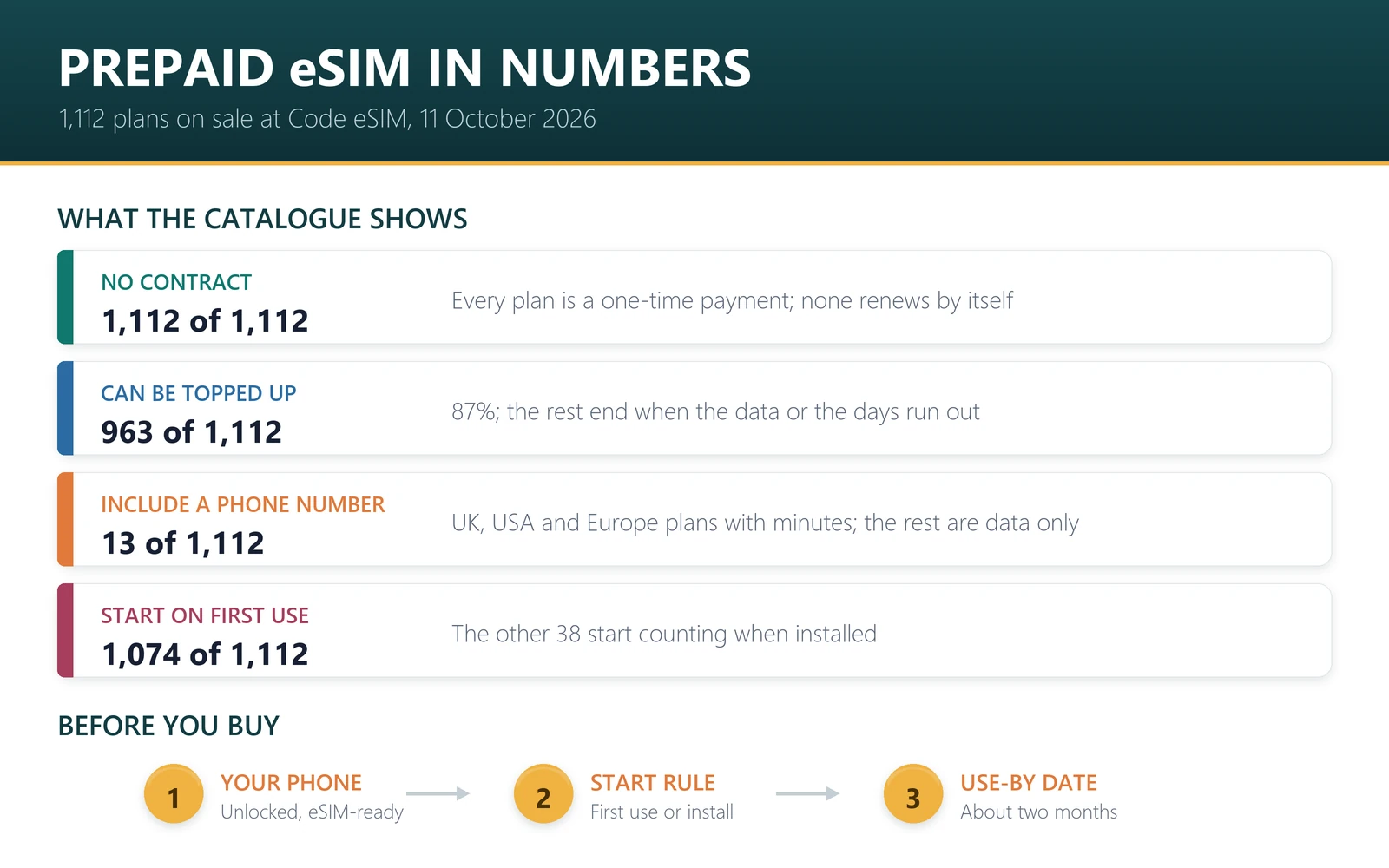
You pay the full price before you use anything, and the plan cannot run up a bill. When the data or the days run out, it stops. Every one of the 1,112 plans we sell works this way: none renews by itself.
| Prepaid travel eSIM | Carrier roaming day pass | Local prepaid SIM card | |
|---|---|---|---|
| How you pay | Once, before the trip | Per day, on your next bill | Once, at a shop or kiosk |
| Where you get it | Online, by email, in minutes | Already on your phone | In person after you land |
| ID check | None at our checkout | None; you are already a customer | Passport in many countries |
| Phone number | Rarely; most plans are data only | Your own number | A local number |
| A week in Europe | $7.54 for 10 GB over 30 days | $84 at $12 a day | Varies by country |
The day-pass price is what Verizon TravelPass and AT&T International Day Pass each charged on 1 October 2026; our comparison of travel eSIMs and US carrier day passes has the details, including the cases where roaming is the better deal.
What a prepaid eSIM costs
Price depends on the destination and the amount of data far more than on the brand. In our study of 944 fixed-data plans on 9 October 2026, the middle prices were:
| Data | Median price | Per gigabyte |
|---|---|---|
| 1 GB | $3.70 | $3.70 |
| 5 GB | $9.50 | $1.90 |
| 10 GB | $12.07 | $1.21 |
| 20 GB | $17.65 | $0.88 |
Many popular destinations cost less than the median. On 11 October 2026, 10 GB for 30 days cost $7.00 in Japan, $7.54 across 34 European countries and $9.00 in the USA. Our table of the cheapest travel eSIM by country sets those prices against Ubigi and Airalo in 22 destinations, and how much a travel eSIM costs has the full price study.
Of the 1,112 plans, 981 have a fixed amount of data, 91 are day passes with a daily allowance, and 40 are sold as unlimited. Unlimited plans normally slow down after a daily amount of high-speed data, which the plan page states.
How long a prepaid eSIM lasts
Each plan has a fixed number of days, and more than half run for 16 to 30 days.
| Validity | Plans | Share |
|---|---|---|
| 1 day | 17 | 1.5% |
| 2 to 7 days | 221 | 19.9% |
| 8 to 15 days | 187 | 16.8% |
| 16 to 30 days | 653 | 58.7% |
| More than 30 days | 34 | 3.1% |
Two dates matter, and they are easy to confuse. The first is when the days start counting: 1,074 of the 1,112 plans start when the eSIM first connects in the destination, and 38 start the moment you install them. The second is the use-by date before you start: 1,076 plans state that they must be started within two months, or 60 days, of purchase. Buy weeks ahead, not seasons ahead. Our guide to when an eSIM starts counting lists which plans start on install.
Topping up, and what happens when the data runs out
When a fixed-data plan reaches zero, it stops. Nothing is charged, because nothing is on account. On 963 of our 1,112 plans (87%) you can buy a top-up that adds data to the same eSIM. On the other 149 you buy a new plan and install a second eSIM. The plan page says which kind you are looking at, and our guide to what happens when an eSIM runs out of data covers the detail. A plan without top-up is not worse value, but it is less forgiving, so buy it with some margin.
Does a prepaid eSIM come with a phone number?
Usually not. Only 13 of our 1,112 plans include a number with call minutes: seven for the UK, four for the USA and two for Europe. Examples are 10 GB with 100 minutes in the USA for $25.88 and 10 GB with 200 minutes in the UK for $14.05. Every other plan is data only.
That matters less than it sounds. A travel eSIM is a second line, so your home SIM stays in the phone and keeps your own number for calls and texts while the eSIM carries the data. Our guide to keeping your number with a travel eSIM shows the settings that stop the home SIM from roaming. Calls and messages over WhatsApp, FaceTime or Telegram run over data, so they work on a data-only eSIM; codes your bank sends by text reach only your home line.
Do you need ID, an account or a contract?
No. At our checkout you enter a first name, a last name and an email address, and the QR code arrives by email. There is no document upload, no credit check and no account to create. A local prepaid SIM is different: you become a subscriber of a local operator, and many countries require that operator to record your passport. Local law still applies to you and your phone when you travel; our page on buying an eSIM without ID verification explains what that does and does not mean.
A prepaid eSIM for a trip to the USA
For visitors, our cheapest US plan on 11 October 2026 was 10 GB for 30 days at $9.00, on T-Mobile’s network. If you need a US number for calls, the 10 GB plan with 100 minutes is $25.88. Our guide to the best eSIM for the USA compares these with Airalo, Ubigi and Holafly.
If you live in the USA and want a monthly prepaid phone line with a number and unlimited calls, that is a carrier product, not a travel eSIM. We do not sell those.
Hotspot and speed caps
We rechecked every plan on sale on 27 October 2026, when the catalogue held 1,377 plans, not counting top-up packs. Each plan page states its hotspot and speed rules before checkout.
| What the plan page says | Plans |
|---|---|
| Hotspot supported, with no separate limit | 1,348 |
| Hotspot limited to a total amount (KDDI unlimited plans in Japan, 2 to 30 GB) | 29 |
| Fixed-data plans with no speed cap | 1,111 of 1,114 |
| Day passes that slow down after 1 to 3 GB a day | 166 |
| Unlimited plans with a daily or total high-speed allowance, or a speed ceiling | 49 of 97 |
So tethering is almost never blocked; what limits a laptop on hotspot is the allowance. A tethered laptop syncing photos or on video calls can use more in an afternoon than a phone uses in a week, so size up, and on an unlimited plan read the speed line before you buy. The three fixed-data plans with a cap are KDDI plans in Japan that slow to 128 kbps after their allowance instead of stopping.
When a prepaid travel eSIM is the wrong choice
- Your phone is carrier-locked or has no eSIM. A locked phone refuses other providers’ eSIMs. Check our compatibility list before you buy.
- Your home plan already includes roaming. Some do. On 1 October 2026, T-Mobile’s Experience plans included 5 GB or 15 GB of high-speed data abroad, which is enough for a short trip.
- You need people to call you on a local number. Only 13 of our plans have one. A local SIM, or one of those plans, fits better.
- You are staying for months. Most prepaid plans last 30 days, so you would buy a new one each month. Compare that with a local operator’s monthly plan.
- You are buying far in advance. Most plans must be started within about two months of purchase.
What does the brand in a plan’s name change? The start rule, top-up and exit location usually follow the brand. See travel eSIM brands compared: Sparks, NextLink, TSimTech, eSIMGo, Three and RoamVault.
Frequently asked questions
What is a prepaid eSIM?
A prepaid eSIM is a mobile plan you pay for once, in advance, and install on your phone by scanning a QR code. It has no contract and no monthly bill, and it stops when its data or its days run out. Most prepaid travel eSIMs are data only.
How much does a prepaid eSIM cost?
In our study of 944 fixed-data plans on 9 October 2026, the median price was $3.70 for 1 GB, $9.50 for 5 GB, $12.07 for 10 GB and $17.65 for 20 GB. Day passes start at $1.99. Popular destinations cost less: 10 GB was $7.00 in Japan.
Does a prepaid eSIM expire?
Yes, in two ways. Once started, it lasts a fixed number of days; 59% of the 1,112 plans we checked on 11 October 2026 run for 16 to 30 days. Before that, most plans must be started within two months of purchase.
Can you top up a prepaid eSIM?
Often. On 11 October 2026, 963 of the 1,112 plans in our catalogue (87%) could be topped up with more data on the same eSIM. The other 149 cannot; when they run out, you buy and install a new plan.
Does a prepaid eSIM have a phone number?
Rarely. Of 1,112 plans we checked, 13 include a number with call minutes, for the UK, the USA and Europe. The rest are data only, and your home SIM keeps your usual number for calls and texts.
Is a prepaid eSIM cheaper than roaming?
Usually. Verizon TravelPass and AT&T International Day Pass each cost $12 a day on 1 October 2026, or $84 for a week. A prepaid eSIM with 10 GB for 34 European countries cost $7.54 on 11 October 2026.
Do I need ID to buy a prepaid eSIM?
Not from us. You enter a name and an email address, and the QR code arrives by email. A local prepaid SIM bought in person is different: many countries require the operator to record your passport.
Prepaid means the price you see is all you can spend. Check the size, the start rule and the use-by date before you pay.
Last reviewed 11 October 2026. Plan counts come from the 1,112 plans on sale in our catalogue on that date. Median prices come from our study of 944 fixed-data plans on 9 October 2026. Carrier prices are the carriers’ own published prices on 1 October 2026. Prices change; product pages are authoritative. Verizon, AT&T and T-Mobile are trademarks of their owners; this article is independent of them.