
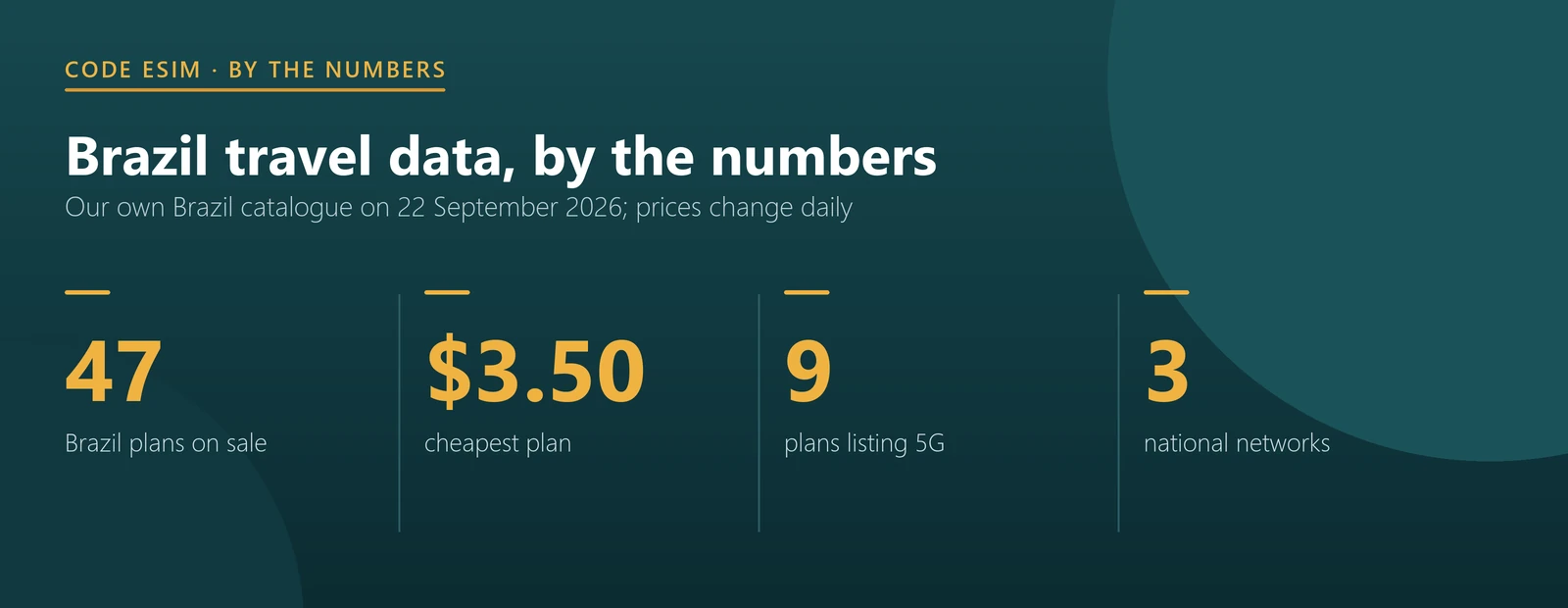
For two weeks in Brazil, most travellers need 10–20 GB, and a travel eSIM lands on Vivo, TIM or Claro — the same networks a local SIM uses. Our catalogue has 47 Brazil plans as of 22 September 2026, starting at $3.50, with 9 of them listing 5G.
Brazil is the destination in this series where buying a local SIM is hardest for a visitor, and it is not about paperwork volume the way India is. It is about one document. Brazilian prepaid lines are normally registered against a CPF — the national taxpayer number — and a short-term visitor does not have one. Some shops will find workarounds, many will simply decline, and you will have spent an afternoon finding out which.
That single fact is why travel eSIMs are disproportionately useful here. You skip the question entirely.
- Two weeks for most people: 10–20 GB, with ride-hailing and navigation running daily.
- Networks: Vivo, TIM or Claro, depending on the plan.
- Prices: from $3.50, with plans up to 50 GB and up to 365 days.
- 5G: 9 of our 47 Brazil plans list it. Expect 4G LTE in most places.
- No CPF needed: an eSIM installs before you fly, with no Brazilian tax number and no shop visit.
The CPF problem
Worth understanding properly, because it is the thing that decides the question.
Brazil registers mobile lines against a CPF, the individual taxpayer registry number that residents use for almost everything — bank accounts, contracts, purchases. Tourists do not normally have one. Foreigners can apply for a CPF, and it is not difficult in principle, but it means a visit to a Receita Federal office or a partner bank, and that is a strange way to spend a morning of a two-week holiday.
In practice, some operators and resellers have tourist processes, airport kiosks sometimes help, and travellers do succeed. But it is inconsistent enough that planning around it is unwise. Rules also change, so check the operator’s own page rather than a travel blog — including this one — if you intend to try.
A travel eSIM sidesteps this: you install the profile at home on Wi-Fi, it activates on first data use after you land, and no Brazilian registration is involved at any point.
Ready to sort it out? Compare Brazil eSIM plans — 47 of them, from $3.50 — or see regional Americas plans if Brazil is one stop on a longer route.
How much data do you need in Brazil?
Size the plan from behaviour, not fear. A normal tourist uses 500 MB to 1 GB a day, and Brazil runs at the higher end of that. Ride-hailing is the default way to move around Rio and São Paulo and it runs navigation for every journey. WhatsApp is the national communication layer — restaurants, tour operators, drivers and hotels all expect it. Distances between destinations are large enough that you are often navigating or checking flights.
| Trip length | Light: hotel Wi-Fi at night | Normal tourist | Heavy: video, hotspot, working |
|---|---|---|---|
| 1 week | 3–5 GB | 5–10 GB | 15–20 GB |
| 2 weeks | 5–10 GB | 10–20 GB | 30–50 GB |
| 1 month | 10–20 GB | 20–30 GB | 50 GB |
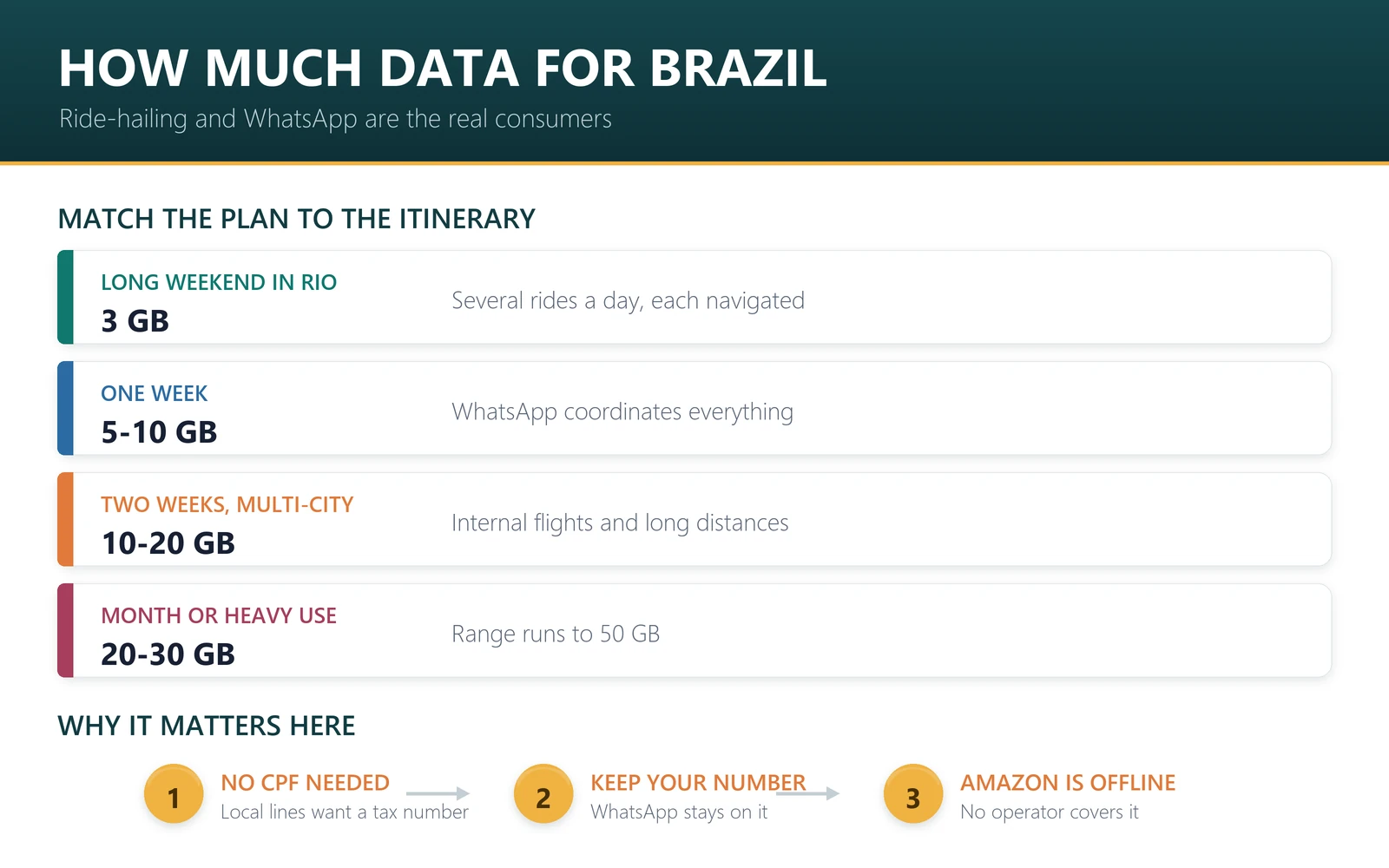
Add roughly 30% margin. Brazil is also one of our more expensive destinations per gigabyte — wholesale rates here are higher than in Asia — so the instinct to buy a huge plan “just in case” costs real money. Size it properly instead, and if you run short you can top up an active eSIM without reinstalling anything.
Which Brazilian network will you land on?
| Network | Tech | Share of our Brazil plans |
|---|---|---|
| Vivo | 4G LTE / 5G | 27 of 47 plans (57%) |
| TIM | 5G / 4G LTE | 26 of 47 plans (55%) |
| Claro | 5G / 4G LTE | 20 of 47 plans (43%) |
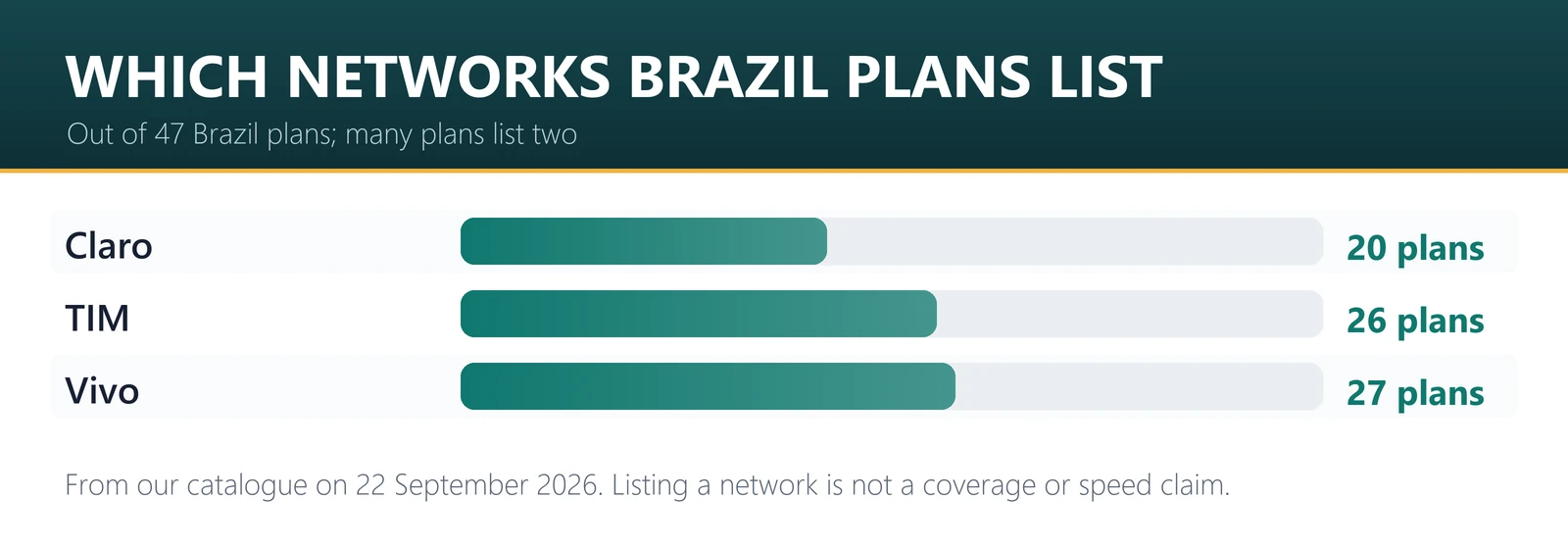
All three cover the coastal cities and the populated southeast well, and 5G has rolled out across the major capitals. The differences show up inland. Vivo and Claro generally have the broadest reach into the interior; TIM is strong along the coast and in the south. On a trip that stays in Rio, São Paulo, Salvador and Foz do Iguaçu, any of them is fine.
The Amazon, and other places with no signal
Brazil is larger than the contiguous United States, and its network map reflects where 215 million people actually live — overwhelmingly near the coast.
In the Amazon basin, on river journeys, in the Pantanal and across stretches of the interior, there is no mobile signal from any operator. That is not a travel eSIM limitation; a Vivo SIM bought in São Paulo has the same experience. Lodges often run satellite internet with a shared connection and fixed hours, and that is what you will be using.
Plan for it rather than buying more data: download offline maps before leaving a city, save booking references and lodge addresses as screenshots, tell someone your itinerary, and treat multi-day river trips as offline by default. The data plan matters for the cities at either end of that journey, not for the middle of it.
When you should not buy a travel eSIM
If you are staying several months, studying, or working in Brazil, get a CPF and a local line. A Brazilian number is genuinely useful — WhatsApp verification, Pix payments, deliveries, domestic bookings — and domestic tariffs are cheaper than anything a roaming plan can offer. The CPF pain is a one-time cost that pays back over a long stay.
For a holiday of one to four weeks, the arithmetic goes the other way: the eSIM works from the moment you land, needs no registration, and leaves your own number reachable for bank codes.
Choosing a plan by trip type
| Trip | What to buy | Why |
|---|---|---|
| Stopover or a few days | 1 GB / 7 days | Maps and rides for a short stay. |
| Long weekend in Rio | 3 GB / 15 days | Ride-hailing several times a day adds up. |
| One week | 5 GB / 30 days | The standard week with WhatsApp coordination. |
| Two weeks, multiple cities | 10 GB / 30 days | Internal flights, navigation, daily uploads. |
| Month-long or heavy use | 20 GB / 30 days | Comfortable for a longer stay. Our range runs to 50 GB. |
| Brazil plus other countries | A regional Americas plan | One profile if Argentina or Chile is on the route. |
Travelling on through Latin America? The Mexico guide covers that leg, and the same rule applies: a regional plan is worth comparing against separate country plans before you buy.
How to install and activate
Buy before you fly, install on home Wi-Fi, and leave the profile switched off until you land. Installation needs internet; activation does not.
iPhone: open the QR code email on a second screen, then Settings → Cellular → Add eSIM → Use QR Code. Keep your home line as the default for calls and texts, and switch mobile data to the travel plan after landing.
Android: Settings → Network & internet → SIMs → Add eSIM, then scan the same code. Samsung, Pixel and Xiaomi word it slightly differently; the flow is the same.
Most of our Brazil plans start counting validity on first data use rather than at purchase, so installing early does not burn days — each plan page states its policy. Your own number stays reachable on your primary SIM, which is the main reason to use a travel eSIM rather than swapping to a local SIM, and it matters in Brazil because your WhatsApp account stays tied to your existing number. Check the phone is carrier-unlocked and eSIM-capable on our compatibility list first, and if it does not connect, the troubleshooter covers the usual causes.
Frequently asked questions
Do I need a CPF to use an eSIM in Brazil?
No. A travel eSIM roams on a Brazilian network and involves no local registration, so no CPF is required. That is the main practical advantage here, because Brazilian prepaid lines normally are registered against a CPF that visitors do not have.
Can tourists buy a SIM card in Brazil?
Sometimes, but it is inconsistent. Lines are usually registered against a CPF, and while some shops and airport kiosks have tourist processes, many will decline. Foreigners can apply for a CPF, but that means an office visit during your trip.
How much data do I need for two weeks in Brazil?
Most travellers land between 10 and 20 GB. Ride-hailing runs navigation for every journey and WhatsApp is how everything gets coordinated, so consumption is higher than a sightseeing-only estimate suggests.
Is there mobile coverage in the Amazon?
Largely no. River journeys, the Pantanal and much of the interior have no signal from any operator, including local SIMs. Lodges typically run a shared satellite connection. Download maps and save booking details before you leave the city.
Which network is best in Brazil?
The three are closely matched in the cities. Vivo and Claro generally reach further into the interior, TIM is strong along the coast and in the south. Many plans list two networks, which helps on trips that leave the coastal corridor.
Why are Brazil plans more expensive than Asian ones?
Wholesale roaming rates for Brazil are higher, which raises the price per gigabyte across the market rather than only here. Size the plan properly instead of over-buying, and use a top-up if you run short.
When does the validity period start?
On most of our Brazil plans, on first data use rather than at purchase, so you can install days ahead. Each plan page states its activation policy, so check there rather than assuming.
Plan counts, prices and network shares here are from our own catalogue on 22 September 2026. Prices move daily with supplier pricing, so the figures are a snapshot and the Brazil plans page is the live version. CPF and SIM registration requirements are set by Brazilian regulation and individual operators and do change — verify with the operator before relying on them.
Brazil is the trip where arriving connected is worth more than it looks, because the alternative involves a tax number. Install before you fly, size for the ride-hailing, and accept that the Amazon leg is offline no matter what you buy.