
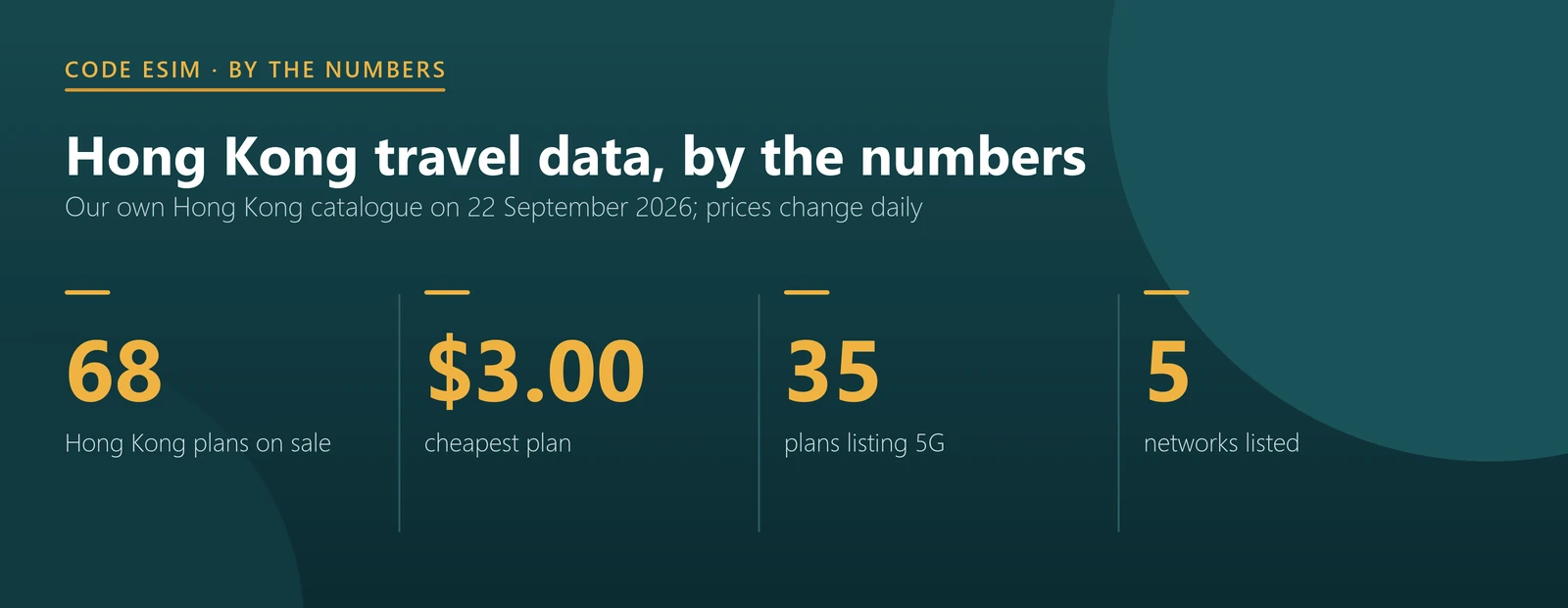
For a week in Hong Kong, most travellers need 5–10 GB, and a travel eSIM lands on 3, SmarTone or CSL — the same networks a local SIM uses. Our catalogue has 68 Hong Kong plans as of 22 September 2026, starting at $3.00, with 35 of them offering 5G where the network provides it.
Hong Kong is small, dense and exceptionally well covered — including in the MTR tunnels and up on the Peak. Coverage is not the interesting question here. The interesting question is the border, because a large share of Hong Kong trips do not stop at Hong Kong. Macau is an hour by ferry or bridge coach. Shenzhen is a metro ride. And a Hong Kong-only plan covers neither.
- A week for most people: 5–10 GB. Wi-Fi is everywhere, so many travellers use less than expected.
- Networks: 3, SmarTone, CSL/1010, HKT or CMCC HK, depending on the plan.
- Prices: from $3.00, with plans up to 50 GB and up to 365 days.
- 5G: 35 of our 68 Hong Kong plans include it — roughly half the range.
- Crossing a border: Hong Kong, Macau and mainland China are three separate coverage areas. Check the plan lists each one you will visit.
Hong Kong, Macau and the mainland are three different things
This is the part worth reading twice, because the geography misleads people.
Hong Kong and Macau are Special Administrative Regions with their own mobile networks and their own roaming agreements. Mainland China is separate again. A plan sold as “Hong Kong” covers Hong Kong. It does not automatically extend to a Macau day trip or a Shenzhen meeting, even though both are short journeys.
| Your trip | What to look for |
|---|---|
| Hong Kong only | A Hong Kong plan. Simplest and cheapest. |
| Hong Kong + Macau | A plan naming both, such as the China, HK & Macau 15 GB / 180 days. |
| Hong Kong + mainland China | A plan naming mainland China explicitly — see the China guide. |
| Hong Kong + Taiwan + mainland | A Greater China and Taiwan plan covering all of it. |
The coverage table on each plan page lists every territory by name. Open it and look for the ones on your itinerary — that check takes ten seconds and prevents the most common problem on this route.
Ready to sort it out? Compare Hong Kong eSIM plans — 68 of them, from $3.00 — or see Macau plans if the ferry is on the itinerary.
Where your traffic comes out
Worth understanding before you buy, and frequently misunderstood.
Travel eSIMs are typically home-routed: your data is carried back to the issuing operator’s network and reaches the internet there, rather than breaking out locally in the country you are standing in. A local SIM bought in a shop does the opposite. That is why a travel eSIM often shows a different country to the one you are in when a website checks your location, and it is also why streaming services may behave differently to what you expect.
We publish this rather than hide it. Each plan page has an IP routing location row in the plan details table, filled in wherever the supplier told us the exit point. If where your traffic surfaces matters to you — for work tools, banking apps or a particular service — read that row before paying, and pick accordingly. We explain the mechanism in more detail in does a travel eSIM change your IP address.
How much data do you need in Hong Kong?
Size the plan from behaviour, not fear. A normal tourist uses 500 MB to 1 GB a day, and Hong Kong sits at the lower end. Free Wi-Fi is widespread in malls, MTR stations, ferry terminals and public venues, and journeys are short — you are rarely navigating for hours the way you would in Australia or Mexico.
| Trip length | Light: Wi-Fi most of the day | Normal tourist | Heavy: video, hotspot, working |
|---|---|---|---|
| Layover or 2–3 days | 1–2 GB | 3 GB | 5–10 GB |
| 1 week | 3–5 GB | 5–10 GB | 15–20 GB |
| 2 weeks or business trip | 5–10 GB | 10–20 GB | 30–50 GB |
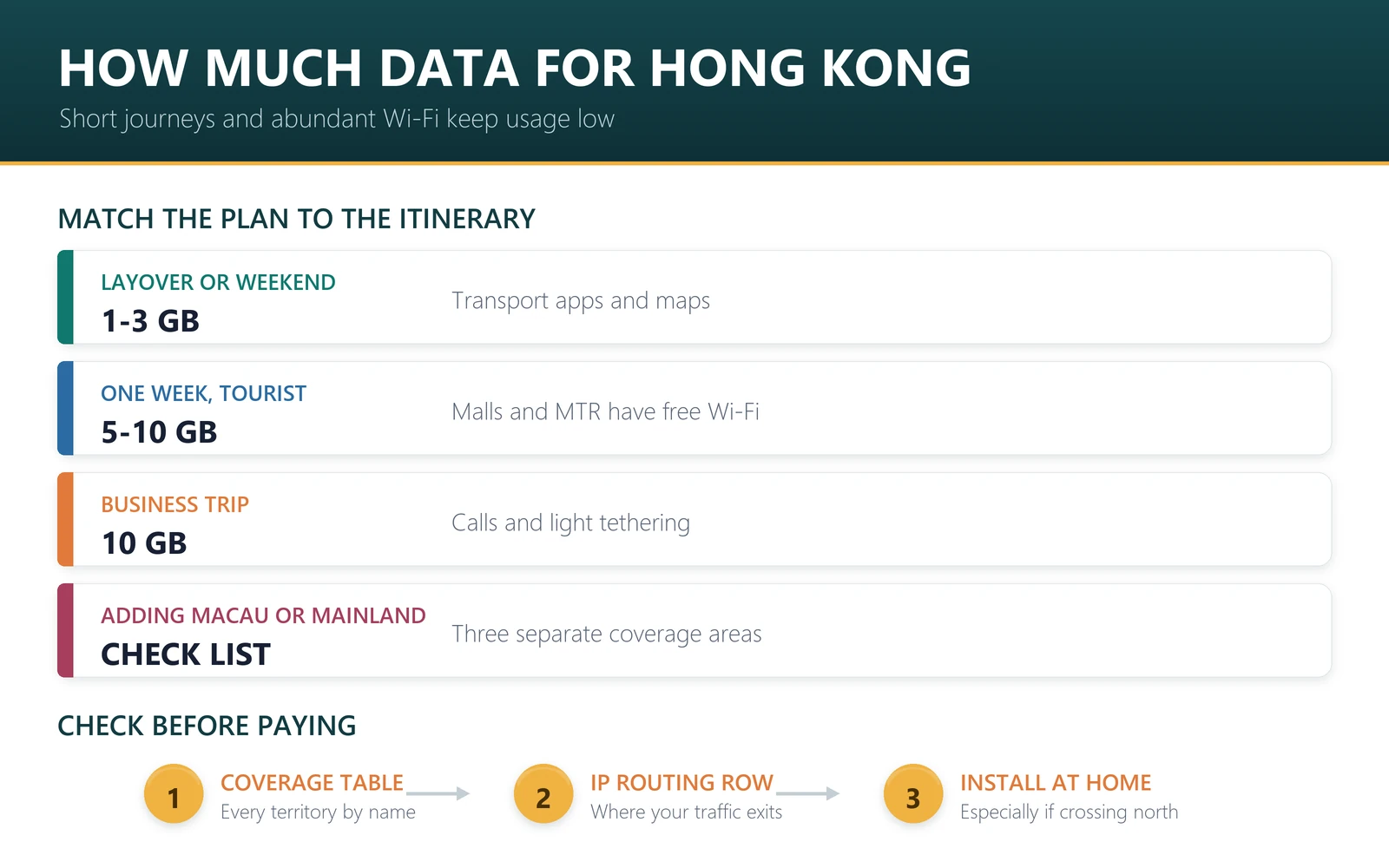
Add roughly 30% margin. Business travellers should size up rather than down: hotel Wi-Fi in Hong Kong is generally good, but video calls and tethering a laptop through a working day will outrun a 5 GB plan quickly. If you do run out, you can top up an active eSIM without reinstalling anything.
Which Hong Kong network will you land on?
| Network | Tech | Share of our Hong Kong plans |
|---|---|---|
| 3 | 5G / 4G LTE | 35 of 68 plans (51%) |
| SmarTone | 4G LTE / 5G | 20 of 68 plans (29%) |
| CSL / 1010 | 5G | 16 of 68 plans (24%) |
| HKT | 5G | 4 of 68 plans (6%) |
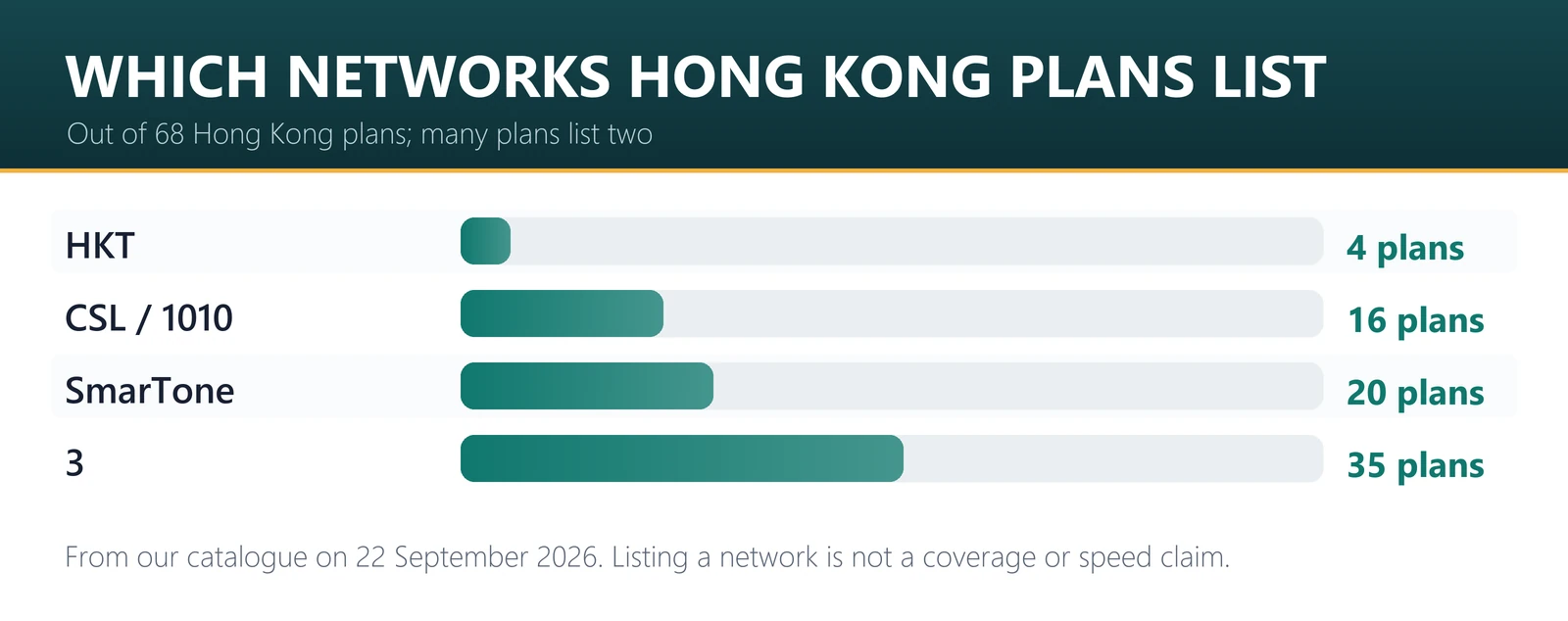
Hong Kong is 1,100 square kilometres with one of the densest network deployments anywhere. All the operators above give you reliable service across Hong Kong Island, Kowloon, the New Territories and the MTR. Unlike Australia or the Philippines, the network badge is not a decision factor here — buy on data size, validity and which territories the plan covers.
When you should not buy a travel eSIM
Hong Kong has genuinely convenient alternatives, and we would rather say so.
Prepaid SIM cards are sold in 7-Eleven, Circle K and convenience stores across the city, cheap and with no paperwork beyond handing over cash. If you are staying a month, or want a local number, that is a fine choice. Airport Wi-Fi and city Wi-Fi are also good enough that a very short layover may not need mobile data at all.
Where the eSIM wins is the arrival itself — walking off a long-haul flight already connected, booking an Uber or checking the Airport Express while still airside — and multi-territory trips where one profile covering Hong Kong, Macau and the mainland saves juggling three SIMs.
Choosing a plan by trip type
| Trip | What to buy | Why |
|---|---|---|
| Layover or a weekend | 3 GB / 15 days | Enough for maps, messages and transport apps. |
| One week, tourist | 5 GB / 30 days | Comfortable given how much Wi-Fi you will use. |
| Business trip | 10 GB / 30 days | Handles calls and some tethering between meetings. |
| Heavy use or two weeks | 20 GB / 30 days | Hotspot a laptop without rationing. |
| Adding Macau or the mainland | China, HK & Macau 15 GB / 180 days | One profile across all three, with a long validity window. |
| Adding Taiwan as well | Greater China and Taiwan 10 GB / 30 days | Covers the full regional route on one profile. |
How to install and activate
Buy before you fly, install on home Wi-Fi, and leave the profile switched off until you land. Installation needs internet; activation does not.
iPhone: open the QR code email on a second screen, then Settings → Cellular → Add eSIM → Use QR Code. Keep your home line as the default for calls and texts, and switch mobile data to the travel plan after landing.
Android: Settings → Network & internet → SIMs → Add eSIM, then scan the same code. Samsung, Pixel and Xiaomi word it slightly differently; the flow is the same.
Installing before departure matters more on this route than most, because if your itinerary continues into mainland China, downloading a QR code after you cross can be harder than doing it at home. Most of our Hong Kong plans start counting validity on first data use rather than at purchase, so installing early does not burn days — each plan page states its policy. Your own number stays reachable on your primary SIM, which is the main reason to use a travel eSIM rather than swapping to a local SIM. Check the phone is carrier-unlocked and eSIM-capable on our compatibility list first, and if it does not connect, the troubleshooter covers the usual causes.
Frequently asked questions
Does a Hong Kong eSIM work in mainland China?
Not unless the plan lists mainland China in its coverage. Hong Kong, Macau and the mainland are three separate coverage areas despite the short distances. For a Shenzhen day trip, choose a plan that names mainland China explicitly.
Does a Hong Kong eSIM work in Macau?
Only if Macau is listed on the plan page. Macau is a separate Special Administrative Region with its own networks. Plans covering China, Hong Kong and Macau together exist and are the simplest answer for that itinerary.
How much data do I need for a week in Hong Kong?
Most travellers use 5 to 10 GB. Free Wi-Fi is widespread in malls, MTR stations and public venues, and journeys are short, so consumption runs lower than in countries where you navigate for hours a day.
Which network is best in Hong Kong?
All of them work well. Hong Kong has one of the densest network deployments anywhere, including full MTR coverage. Choose on data size, validity and which territories the plan covers rather than on the network name.
Will a travel eSIM show a Hong Kong IP address?
Often not. Travel eSIMs are usually home-routed, so traffic reaches the internet at the issuing operator’s network rather than locally. Each plan page lists an IP routing location where the supplier provided it — check that row if this matters for your apps.
Is it cheaper to buy a SIM at 7-Eleven?
For longer stays, often yes, and it gets you a local number with no paperwork. The eSIM advantage is arriving already connected and covering multiple territories on one profile, not beating a convenience-store SIM on price for a month-long stay.
When does the validity period start?
On most of our Hong Kong plans, on first data use rather than at purchase, so you can install days ahead. Each plan page states its activation policy, so check there rather than assuming.
Plan counts, prices and network shares here are from our own catalogue on 22 September 2026. Prices move daily with supplier pricing, so the figures are a snapshot and the Hong Kong plans page is the live version. Coverage territories and IP routing locations are as supplied by each provider and listed on the individual plan pages.
Hong Kong itself is the easy part. The plan you want depends on whether you are staying inside it — decide that first, check the coverage table for every territory on your route, and the rest takes care of itself.