
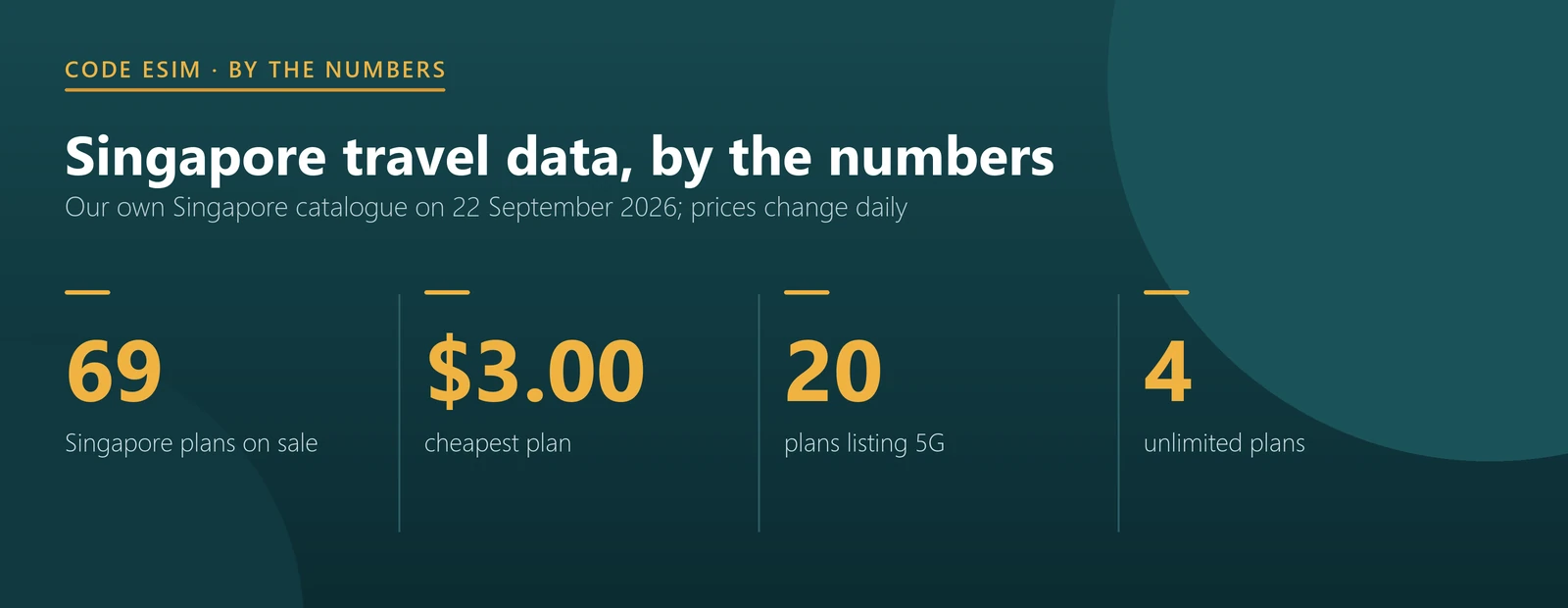
For a week in Singapore, most travellers need 5–10 GB, and a travel eSIM lands on Singtel, StarHub or SIMBA — the same networks a local SIM uses. Our catalogue has 69 Singapore plans as of 22 September 2026, starting at $3.00, with 20 of them offering 5G where the network provides it.
Singapore is the easiest destination in this series to get connected in and the easiest to overspend on. Coverage is not a question: the island is 50 km across, 5G is everywhere, and all three networks work. The two decisions that actually matter are how long you are there, and whether you are staying.
Because most people are not staying. Changi is one of the world’s biggest transfer hubs, and a large share of arrivals are either on a long layover or using Singapore as the front door to Malaysia, Thailand or Indonesia. That changes which plan is correct, and it is where the money is.
- A week for most people: 5–10 GB. Singapore has excellent public and mall Wi-Fi, so many travellers use less than they expect.
- Networks: Singtel, StarHub or SIMBA, depending on the plan.
- Prices: from $3.00, with plans up to 60 GB and up to 365 days.
- 5G: 20 of our 69 Singapore plans include it, and 4 are unlimited-data plans.
- Going onward: a Singapore–Malaysia–Thailand plan with 30 GB costs $10.90, less than our 20 GB Singapore-only plan at $13.00. If your trip crosses a border, check the regional option first.
The regional plan is usually the better buy
Start here, because it is the part most guides get wrong by omission.
Singapore-only plans make sense for a Singapore-only trip. But a large share of Singapore itineraries include Kuala Lumpur, Penang, Bangkok, Phuket or Bali. The moment a second country enters the plan, a regional profile usually beats two country plans — and in our catalogue it currently beats even one.
| Plan | Data | Price | Covers |
|---|---|---|---|
| Singapore 20 GB / 30 days | 20 GB | $13.00 | Singapore only |
| Singapore, Malaysia & Thailand 30 GB / 30 days | 30 GB | $10.90 | Three countries |
More data, three countries, lower price. That is not a trick of presentation — it is what different wholesale agreements produce, and it changes month to month, which is exactly why you should compare rather than assume the single-country plan is the focused, cheaper choice. It often is not.
The rule that follows: decide your route before you decide your plan. If Singapore is the only stop, buy Singapore. If a border crossing is on the itinerary — including the very common Johor Bahru day trip — look at the regional plan first.
One practical difference: that regional plan starts its 30 days the moment the eSIM is installed, unlike most of our Singapore-only plans, which wait for first use. Install it the day before you fly rather than a week early. The activation row on each plan page says which kind you are buying.
Ready to sort it out? Compare Singapore eSIM plans — 69 of them, from $3.00 — or see regional Asia plans if you are crossing a border.
How much data do you need in Singapore?
Size the plan from behaviour, not fear. A normal tourist uses 500 MB to 1 GB a day. Singapore sits at the low end of that, for a reason worth knowing: free public Wi-Fi is genuinely widespread, malls and MRT stations are covered, and cafés are reliable. You will offload more here than in most countries.
| Trip length | Light: Wi-Fi most of the day | Normal tourist | Heavy: video, hotspot, working |
|---|---|---|---|
| Layover (under 24h) | 1 GB | 1–2 GB | 3–5 GB |
| 1 week | 3–5 GB | 5–10 GB | 15–20 GB |
| 2 weeks | 5–10 GB | 10–20 GB | 30–50 GB |
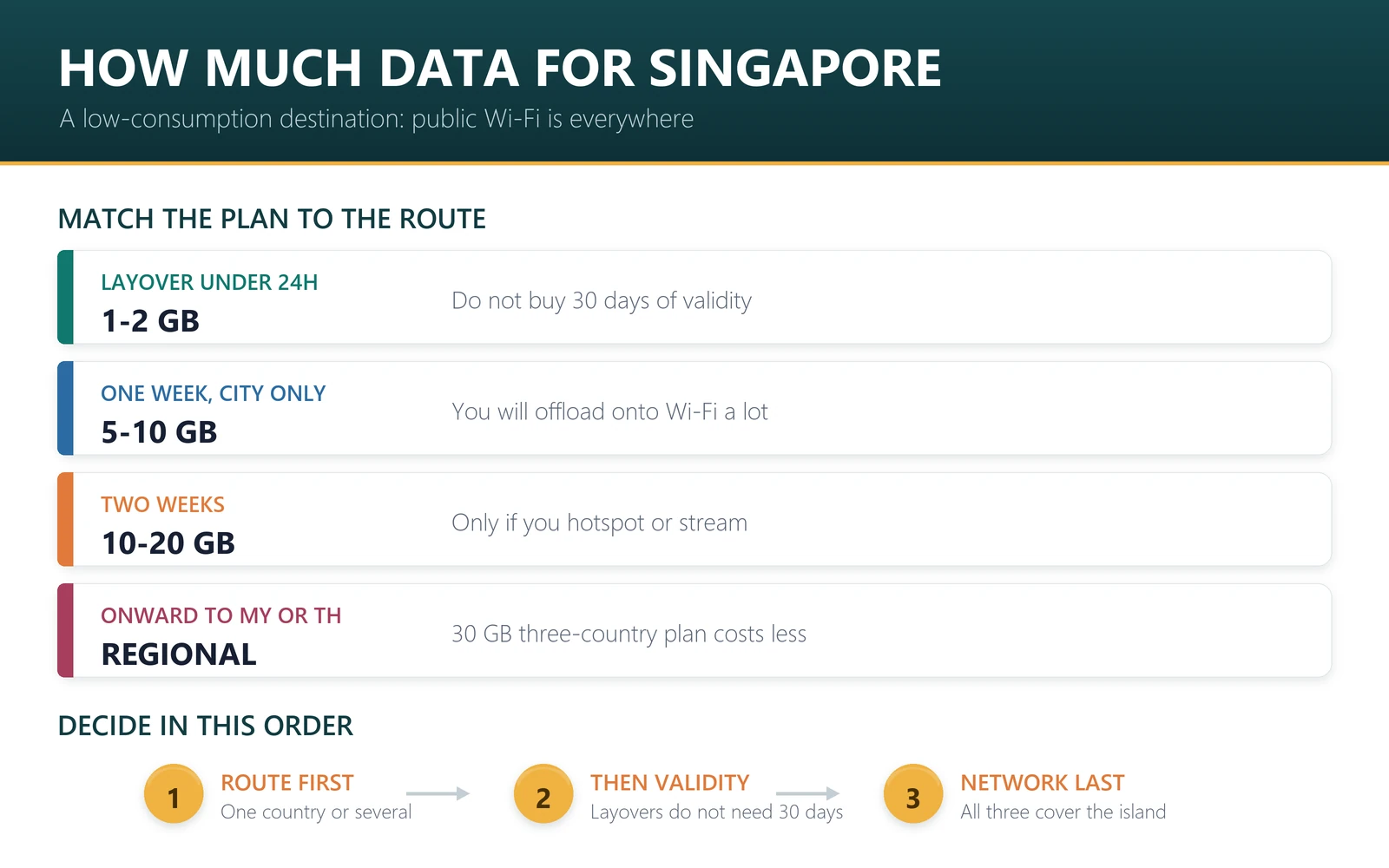
For a layover, resist buying a 30-day plan. A 2 GB / 15 day plan covers a transfer with room to spare, and an unlimited 3-day plan exists for the case where you would rather not think about it at all. Buying validity you will not use is the most common way to overpay on this destination.
Which Singapore network will you land on?
Less consequential here than anywhere else in this series, but worth knowing.
| Network | Tech | Share of our Singapore plans |
|---|---|---|
| Singtel | 5G | 41 of 69 plans (59%) |
| StarHub | 5G | 38 of 69 plans (55%) |
| SIMBA | 5G / 4G LTE | 18 of 69 plans (26%) |
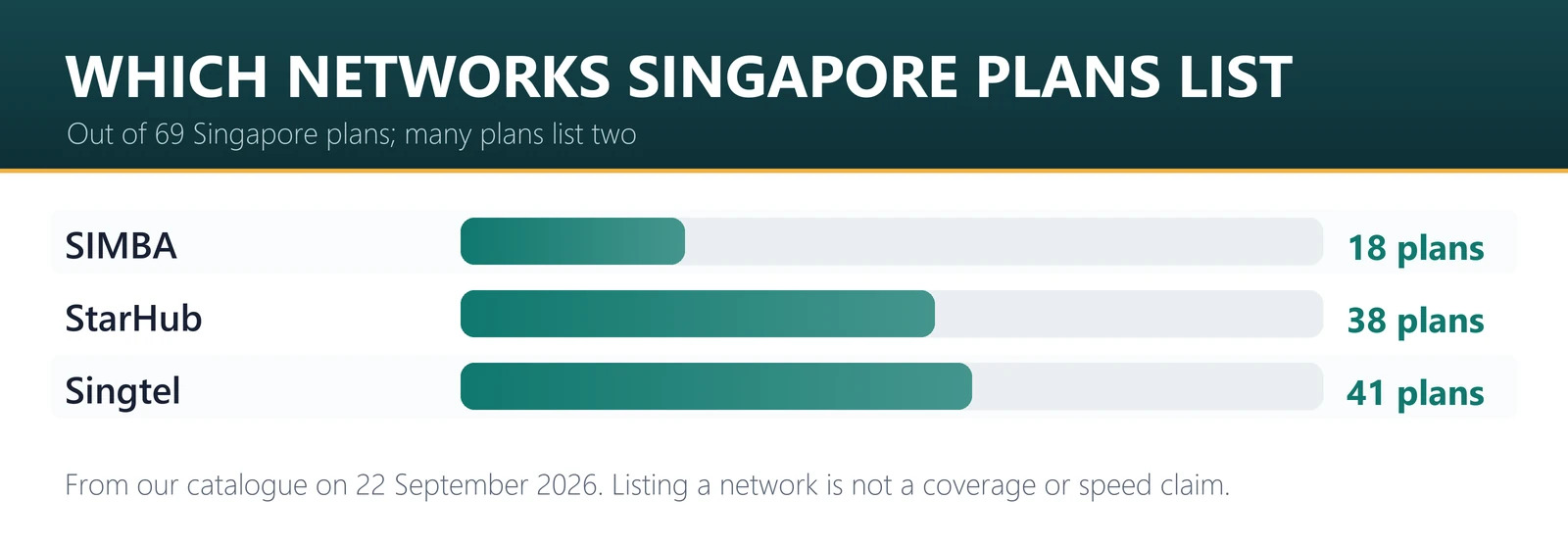
Singapore has near-total 5G coverage across a small, dense island. Singtel and StarHub are the established networks; SIMBA is the newer challenger and is competitive in built-up areas. For a visitor, any of the three will do what you need — including in the MRT tunnels, which are covered. Choose on data size and validity, not on the network badge.
When you should not buy a travel eSIM
Singapore is one of the places where the alternative is genuinely good. Tourist SIM cards are sold at Changi arrivals and in convenience stores across the island, they are inexpensive, and buying one takes minutes with just a passport — none of the paperwork you would face in India.
So if you want a local Singapore number, or you are staying for a month or more, buy locally. The eSIM advantage here is narrower than elsewhere and it is about the first hour: you walk off the plane already online, you do not queue at a counter after a long-haul flight, and your own number stays reachable. On a 14-hour layover, that is the whole value proposition. On a six-week stay, it is not.
Choosing a plan by trip type
| Trip | What to buy | Why |
|---|---|---|
| Long layover at Changi | 2 GB / 15 days | Maps, messages and a ride into town. Do not buy 30 days. |
| Layover, zero thinking | Unlimited / 3 days | When you would rather not watch a counter at all. |
| One week, Singapore only | 5 GB / 30 days | Plenty, given how much Wi-Fi you will use here. |
| Two weeks or heavier use | 10 GB / 30 days | Comfortable without paying for headroom you will not touch. |
| Onward to Malaysia or Thailand | Regional 30 GB / 30 days | More data and three countries for less than the 20 GB local plan. |
| Wider Asia trip | A regional Asia plan | One profile across the route beats installing one per country. |
If Thailand is the main event rather than a side trip, the Thailand guide covers that leg in detail, and Malaysia plans are worth comparing separately if you are spending real time there.
How to install and activate
Buy before you fly, install on home Wi-Fi, and leave the profile switched off until you land. Installation needs internet; activation does not. This matters more for Singapore than most places, because layover travellers are exactly the people who cannot afford to be fiddling with settings in a transit hall.
iPhone: open the QR code email on a second screen, then Settings → Cellular → Add eSIM → Use QR Code. Keep your home line as the default for calls and texts, and switch mobile data to the travel plan after landing.
Android: Settings → Network & internet → SIMs → Add eSIM, then scan the same code. Samsung, Pixel and Xiaomi word it slightly differently; the flow is the same.
Most of our Singapore plans start counting validity on first data use rather than at purchase, so installing early does not burn days — each plan page states its policy. Your own number stays reachable on your primary SIM, which is the main reason to use a travel eSIM rather than swapping to a local SIM. Check the phone is carrier-unlocked and eSIM-capable on our compatibility list first. If it does not connect, the troubleshooter covers the usual causes, and remaining data shows on the usage page.
Frequently asked questions
Is a Singapore eSIM worth it for a layover?
Yes, if the layover is long enough to leave the airport. Buy a small short-validity plan rather than a 30-day one. You walk out already connected, which matters when you have a fixed number of hours and a return flight to make.
Does a Singapore eSIM work in Malaysia?
Not unless the plan lists Malaysia. A Singapore-only plan stops at the border, including on the Johor Bahru day trip. For any border crossing, choose a regional plan that names each country on the plan page.
How much data do I need for a week in Singapore?
Most travellers use 5 to 10 GB. Singapore has unusually good public and mall Wi-Fi, so actual consumption often comes in below what the same person would use in Europe. Size up only if you will hotspot or stream.
Which network is best in Singapore?
All three work well across the island, including in MRT tunnels. Singtel and StarHub are the established networks and SIMBA is the newer entrant. Choose on data size and validity instead — the network badge matters far less here than in larger countries.
Is it cheaper to buy a SIM card at Changi?
For longer stays, often yes, and it gets you a local number. Tourist SIMs are sold at arrivals with just a passport. The eSIM wins on the first hour after landing and on short stops, not on a month-long stay.
Do you have unlimited plans for Singapore?
Yes, four of our Singapore plans are unlimited, with validity from 3 days upward. They suit layovers and short trips where you would rather not track usage. For a normal week, a metered plan is usually cheaper.
When does the validity period start?
On most of our Singapore plans, on first data use rather than at purchase, so you can install days ahead. Each plan page states its activation policy, so check there rather than assuming.
Plan counts, prices and network shares here are from our own catalogue on 22 September 2026. Prices move daily with supplier pricing — the $10.90 regional comparison above is a snapshot, so re-check it against the Singapore plans page before you buy.
Singapore is the destination where buying less, for a shorter time, is usually right — and where the plan covering three countries can quietly cost less than the one covering one. Decide the route first, and the plan picks itself.