
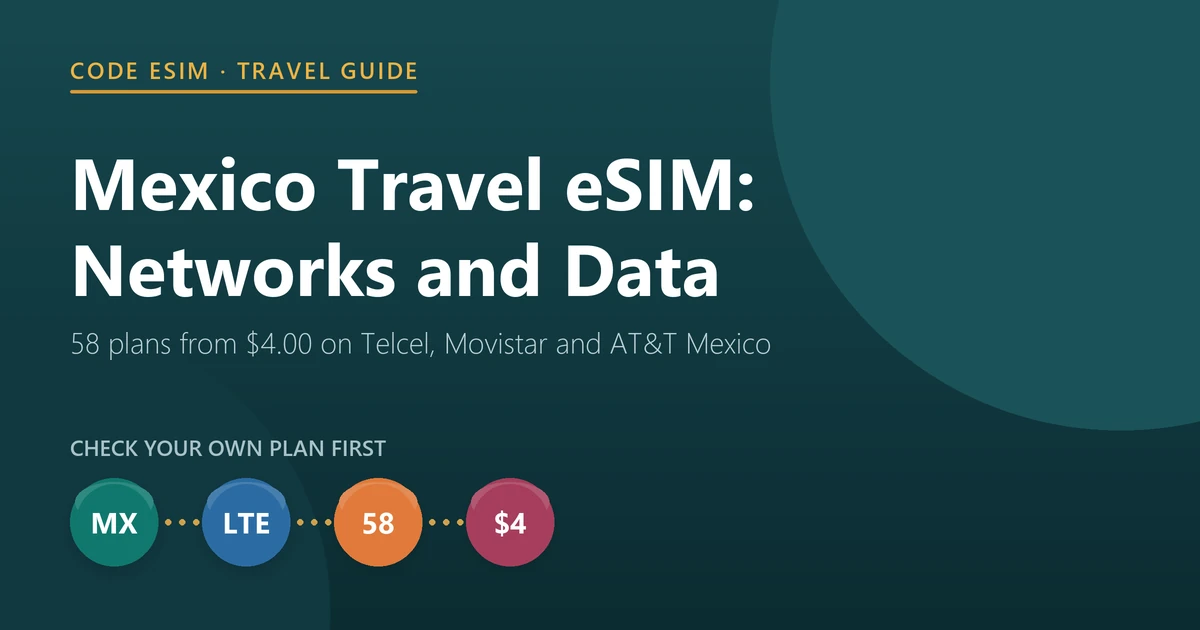
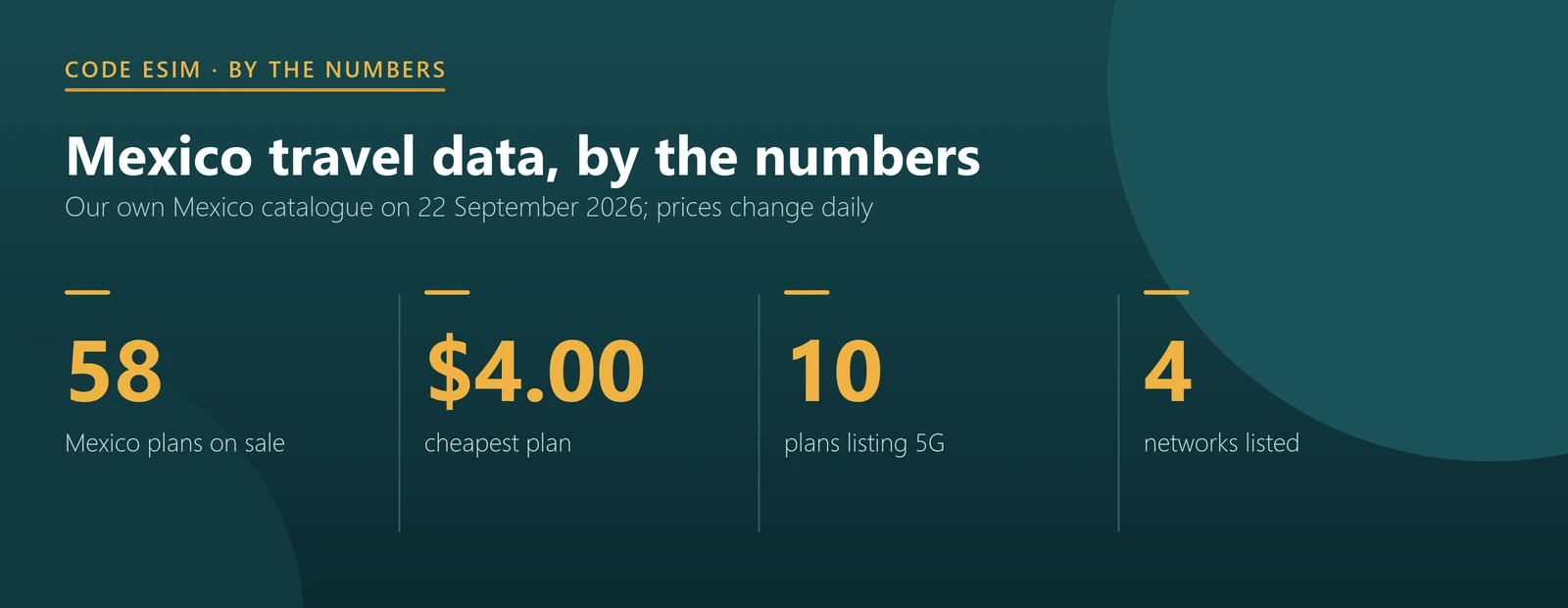
For a week in Mexico, most travellers need 5–10 GB, and a travel eSIM lands on Telcel, Movistar or AT&T Mexico — the same networks a local SIM uses. Our catalogue has 58 Mexico plans as of 22 September 2026, starting at $4.00, with 10 of them offering 5G where the network provides it.
Start with an unusual instruction for a page that sells eSIMs: check your existing plan before you buy anything here. If you are travelling from the United States or Canada, there is a real chance Mexico is already bundled into your monthly plan at no extra cost. Several North American carriers include Mexico and Canada in their standard packages. If yours does, you do not need us for this trip, and we would rather say so than sell you a plan you will not use.
If Mexico is not bundled — which is the case for most travellers arriving from Europe, Asia, South America or on a US prepaid plan that stops at the border — then the rest of this guide is for you.
- A week for most people: 5–10 GB, or 2–3 GB a day if video and hotspot are part of your routine.
- Networks: Telcel, Movistar, AT&T Mexico or Altan Redes, depending on the plan.
- Prices: from $4.00, with plans up to 50 GB and up to 365 days.
- 5G: 10 of our 58 Mexico plans include it; most of the range is 4G LTE.
- Check first: many US and Canadian plans already include Mexico. Look before you buy.
How much data do you need in Mexico?
Size the plan from behaviour, not fear. A normal tourist uses 500 MB to 1 GB a day: maps, messaging, translation, a few uploads. Mexico trips split into two shapes, and they consume very differently. A resort week in Cancún runs mostly on hotel Wi-Fi. A route through Mexico City, Puebla and Oaxaca runs on mobile data all day, because you are moving, navigating and booking as you go.
| Trip length | Light: resort, hotel Wi-Fi at night | Normal tourist | Heavy: video, hotspot, working |
|---|---|---|---|
| 1 week | 3–5 GB | 5–10 GB | 15–20 GB |
| 2 weeks | 5–10 GB | 10–20 GB | 30–50 GB |
| 1 month | 10–20 GB | 20–30 GB | 50 GB |
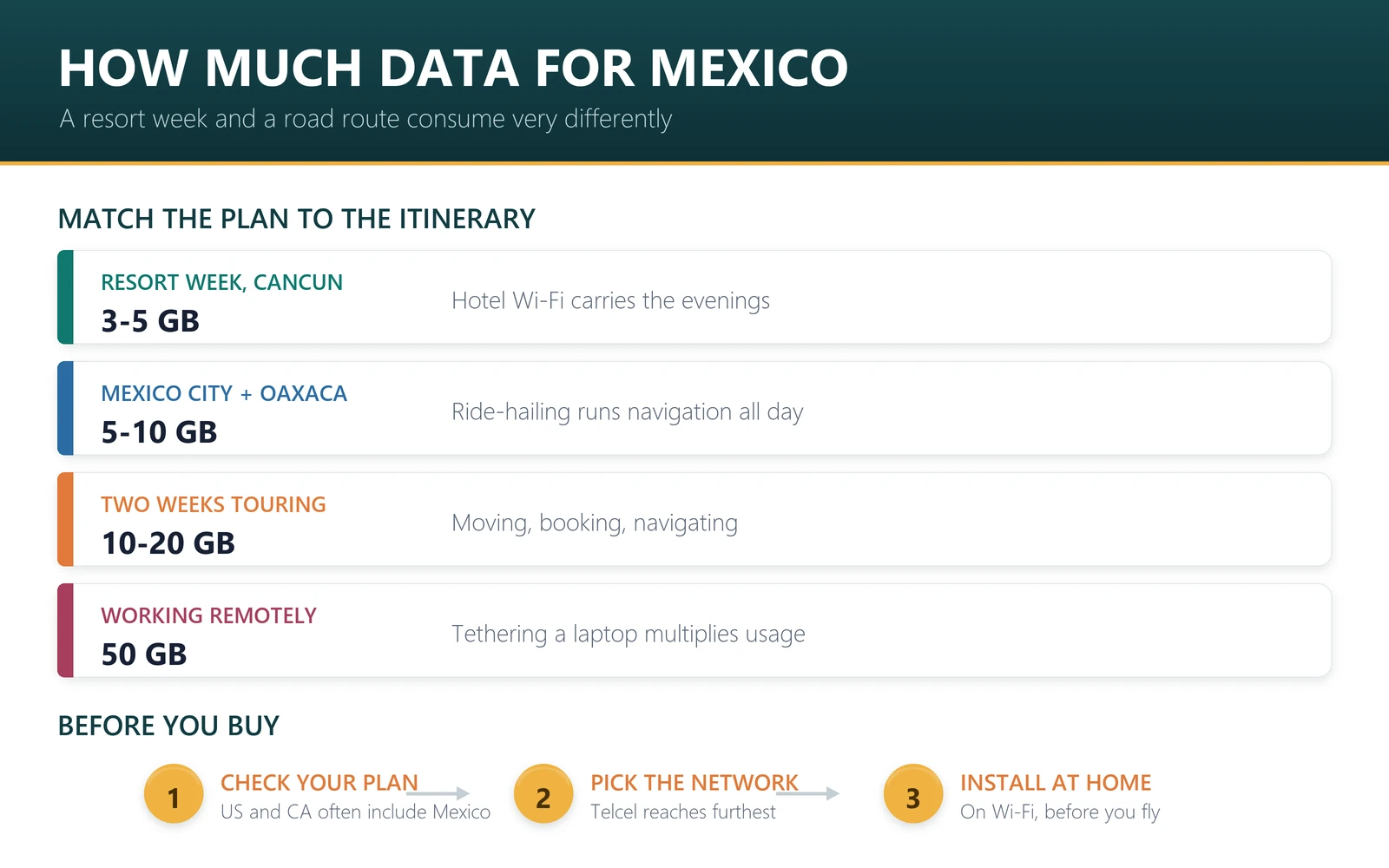
Add roughly 30% margin, and be honest about ride-hailing. Uber and DiDi are the default way to move around Mexican cities for most visitors, and both run navigation and live tracking the entire journey. A few trips a day adds up faster than sightseeing does. If you do run dry, you can top up an active eSIM without reinstalling anything.
Ready to sort it out? Compare Mexico eSIM plans — 58 of them, from $4.00 — or see regional Americas plans if Mexico is one stop on a longer trip.
Which Mexican network will you land on?
Mexico’s network map is more fragmented than most countries, and the differences between the operators are real rather than marketing.
| Network | Tech | Share of our Mexico plans |
|---|---|---|
| Telcel | 4G LTE | 40 of 58 plans (69%) |
| Movistar | 5G / 4G LTE | 27 of 58 plans (47%) |
| Altan Redes | 4G LTE | 14 of 58 plans (24%) |
| AT&T Mexico | 5G | 14 of 58 plans (24%) |
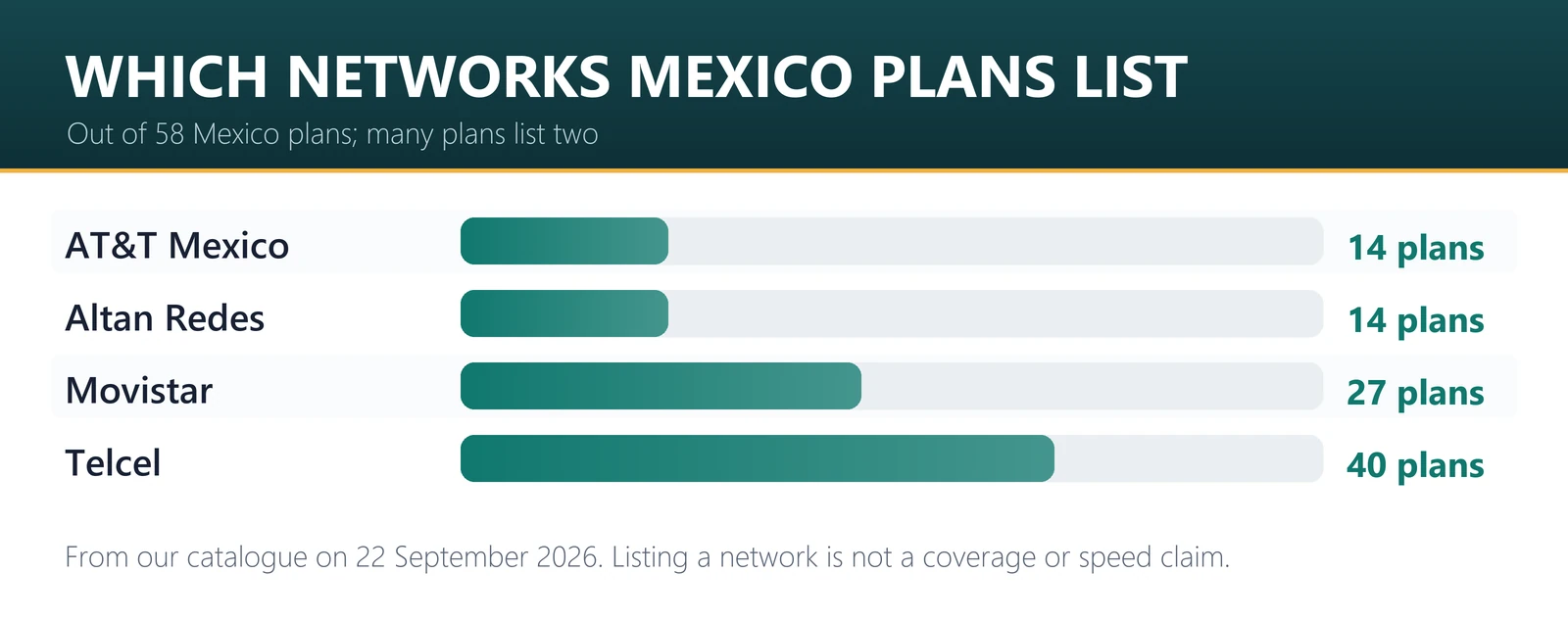
Telcel has the widest footprint in Mexico, particularly in mountainous terrain, on the coasts away from resort zones, and through the rural stretches between colonial towns. AT&T Mexico and Movistar are strong in metropolitan areas and along major highways. Altan Redes operates a wholesale network that other brands ride on.
The practical rule: if your trip stays in Mexico City, Guadalajara, Monterrey, Cancún or the main resort corridors, any of these performs well. If you are driving to Oaxaca’s coast, through Chiapas, or into the Copper Canyon, a Telcel-based plan is the safer choice — and Telcel happens to carry most of our Mexico range anyway. Each plan page lists its network, so check before paying rather than after landing.
Honest note on price
Mexico is not one of our cheap destinations. Data here costs more per gigabyte than in Turkey, Vietnam or India, and that is a supplier reality rather than a markup decision — wholesale rates for Mexican roaming are simply higher.
So compare properly. If you are coming from the US or Canada and your carrier already includes Mexico, use that. If you are staying a month and need a local number, a Telcel prepaid SIM bought at an Oxxo — they are on practically every corner — is inexpensive and easy, far easier than the equivalent errand in India. Where a travel eSIM wins in Mexico is the first 48 hours and the short trip: no queue, no Spanish-language paperwork at a counter, working data the moment you land, and your own number still reachable.
Choosing a plan by trip type
| Trip | What to buy | Why |
|---|---|---|
| Weekend or a few days | 1 GB / 5 days | Maps and rides for a short city break. |
| Resort week, mostly Wi-Fi | 3 GB / 7 days | Covers the transfers and the days out. |
| One week, cities and moving | 5 GB / 15 days | Mexico City, Puebla, Oaxaca with ride-hailing all day. |
| Two weeks touring | 10 GB / 15 days | Navigation-heavy days with margin. |
| Month-long stay | 20 GB / 30 days | Comfortable for daily use over a longer trip. |
| Working remotely | 30 GB / 30 days | Hotspot a laptop. Our Mexico range runs to 50 GB. |
How to install and activate
Buy before you fly, install on home Wi-Fi, and leave the profile switched off until you land. Installation needs internet; activation does not.
iPhone: open the QR code email on a second screen, then Settings → Cellular → Add eSIM → Use QR Code. Keep your home line as the default for calls and texts, and switch mobile data to the travel plan after landing.
Android: Settings → Network & internet → SIMs → Add eSIM, then scan the same code. Samsung, Pixel and Xiaomi word it slightly differently; the flow is the same.
Most of our Mexico plans start counting validity on first data use rather than at purchase, so installing early does not burn days — the plan page states which policy applies. Your own number stays reachable on your primary SIM, which is the main reason to use a travel eSIM rather than swapping to a local SIM. Confirm the phone is carrier-unlocked and eSIM-capable on our compatibility list before buying. If it does not connect on arrival, the troubleshooter covers the usual causes, and remaining data shows on the usage page.
What this costs against roaming
If Mexico is not bundled in your plan, out-of-bundle roaming is charged per day or per megabyte, and a week of it typically exceeds a 10 GB travel plan by a wide margin. The trap is the traveller who assumes coverage is included, uses data normally for five days, and reads the bill later. Our write-up of how roaming charges work in 2026 explains where the charges actually come from.
Travelling on to the United States afterwards? Coverage does not carry across the border on a Mexico-only plan — see the USA eSIM guide or pick a regional Americas plan that names both countries.
Frequently asked questions
Do I even need a Mexico eSIM if I have a US plan?
Often not. Several North American plans include Mexico at no extra cost. Check your carrier’s international terms before buying anything. If Mexico is included, use it — an eSIM only helps when your own plan stops at the border or charges by the day.
Which network has the best coverage in Mexico?
Telcel reaches furthest, especially in mountains, on non-resort coastline and between colonial towns. AT&T Mexico and Movistar are strong in cities and along highways. For trips beyond the main corridors, choose a Telcel-based plan specifically.
How much data do I need for a week in Mexico?
Most travellers land between 5 and 10 GB. A resort week on hotel Wi-Fi needs less; a city route with Uber or DiDi several times a day needs more, because ride-hailing runs navigation for the whole journey.
Why are Mexico plans more expensive than Asian ones?
Wholesale roaming rates for Mexico are higher, so the price per gigabyte is higher across the market, not just here. For a long stay, a local Telcel prepaid SIM from an Oxxo is cheaper. For short trips, the convenience usually still wins.
Will a Mexico eSIM work in the United States?
No, unless the plan lists both countries. A Mexico-only plan stops at the border. If your trip crosses into the US, check the coverage table on the plan page or choose a regional Americas plan naming each country.
Can I use it for hotspot?
Most of our Mexico plans support hotspot sharing, and each plan page states it explicitly in the plan details table. Remember that tethering a laptop consumes several times what a phone does, so size up if you plan to work.
When does the validity period start?
On most of our Mexico plans, on first data use rather than at purchase, so you can install days ahead. Each plan page states its activation policy, so check there rather than assuming.
Plan counts, prices and network shares here are from our own catalogue on 22 September 2026. Prices move daily with supplier pricing, so the figures are a snapshot and the Mexico plans page is the live version. Whether your home plan includes Mexico is set by your own carrier — check their terms directly.
Mexico is the trip where the cheapest correct answer is often “you already have this”. Check your own plan first, and if it does stop at the border, buy for the shape of the trip rather than the length of it.