
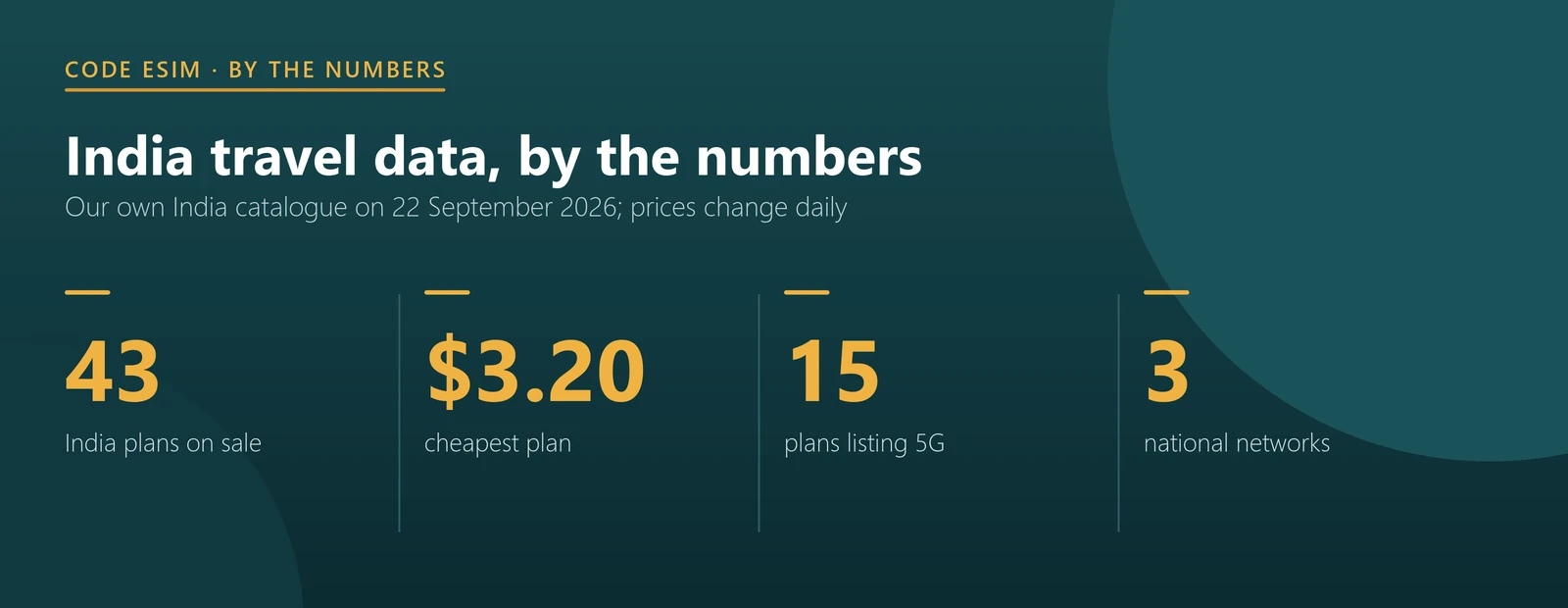
For two weeks in India, most travellers need 10–20 GB, and a travel eSIM lands on Airtel, Vi or Jio — the same networks a local SIM uses. Our catalogue has 43 India plans as of 22 September 2026, starting at $3.20, with 15 of them offering 5G where the network provides it.
India is the destination where the eSIM argument is easiest to make, and it has nothing to do with price. Indian mobile data is among the cheapest in the world — for residents. As a visitor, getting onto that pricing means a tourist SIM, and a tourist SIM in India means paperwork: passport, visa copy, passport photo, a local address, a signed form, and then a verification step before the line goes live. Travellers regularly describe landing at 2am and spending the first day of a trip without data.
- Two weeks for most people: 10–20 GB, or 2–3 GB a day if you use video and maps heavily.
- Networks: Airtel, Vi (Vodafone Idea) or Jio, depending on the plan.
- Prices: from $3.20, with plans up to 40 GB and up to 365 days.
- 5G: 15 of our 43 India plans include it where available.
- No unlimited: none of our India plans are unlimited, so size this one properly rather than assuming a safety net.
How much data do you need in India?
Size the plan from behaviour, not fear. A normal tourist uses 500 MB to 1 GB a day: maps, messaging, translation, a few uploads. India pushes that upward for two reasons. Ride-hailing and UPI-style payment apps run constantly, and train and flight bookings get checked and re-checked because schedules move.
| Trip length | Light: maps, chat, hotel Wi-Fi at night | Normal tourist | Heavy: video, hotspot, working |
|---|---|---|---|
| 1 week | 3–5 GB | 5–10 GB | 15–20 GB |
| 2 weeks | 5–10 GB | 10–20 GB | 30–40 GB |
| 1 month | 10–20 GB | 20–30 GB | 40 GB |
Add roughly 30% margin. Hotel Wi-Fi in India is genuinely variable — excellent in business hotels, unusable in a heritage haveli — so plan to be on mobile data more of the time than you would in Europe. And because none of our India plans are unlimited, running dry means buying again rather than slowing down. If it happens, you can top up an active eSIM without reinstalling anything.
Ready to sort it out? Compare India eSIM plans — 43 of them, from $3.20 — or see regional Asia plans if India is one stop on a longer trip.
Which Indian network will you land on?
India has three national mobile networks. Which one your eSIM uses is stated on each plan page, and it matters more here than in most countries because coverage quality varies sharply between metros and rural districts.
| Network | Tech | Share of our India plans |
|---|---|---|
| Airtel | 5G | 29 of 43 plans (67%) |
| Vi (Vodafone Idea) | 5G | 24 of 43 plans (56%) |
| Jio | 4G LTE / 5G | 20 of 43 plans (47%) |
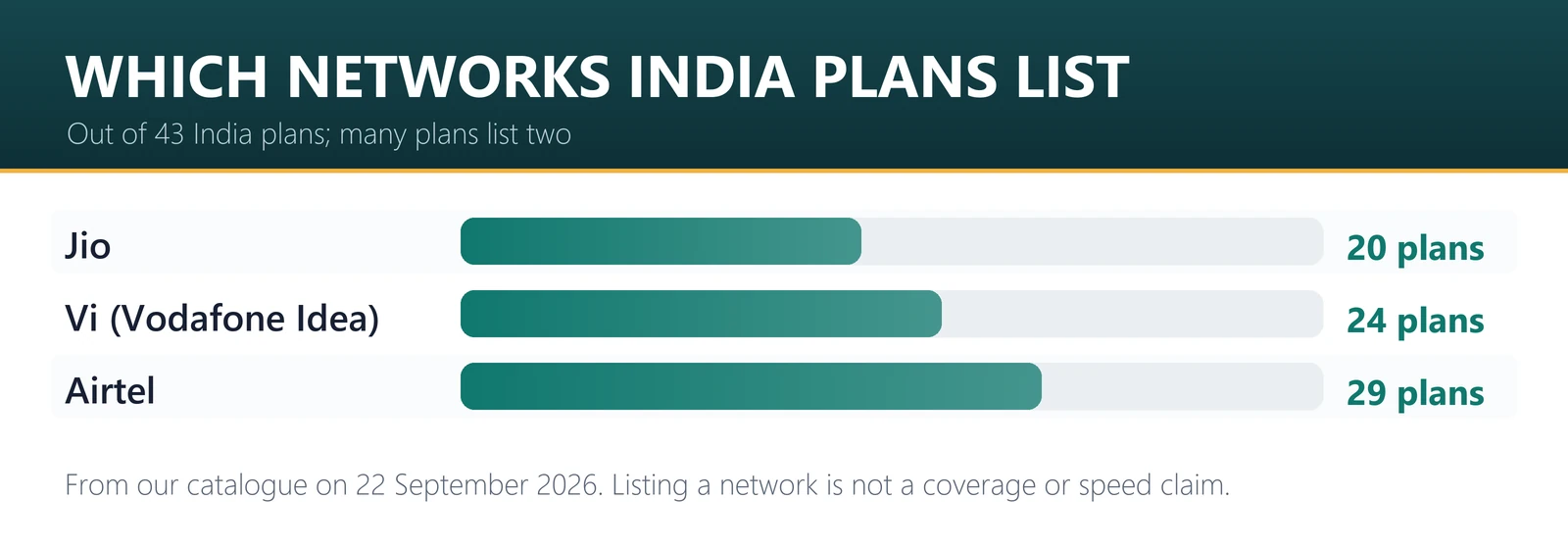
Plans that list two or three networks can select whichever is strongest where you are standing, which is worth having on a trip that mixes Delhi with rural Rajasthan. Airtel and Jio have both pushed 5G out aggressively across metros and larger cities; outside those, expect solid 4G rather than 5G regardless of what the plan badge says. Each plan page on this site states its network and its activation policy — for example the 10 GB / 30 day TSimTech plan lists both on the page itself.
Why a local Indian SIM is harder than it looks
This is the section that decides the question for most visitors.
India regulates prepaid SIM sales tightly. A visitor buying a tourist SIM is generally asked for a passport, a copy of the visa page, a passport photograph, a local address in India, and a signed customer acquisition form. The line then goes through a verification step before it carries data, and that step is not instant — plan for hours, and be ready for it to take longer if you arrive late at night or on a public holiday. Validity is often tied to the visa period rather than sold as a flat 30 days.
None of that is unreasonable, and millions of visitors do it every year. But it is a poor fit for the first morning of a two-week trip, when what you actually need is a working map and a ride from the airport. A travel eSIM inverts the order: you install it at home on Wi-Fi before you fly, it activates on first data use after you land, and the paperwork problem never arises.
Rules and required documents change, and they differ between operators and between states. If you do plan to buy locally, check the operator’s own tourist SIM page shortly before you travel rather than relying on a blog post — including this one.
When you should not buy a travel eSIM
Two cases, stated plainly.
Long stays. If you are in India for a month or more, and especially if you need a local number for deliveries, bookings and payment apps, a local SIM wins. Indian domestic tariffs are extremely cheap, and the paperwork you resent on day one stops mattering by week three. A travel eSIM gives you data, not an Indian phone number, and some Indian services expect a local number.
Very heavy use. We have no unlimited India plans. If you will stream and hotspot all day for two weeks, 40 GB is our ceiling and a local unlimited package may serve you better.
For the common case — a one to three week trip where you need maps, ride-hailing, messaging and the ability to book things — the eSIM is the simpler answer, and your own number stays reachable the entire time.
Choosing a plan by trip type
| Trip | What to buy | Why |
|---|---|---|
| Layover or a few days | 3 GB / 5 days | Sized for a short stop rather than a month you will not use. |
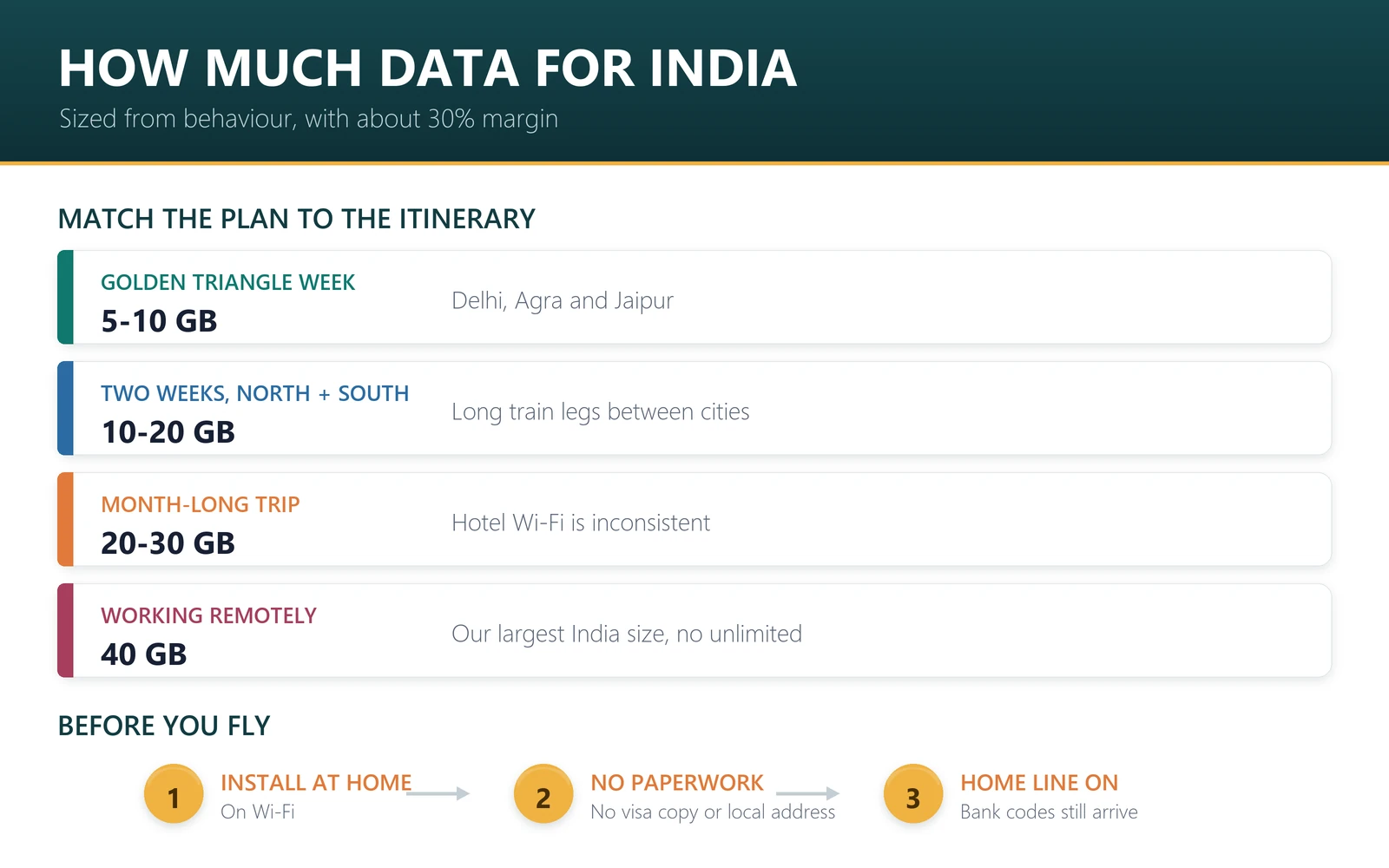
| Golden Triangle week | 5 GB / 30 days | Delhi, Agra, Jaipur with margin for patchy hotel Wi-Fi. |
| Two weeks, north and south | 10 GB / 30 days | The standard India trip, including long train legs. |
| Month-long or heavy use | 20 GB / 30 days | Comfortable for daily navigation plus evening video. |
| Working remotely | 30 GB / 30 days | Hotspot a laptop without rationing. Our largest India size is 40 GB. |
| Cheapest possible test | 1 GB / 14 days | Enough to check the profile installs and connects before committing. |
How to install and activate
Buy before you fly, install on home Wi-Fi, and leave the profile switched off until you land. Installation needs internet; activation does not.
iPhone: open the QR code email on a second screen, then go to Settings → Cellular → Add eSIM → Use QR Code. Once installed, leave Data Roaming on for that profile and keep your home line as the default for calls and texts. On landing, switch mobile data to the travel plan.
Android: Settings → Network & internet → SIMs → Add eSIM, then scan the same code. Samsung, Pixel and Xiaomi each word it slightly differently, but the flow is the same.
Most of our India plans start counting validity on first data use rather than at purchase, so installing early does not burn days — the plan page states which policy applies. Your own number stays reachable on your primary SIM throughout, which is the main reason to use a travel eSIM rather than swapping to a local SIM, and it matters in India specifically because your bank’s verification codes still need to reach you. Check the phone is carrier-unlocked and eSIM-capable on our device compatibility list first. If something does not connect on arrival, the troubleshooter covers the common causes, and remaining data is visible on the usage page.
What this costs against roaming
The real comparison is not eSIM against local SIM — it is eSIM against letting your home plan roam in India. Out-of-bundle roaming is charged per day or per megabyte depending on your operator, and two weeks of it routinely costs several times a 20 GB travel plan. We have written up how roaming charges work in 2026 if you want to check your own operator first.
If India is one leg of a longer Asia trip, compare a regional plan against two country plans — the same arithmetic we walk through in the China eSIM guide, where the regional option often wins.
Frequently asked questions
Can tourists use an eSIM in India?
Yes. A travel eSIM roams on an Indian network and needs no local paperwork. It gives you data, not an Indian phone number. Your home number stays active on your primary SIM, so calls and verification codes still reach you.
Is it hard for foreigners to buy an Indian SIM card?
Harder than in most countries. Expect to provide a passport, visa copy, photograph, local address and a signed form, followed by a verification step before the line works. It is doable, but it is a poor use of your first day.
How much data do I need for two weeks in India?
Most travellers land between 10 and 20 GB. Go higher if you will hotspot a laptop or stream in the evenings. Hotel Wi-Fi is inconsistent outside business hotels, so assume more mobile data than you would in Europe.
Which network is best in India?
Airtel and Jio have the widest 5G rollout across metros and larger cities; Vi is competitive in urban areas. Plans listing two or three networks are useful on trips that mix cities with rural districts, since the profile can pick the strongest signal.
Do you have unlimited data plans for India?
No. Our India range tops out at 40 GB. If you genuinely need unlimited for a long stay, a local package will serve you better — that is an honest limit of what we sell for this destination.
Will my Indian eSIM work in Nepal or Sri Lanka?
Not unless the plan lists those countries. An India-only plan stops at the border. For multi-country trips, check the coverage table on the plan page or choose a regional Asia plan that names each country.
When does the validity period start?
On most of our India plans, on first data use rather than at purchase, so you can install days ahead. Each plan page states its activation policy, so check there rather than assuming.
Plan counts, prices and network shares here are from our own catalogue on 22 September 2026. Prices move daily with supplier pricing, so the figures are a snapshot and the India plans page is the live version. Tourist SIM requirements are set by Indian regulation and individual operators and do change — verify with the operator before you rely on them.
India rewards travellers who arrive already connected. Get the data sized for the train legs rather than the sightseeing, skip the queue for a tourist SIM you may not need, and the first morning stops being about paperwork.