
It is day six of a ten-day trip. You open maps outside a train station and nothing loads. Your eSIM has used its last gigabyte. The good news is that nothing bad is happening — you are not being charged by the megabyte, no bill is quietly growing, and nothing has been cut off in anger. Prepaid data simply stops.
Short answer: when a travel eSIM runs out, the line goes quiet and you have two options — top up the plan you already have, or buy a new one. Which of those is available depends on the plan, and the pattern is not the one most people expect. From our catalogue on 18 August 2026:
- 614 of 827 plans (74%) can be topped up. The remaining 213 cannot — for those, running out means buying and installing a second plan.
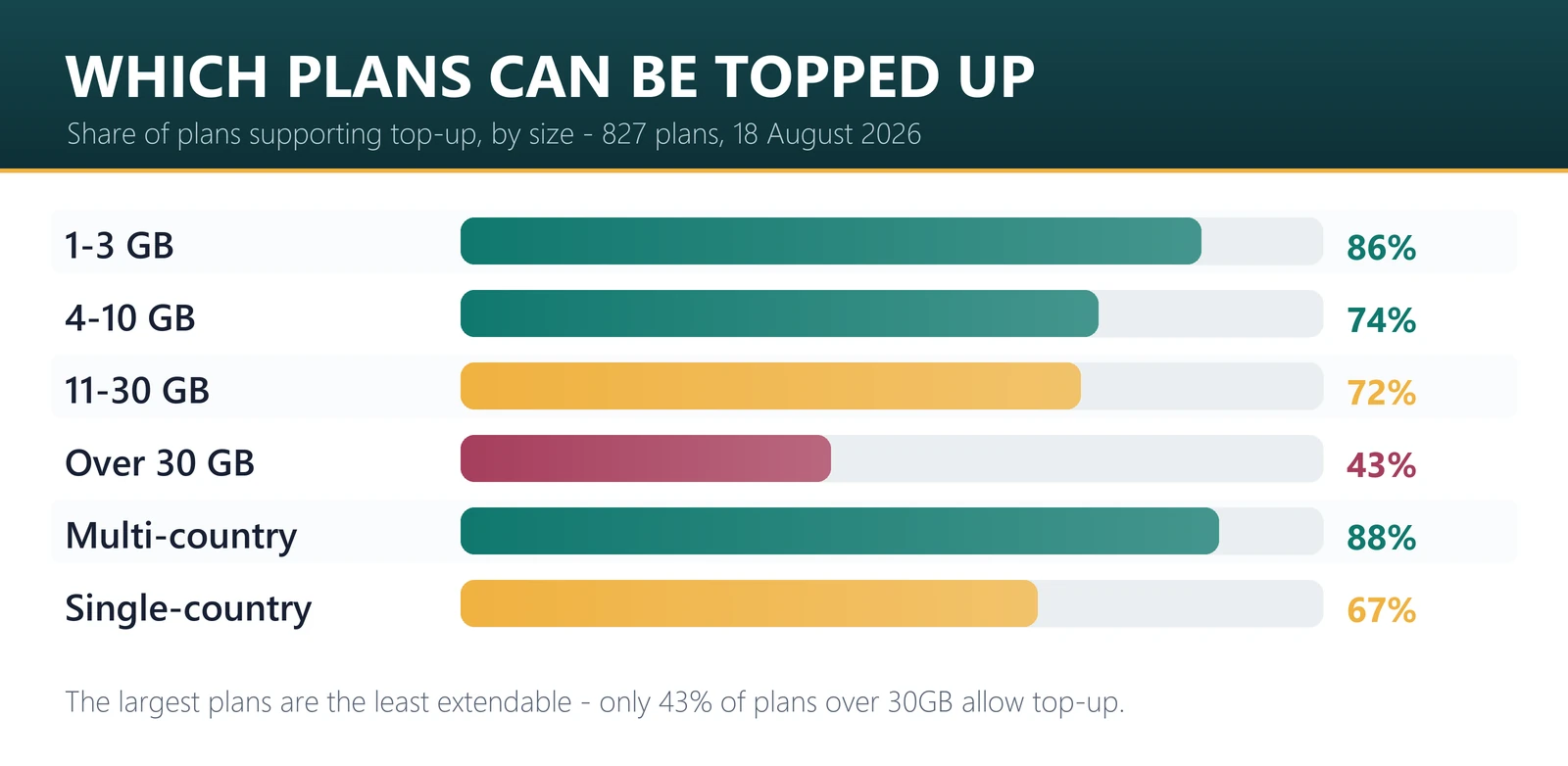
- The biggest plans are the least likely to be extendable. 86% of 1–3GB plans support top-up, but only 43% of plans above 30GB do.
- Multi-country plans are far more likely to allow it than single-country ones: 88% versus 67%.
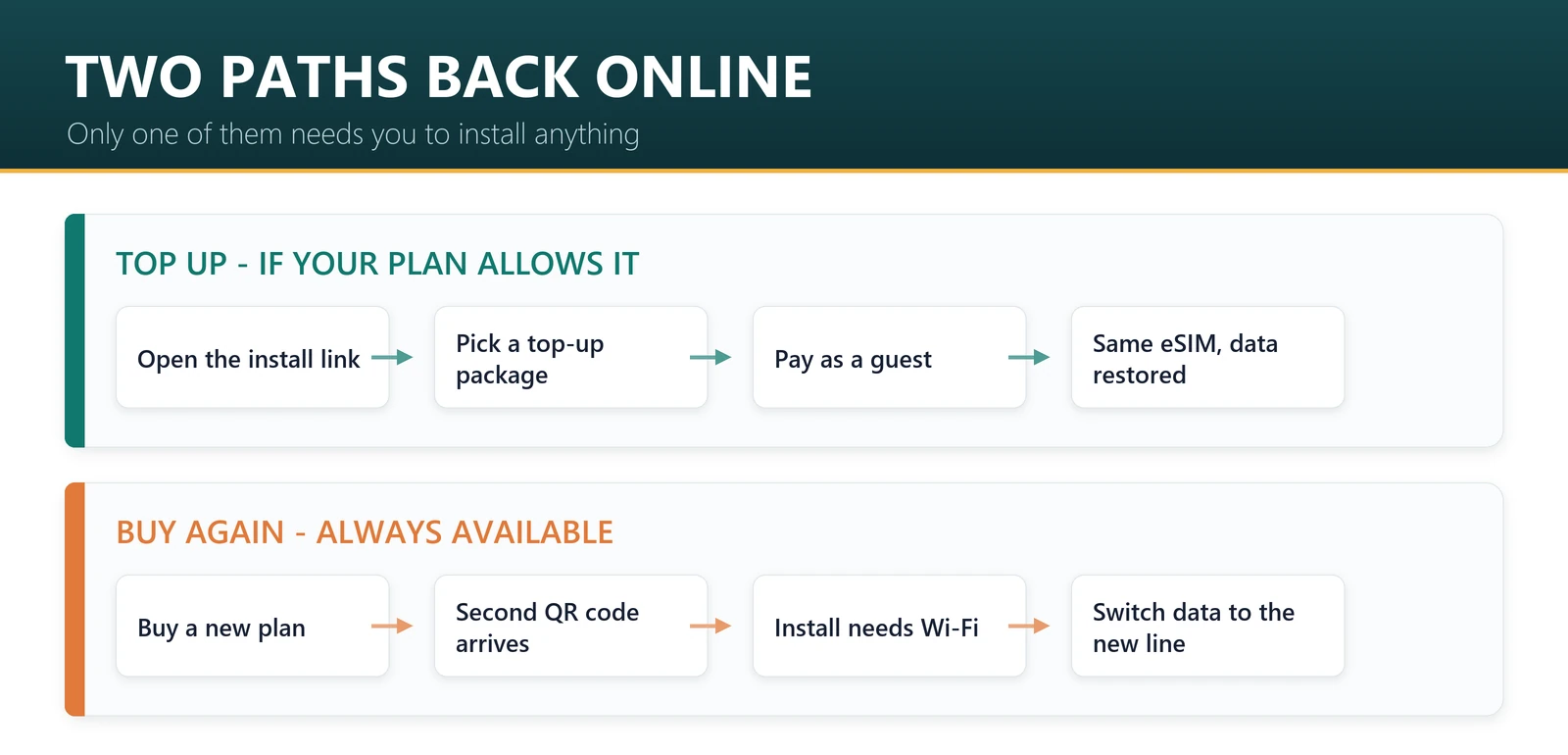
- Topping up keeps your existing eSIM — no second QR code and no second installation.
- You do not need an account. The top-up link lives on the install page we email you, and works for guest orders.
What actually happens the moment it runs out
A travel eSIM is prepaid, and that single fact removes most of what people worry about:
- No overage charges. There is no account to bill and no per-megabyte rate waiting behind the allowance. This is the opposite of leaving your home SIM roaming.
- No warning shot you can miss. Data simply stops working on that line. Apps time out; the phone still shows signal.
- Your other line is untouched. If your home SIM is still in the phone, calls and verification texts keep arriving exactly as before.
- The profile stays installed. Nothing is deleted from your phone, which matters because that installed profile is what a top-up refills.
The practical risk is not money — it is being offline at the wrong moment. Which is why the useful question is not “what happens” but “what can I do about it in the next five minutes”, and that depends on one line on the product page you probably did not read.
Top up, or buy again?
These are two genuinely different things, and only one of them is available on every plan:
| Top up | Buy a new plan | |
|---|---|---|
| What happens | Data is added to the eSIM already in your phone | A separate eSIM profile is issued |
| Installation | None — nothing to scan or install | A second QR code to install |
| Available on | 614 of our 827 plans | Always |
| Your phone | Keeps one travel profile | Accumulates profiles you later delete |
Topping up is the better experience when it is offered: you are back online in about the time it takes to pay, without touching your phone’s eSIM settings while standing in a station. Buying again always works, but it means installing a second profile — and if you are somewhere with weak signal and no Wi-Fi, installing is exactly the thing that is hard to do.
The inversion: big plans are the least extendable
You would reasonably assume that the larger the plan, the more likely you can extend it. Our catalogue says the opposite:
| Plan size | Plans | Support top-up | Share |
|---|---|---|---|
| 1–3 GB | 283 | 243 | 86% |
| 4–10 GB | 268 | 198 | 74% |
| 11–30 GB | 188 | 135 | 72% |
| Over 30 GB | 88 | 38 | 43% |
So the traveller most exposed is the one who bought big precisely to be safe: on a 50GB plan, there is a better than even chance that running out means starting over with a new profile rather than adding data to the one you have.
Scope matters too, in the other direction. 88% of multi-country plans allow top-up, against 67% of single-country plans — so a regional plan is usually the more forgiving choice if you are unsure how much you will use.
How to top up, including guest orders
This is where most eSIM sellers quietly assume you created an account. Most travellers do not — the majority of our orders are guest checkouts — so the top-up entry point is built around the email instead:
- Open the install link from your delivery email. That link is tied to your specific eSIM, has no expiry, and needs no login. It is the same page you used to install in the first place.
- Scroll to the top-up section. It lists the top-up packages that match your plan and destination, with prices.
- Pick one and pay. Checkout works as a guest — no account, no password.
- Nothing to install. The data is added to the eSIM already on your phone, and service resumes.
If you did create an account, the same top-ups appear on your My eSIMs page. Either route reaches the same place.
One detail worth knowing: if the top-up section is not on your install page, that plan cannot be topped up. We do not show an empty block with a negative message — the absence is the answer, and the alternative is simply to buy a new plan.
How to not be in this situation
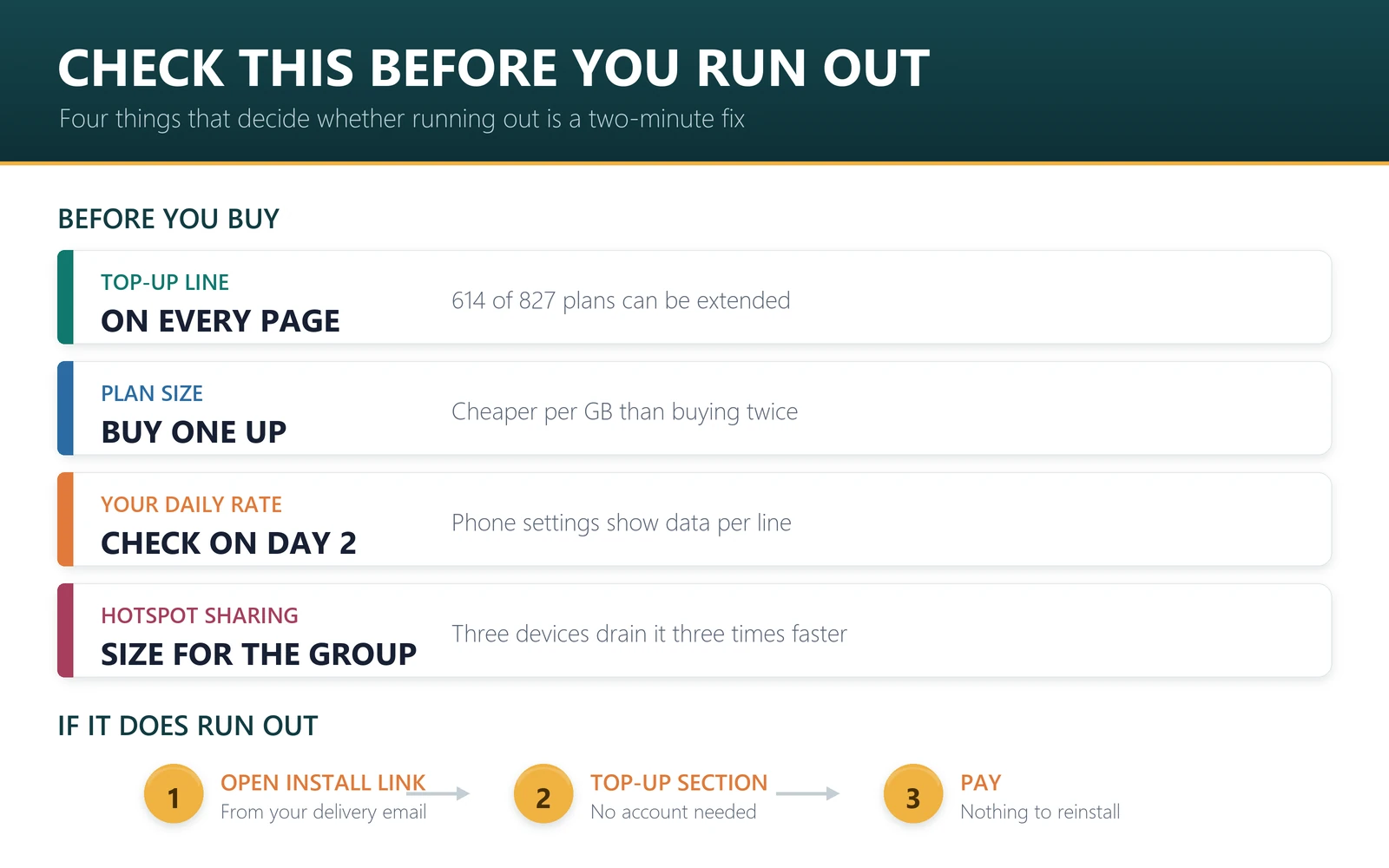
- Check the top-up line before you buy, not after you run out. It is on every product page next to hotspot and speed.
- Buy one size up if you are unsure. A larger plan costs far less per gigabyte than buying twice, and the gap widens with size.
- Watch usage in your phone’s settings. Both iPhone and Android show mobile data used per line; check it on day two and you will know your daily rate for the rest of the trip.
- Remember what actually consumes data: video calls and uploads, not maps and messaging. Our data usage guide has per-app numbers.
- If you are sharing a hotspot, size for the group. One phone’s plan feeding three devices runs out roughly three times as fast.
Frequently asked questions
What happens when a travel eSIM runs out of data?
Data stops working on that line. Because travel eSIMs are prepaid, there are no overage charges and no bill to worry about — you simply have no data until you top up or buy another plan. Your home SIM, if it is still in the phone, is unaffected.
Will I be charged extra if I go over my eSIM data?
No. There is no metered overage on a prepaid travel eSIM. This is the main practical difference from leaving your home SIM roaming, where usage beyond a bundle can be billed at high per-megabyte rates.
Can I add more data to my existing eSIM?
On most plans, yes. 614 of our 827 plans support top-up, which adds data to the eSIM already installed on your phone — no second QR code and nothing to install. The other 213 require buying a new plan instead.
How do I top up if I checked out as a guest?
Use the install link in your delivery email. It is tied to your eSIM, does not expire and needs no login, and the top-up section is on that page. Checkout for the top-up also works without an account.
Which eSIM plans cannot be topped up?
Larger plans, disproportionately. 86% of plans up to 3GB support top-up, falling to 43% for plans over 30GB. Single-country plans are also less likely to allow it than multi-country ones, at 67% versus 88%. The top-up line on each product page is definitive.
Does topping up extend the validity period too?
Top-up packages carry their own terms, including their own validity, which are shown on the package before you pay. Treat added data and added days as separate questions and read what the package states rather than assuming it simply extends your original plan.
Is it cheaper to top up or to buy a bigger plan upfront?
Buying the right size upfront is almost always cheaper per gigabyte, because larger plans have better per-gigabyte pricing and topping up means paying two lots of the smallest increment. Top-up is best treated as insurance against a bad estimate, not as a purchasing strategy.
If I buy a second eSIM, do I have to delete the first one?
No. Modern phones hold multiple eSIM profiles, and you simply switch which line carries data. Do not delete the old profile mid-trip out of tidiness — most QR codes install only once, so a deleted profile is usually gone for good.
Bottom line
Running out of data on a travel eSIM costs you connectivity, not money — prepaid means no overage, no bill shock and no surprise. What decides how annoying it is, is whether your plan can be topped up: 614 of our 827 can, and topping up needs no reinstall and no account, just the install link from your delivery email. The trap is at the top of the range, where only 43% of plans over 30GB can be extended at all. Check that one line before you buy, and size up rather than plan on topping up.
Compare plans with the top-up line shown on every page: all 191 destinations, or start with Japan, Europe, Thailand or USA. Related reading: how much data you actually need, whether unlimited is really unlimited and when an eSIM starts counting.
Last reviewed 18 August 2026. Top-up availability was counted from the 827 plans on sale at Code eSIM on that date, excluding top-up packages themselves and out-of-stock items. Availability and top-up package terms are set by the network provider behind each plan and change over time, so the top-up line on the product page is always the authoritative version.