
It is day two in Tokyo. Your unlimited eSIM worked beautifully yesterday. This morning the maps app is crawling, photos will not upload, and nothing is technically broken. You have used your first 3GB, and the plan has quietly dropped you to 1Mbps for the rest of the day.
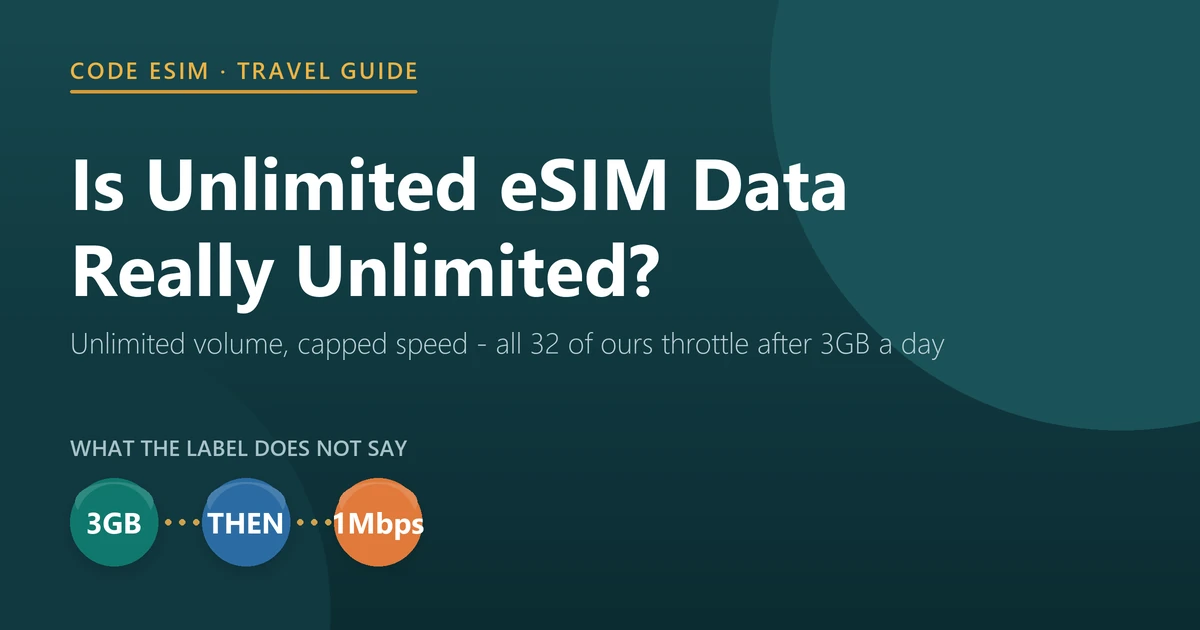
Short answer: “unlimited” almost always means unlimited volume, not unlimited speed. You will not be cut off and you will not be charged extra, but after a daily threshold the speed drops sharply. In our own catalogue on 18 August 2026 the pattern is absolute:
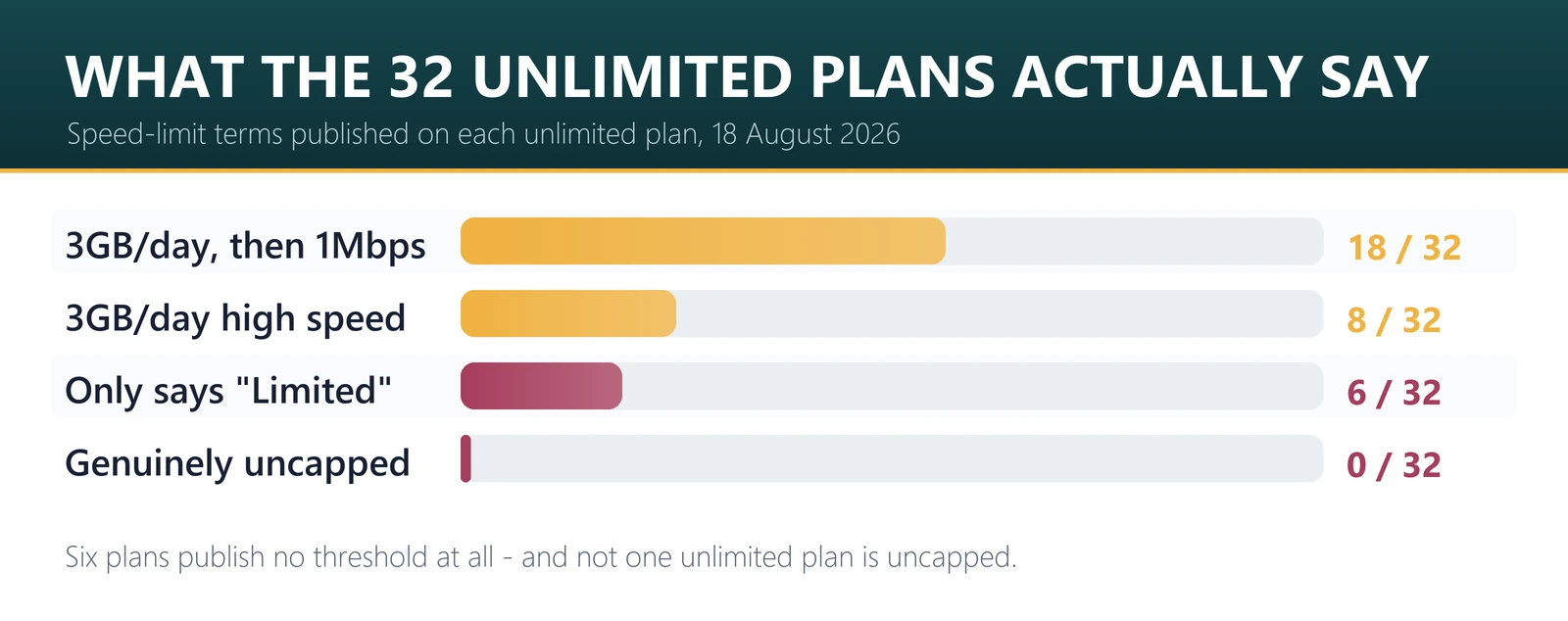
- Every one of the 32 unlimited-data plans we sell has a documented speed cap. Not most — all of them.
- Those 32 are also the only capped plans in the entire catalogue. The other 799 plans, all sold with a fixed number of gigabytes, run at full speed until the data is gone.
- The most common term is 3GB per day at high speed, then 1Mbps for the rest of that day.
- 6 of the 32 say only “Limited” without publishing a threshold. We would rather tell you that than pretend the number exists.
- No unlimited plan we sell runs longer than 15 days — they are built for short trips, not long stays.
What “unlimited” actually means
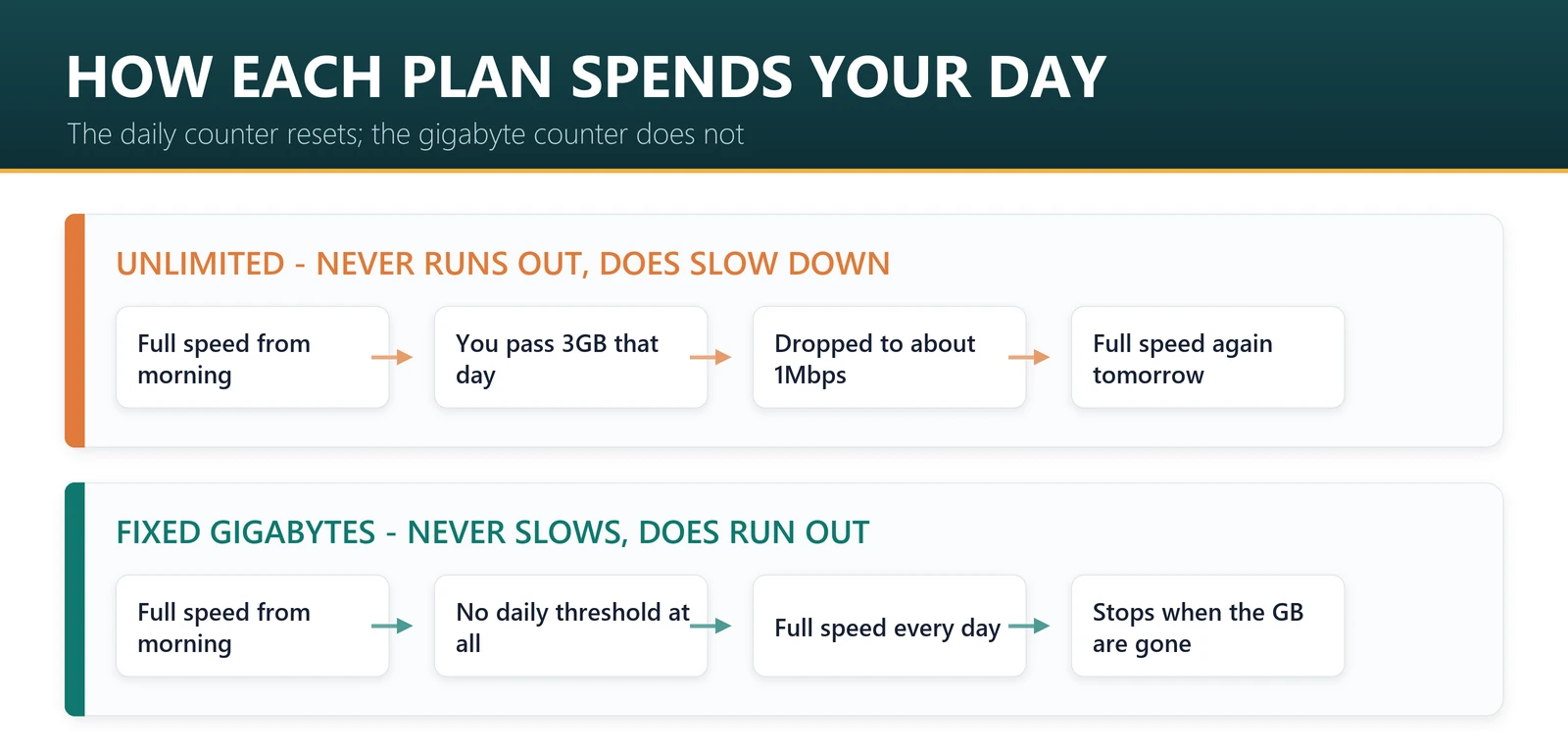
Mobile networks have finite capacity, so an operator that sells a genuinely uncapped plan is exposed to a handful of users consuming a disproportionate share of a cell. The industry answer is a fair use policy: you can keep using data indefinitely, but only a set amount each day runs at full speed. After that you are throttled — usually to around 1Mbps — until the daily counter resets.
1Mbps is not nothing. It is enough for maps, messaging, email, ride-hailing and standard-definition video. It is not enough for comfortable photo uploads, video calls, large downloads or tethering a laptop. So the honest description of an unlimited travel eSIM is: a fast plan for the first few gigabytes each day, and a slow but usable plan after that.
Nothing here is a scam, and none of it is unique to us. It is worth stating plainly only because the word on the label — “unlimited” — describes the volume and says nothing about the speed, which is the part travellers actually notice.
The inversion: the only capped plans are the unlimited ones
This is the finding that surprised us when we counted our own catalogue:
| Plan type | Plans | Have a speed cap |
|---|---|---|
| Sold as “unlimited” data | 32 | 32 — all of them |
| Sold with a fixed number of GB | 799 | 0 — none of them |
| Total on sale | 831 | 32 |
Read it the other way round and it is even clearer: if you want full speed for your whole trip, the fixed-gigabyte plans are the uncapped ones. The plan that promises never to run out is the only kind that promises to slow down.
That is not an argument against unlimited plans — it is an argument for knowing which trade you are making. You are choosing between “I will never be cut off, but I will be slow after 3GB a day” and “I will be fast the whole time, until the gigabytes are gone.”
What the caps actually say
The wording comes from the network provider behind each plan, so it varies:
| Published term | Plans | What it means in practice |
|---|---|---|
| 3GB/day at 20Mbps, 1Mbps afterwards | 18 | The clearest version: a stated speed, a stated threshold, a stated fallback |
| 3GB/day high speed, 1Mbps afterwards | 8 | Same threshold and fallback; peak speed not specified |
| “Limited” | 6 | No threshold published. The provider did not supply one, so we do not invent one |
Those six are worth calling out. If a plan says only “Limited”, you cannot know in advance where the cliff is — and that is a legitimate reason to choose a plan that states its threshold, or a fixed-gigabyte plan where the question does not arise. We would rather flag this than let the word “unlimited” do work the product page cannot back up.
When an unlimited plan is still the right buy
Unlimited plans exist for good reasons, and for some trips they are clearly the better choice:
- Short, unpredictable trips. Every unlimited plan we sell runs between 1 and 15 days. If you genuinely cannot estimate usage for a three-day trip, paying once and never thinking about it is worth something.
- You want a floor, not a ceiling. With a fixed plan, running out means no data until you buy more. With an unlimited plan, the worst case is slow data — which still gets you a map and a ride home.
- Heavy but low-stakes use. Streaming music, browsing and messaging all survive 1Mbps comfortably.
They are the wrong buy when speed is the point: tethering a laptop for work, uploading photos or video daily, frequent video calls, or any trip longer than about two weeks, where no unlimited option exists in our range anyway.
How to choose
| Your trip | Better fit | Why |
|---|---|---|
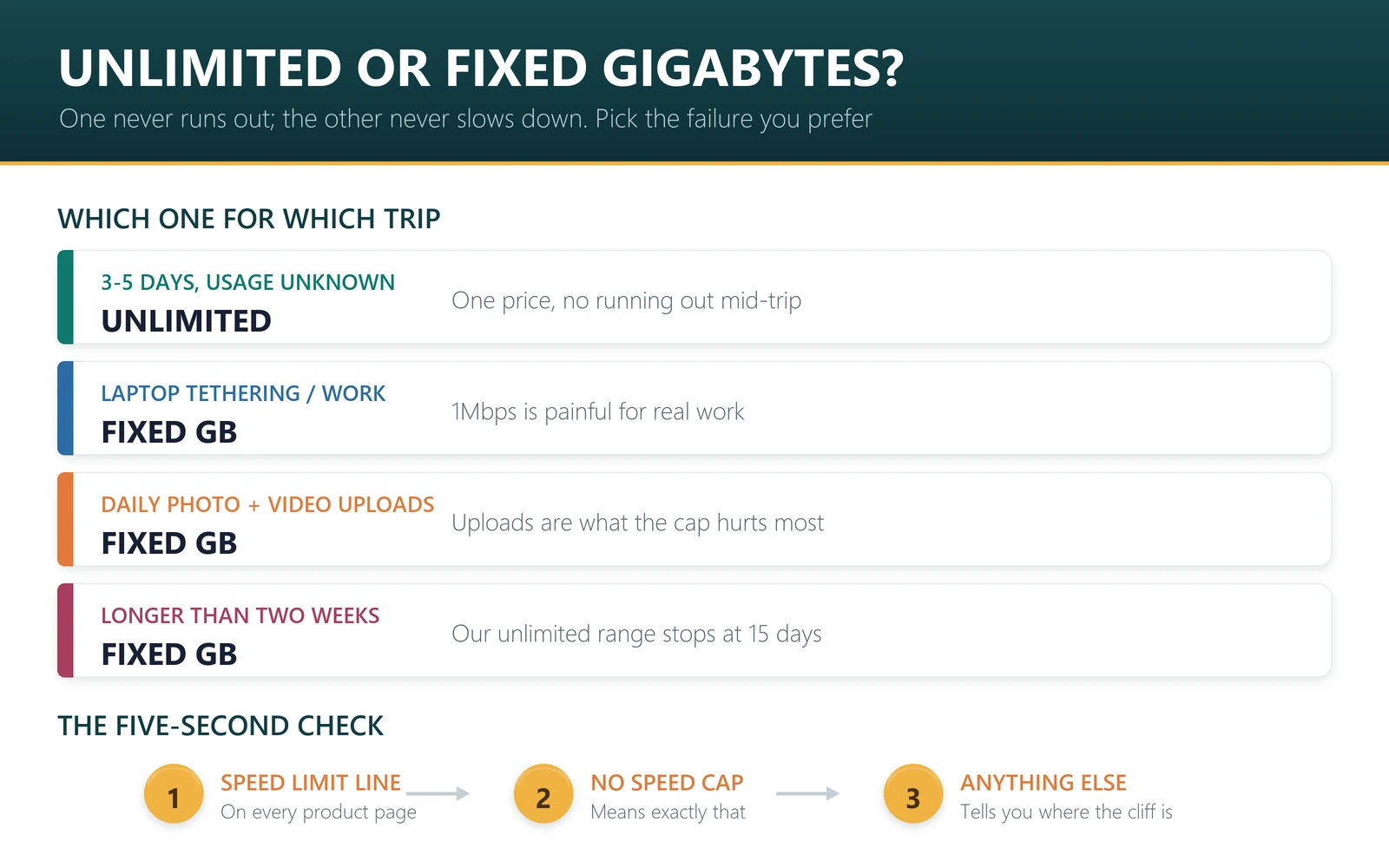
| 3–5 days, usage hard to predict | Unlimited | One price, no running out; 3GB/day at speed covers most days anyway |
| Working remotely, laptop tethering | Fixed GB | No throttle at all — 1Mbps is painful for work |
| Posting photos and video daily | Fixed GB | Uploads are what the cap hurts most |
| Longer than two weeks | Fixed GB | Our unlimited range stops at 15 days |
| Maps, messaging, occasional browsing | Either | You will rarely reach 3GB in a day; buy on price |
Whichever you pick, the check takes five seconds: read the speed limit line on the product page. “No speed cap” means exactly that. Anything else tells you where the cliff is — or, for those six plans, tells you that the provider did not say.
Frequently asked questions
Is unlimited eSIM data really unlimited?
Unlimited in volume, not in speed. All 32 unlimited-data plans we sell have a fair use policy that runs a set amount each day at full speed — most commonly 3GB — and then reduces speed to about 1Mbps until the next day. You are never cut off and never charged extra.
What happens after I hit the daily limit on an unlimited plan?
Your speed drops, typically to around 1Mbps, for the rest of that day. Maps, messaging, email and standard-definition video still work. Large uploads, video calls and laptop tethering become uncomfortable. The counter resets the next day.
Do fixed-gigabyte eSIM plans get throttled too?
Not in our catalogue. All 799 fixed-gigabyte plans on sale are marked “No speed cap” and run at full speed until the data allowance is used. The only 32 plans with a documented cap are the unlimited ones.
Is 1Mbps enough when travelling?
For navigation, ride-hailing, messaging, email and standard-definition streaming, yes. For uploading photos or video, video calls, large downloads or tethering a laptop, no. If those matter on your trip, choose a fixed-gigabyte plan sized generously rather than an unlimited one.
Why do some unlimited plans just say “Limited”?
Because the network provider behind those plans did not publish a threshold, and we do not invent numbers that were not supplied to us. Six of our 32 unlimited plans are in that position. If knowing the exact threshold matters, pick a plan that states it.
Are unlimited eSIM plans good value?
For short trips where usage is hard to predict, often yes — ours run from about US$4.99 up, with a median around US$14. For longer trips or speed-sensitive use, a fixed-gigabyte plan usually gives more usable data per dollar because none of it is throttled.
How long can an unlimited eSIM plan last?
In our range, between 1 and 15 days, with most at 3, 5, 7 or 10 days. There is no unlimited option for a month-long trip, so longer stays need a fixed-gigabyte plan or a top-up.
Does the daily cap apply per day or per trip?
Per day. The high-speed allowance resets each day, so a 5-day plan with a 3GB daily threshold gives you 3GB at full speed on each of those five days, plus unlimited slower data in between.
The unlimited plans we actually sell
If you have read this far and still want one — a perfectly reasonable conclusion for a short trip — these are the specific plans, with the trade-off stated on each plan page rather than buried. Prices are from our catalogue on 22 September 2026 and move daily.
| Destination | Plan | Price | Best for |
|---|---|---|---|
| Singapore | Unlimited / 3 days | $8.20 | A long layover where you will not count anything |
| Australia | Unlimited / 10 days | $27.44 | Short trips with heavy video use |
| New Zealand | Unlimited / 10 days | $27.44 | Campervan trips where metered Wi-Fi is the norm |
Compare each against the metered alternative for the same destination before buying. For a two-week trip a 20 GB plan is usually cheaper and, given the fair-use rules described above, often faster at the point where it matters. Unlimited earns its price on short trips, not long ones.
Bottom line
Unlimited means you will not run out; it does not mean you will stay fast. Every unlimited plan we sell throttles after a daily threshold — most at 3GB, dropping to about 1Mbps — and those 32 plans are the only ones in a catalogue of 831 with any cap at all. If speed matters more than never running out, a fixed-gigabyte plan is the uncapped choice. If you are taking a short trip and would rather not think about it, unlimited does exactly what it should. Either way, the speed limit line on the product page tells you which one you are buying.
Compare both kinds side by side: all 191 destinations, or start with Japan, UAE, Singapore, Australia or Europe. Related reading: how much data you actually need, when an eSIM starts counting and where your traffic actually exits.
Last reviewed 18 August 2026. Plan counts and speed-limit terms were taken from the 831 plans on sale at Code eSIM on that date, excluding top-up add-ons and out-of-stock items. Fair use terms are set by the network provider behind each plan and change over time, so the speed limit line on the product page is always the authoritative version. Throttled speeds are approximate and vary with local network conditions.